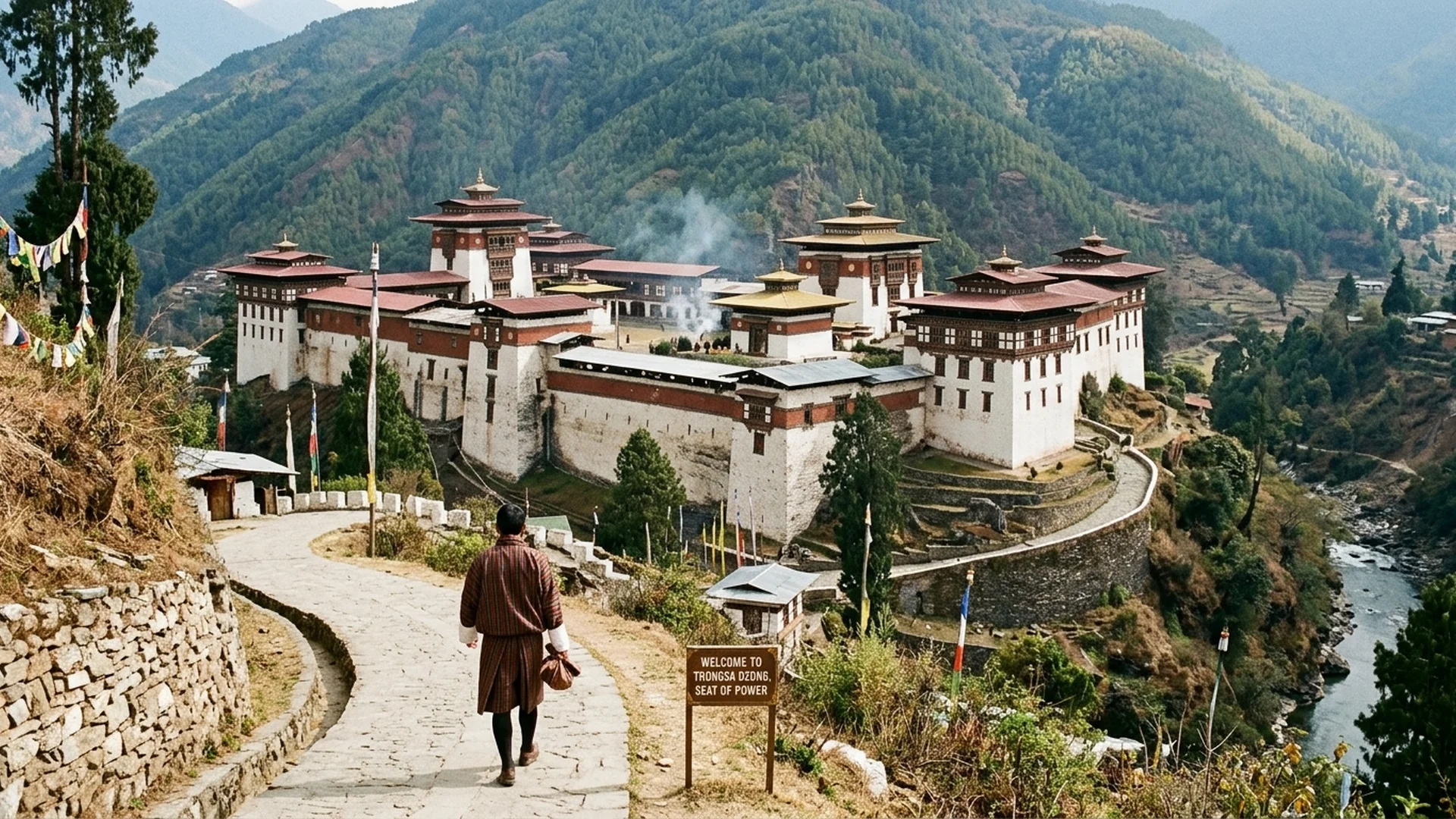
To the casual traveler rushing across the winding overland arteries connecting Bhutan’s western valleys to the eastern reaches, Trongsa is frequently dismissed as little more than a convenient mountain pass. Yet behind the billowing mist that clings to these precipitous slopes and the labyrinthine corridors of this historic settlement beats the very heart of the nation’s political lineage and the dawn of the Wangchuck dynasty, sovereigns of the Land of the Thunder Dragon.
This is hallowed ground where every monarch who ascends the Golden Throne must first hone their statecraft and political acumen as the Trongsa Penlop, the governor of this formidable eastern stronghold. A pilgrimage to Trongsa transcends mere sightseeing; it is an unhurried journey backward into an epoch of absolute sovereignty, unyielding spiritual devotion, and masterclass Himalayan architecture perched dramatically above the rushing glacial waters of the Mangde Chu river.
Trongsa Dzong: A Mountain Citadel of Flawless Architectural Harmony
Upon first sight, Trongsa Dzong materializes like a sleeping dragon draped across a razor-sharp mountain spur, enveloped entirely by plunging precipices and deep river gorges. Originally founded in 1543 by Ngawang Chogyel, a descendant of the revered Drukpa lama Drukpa Kunley, the fortress was vastly expanded over subsequent centuries. Its architectural brilliance lies in its organic adaptation to the stepped topography of the cliffside—constructed entirely without blueprints or a single iron nail. Gleaming whitewashed masonry contrasts brilliantly against intricately carved woodwork adorned with vivid Buddhist motifs and golden roofs that catch the brilliant afternoon sun. Amidst the resonant chanting of hundreds of resident monks, the dzong remains a living sanctuary of the Drukpa Kagyu lineage, pulsating with uncompromised spiritual vitality.
The Cradle of the Wangchuck Dynasty and the Trongsa Penlop
Modern Bhutanese political history is inextricably bound to Trongsa. Before the establishment of the hereditary monarchy in 1907, the region was governed by the Trongsa Penlop, the most formidable temporal and military authority in central and eastern Bhutan. Gongsa Ugyen Wangchuck, the nation’s first king, once ruled as the Trongsa Penlop before uniting the fractured valleys under a single banner and receiving his crown. Consequently, an unwritten royal tradition dictates that every crown prince must first assume the mantle of Trongsa Penlop to master the art of governance and forge a deep, personal bond with the regional populace before ascending the throne in Punakha and Thimphu.
Ta Dzong: From Watchtower Fortress to Royal Sanctuary of Memory
Directly across the vertiginous valley opposite the main fortress stands Ta Dzong, a cylindrical watchtower that once defended the realm against external incursions. Today, this imposing stone tower has been lovingly transformed into the Royal Heritage Museum. Spanning six thoughtfully curated levels, the museum exhibits priceless historical artifacts, royal garments, ancient weaponry, and rare archival photography, culminating in sacred chambers dedicated to the spiritual lineage of the Wangchuck monarchs. Traversing its atmospheric galleries offers discerning travelers an unparalleled perspective on Bhutan’s seamless evolution from a feudal medieval society into a modern, visionary sovereign state.