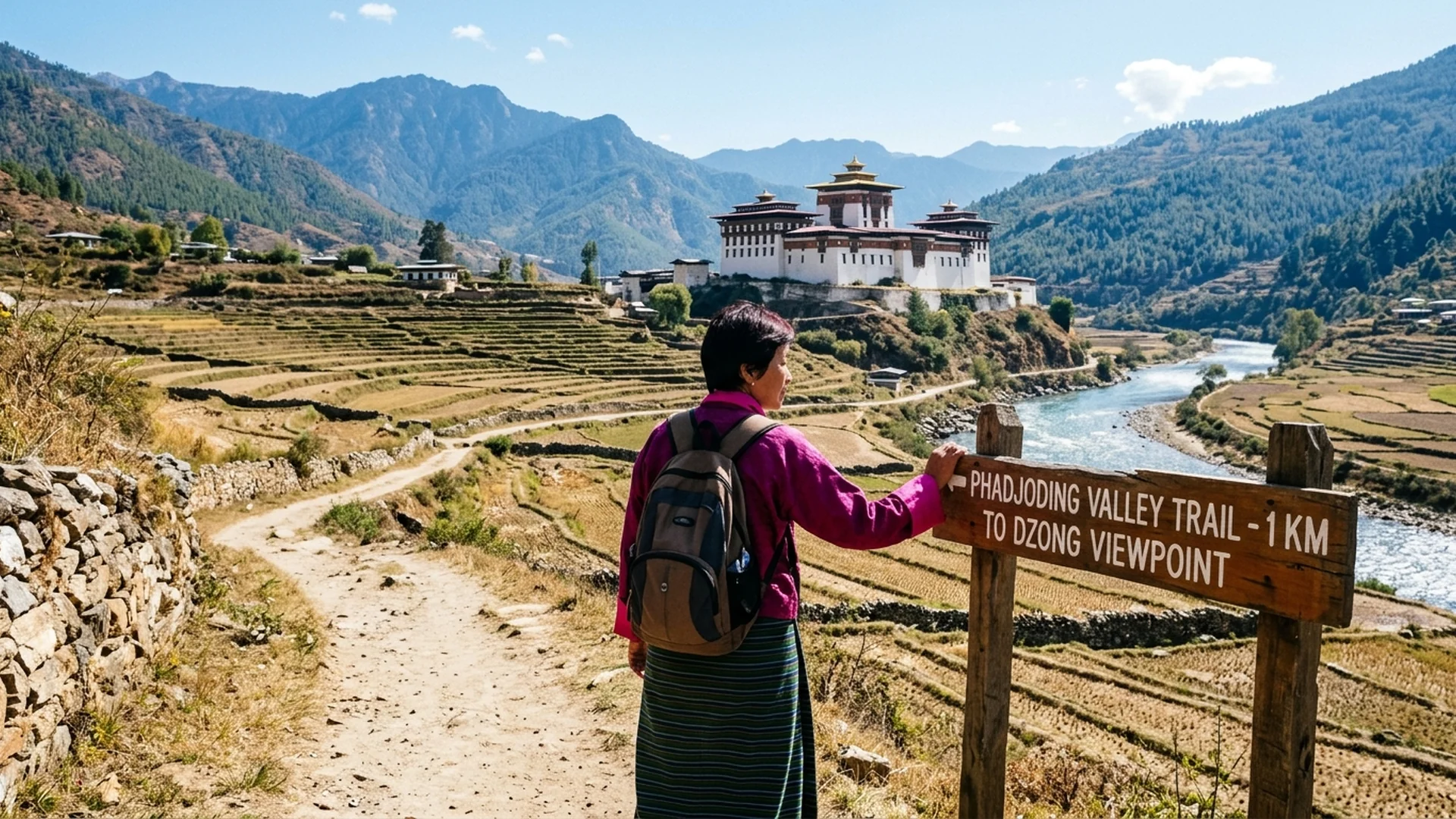
Perched upon a majestic limestone ridge that mirrors the contour of a resting elephant, where the converging currents of the Punatsangchhu and Dangchhu rivers meet, stands the Wangdue Phodrang Dzong. This 17th-century architectural masterpiece was consumed by a devastating fire in 2012, reducing its ancient timbers to ashes. Yet, the indomitable spiritual resilience of the Dragon Kingdom refused to surrender to the flames. Today, this hallowed fortress has risen from its remnants, restored through a seamless synthesis of ancient artisan mastery and state-of-the-art global engineering.
To travel into the Wangdue Phodrang district is to move far beyond the conventional tourist itinerary; it is an initiation into a realm where profound faith, vernacular urban planning, and pristine environmental stewardship exist in absolute harmony. From the intricately carved, nail-less joinery of the fortress to the mist-veiled mountain passes leading down to the glacial expanses of the Phobjikha Valley—the sacred winter sanctuary of the endangered black-necked cranes—every moment invites deep reflection.
This is an authoritative, unhurried guide designed for discerning global travelers who seek intellectual enrichment and authentic resonance. Discover the miraculous transcreation of the dzong, the enduring heritage of ancestral craftsmen, and the hushed majesty of the high Himalayas.
From Ashes to Monumental Rebirth: Wangdue Phodrang Dzong
In 1638, Zhabdrung Ngawang Namgyal, the visionary unifier of Bhutan, selected this commanding promontory at the confluence of two rivers to establish the Wangdue Phodrang Dzong. Guided by a prophetic legend of an old man pointing toward an elephant-shaped ridge that promised dominion over a unified realm, the fortress became the monastic and administrative anchor of central Bhutan for centuries.
Tragedy struck on the night of June 24, 2012, when an electrical fault ignited a blaze that devoured the ancient timber superstructure within hours. Miraculously, because restoration planning was already underway, the vast majority of priceless sacred relics, thangkas, and statues had been cataloged and safely rehoused prior to the disaster. The subsequent reconstruction was a nationwide labor of devotion, bolstered by international engineering expertise and financial solidarity. The paramount challenge lay in preserving authentic architectural heritage—utilizing traditional interlocking joinery without a single iron nail—while seamlessly integrating contemporary Swiss base-isolation seismic technology and a sophisticated 50-meter underground utility tunnel for advanced fire suppression. Re-consecrated on November 11, 2022, the fortress once again commands the landscape with its towering three-story Kuenrey sanctuary and four-story Utse tower.
For more on regional connectivity, explore our insights on /en/attractions/punakha-dzong-guide/ to understand the historical axis linking these valleys.
Phobjikha Valley: Sacred Sanctuary of the Black-Necked Cranes
Ascending eastward from Wangdue Phodrang, the winding road climbs into the glacial expanses of the Phobjikha Valley—also known as the Gangtey Valley—at an elevation of 3,000 meters. This vast, U-shaped valley is enveloped by rolling blue pine forests and pristine alpine meadows, entirely free of overhead electrical wires. The royal government mandated all power lines to be buried underground to preserve the unobstructed aerial corridors vital for protected wildlife.
Every year in late October, endangered black-necked cranes make their arduous pilgrimage across the Himalayan crests from the Tibetan Plateau to winter in these tranquil wetlands. To the Bhutanese, these elegant birds are harbingers of auspicious fortune and peace. Each morning and evening, the cranes are observed circling the revered Gangtey Monastery three times, performing a ritual circumambulation before descending into the dwarf bamboo fields.
A journey into Phobjikha offers travelers an encounter with absolute stillness. Walking the four-kilometer Gangtey Nature Trail invites deep sensory immersion: crisp mountain air, golden grasses catching the low alpine light, and an untouched landscape preserved in its purest form. Discover related seasonal travel itineraries at /en/routes/winter-in-bhutan/.
Rinchengang Village: Living Legacy of Master Stone Masons
Perched on a steep cliffside directly across the river from the Wangdue Phodrang Dzong lies Rinchengang Village, a cluster of tightly packed, mud-mortared stone homes that evokes a living medieval canvas.
The history of this community is inextricably bound to the construction of the dzong in 1638. Zhabdrung Ngawang Namgyal invited master stonemasons from abroad to execute the monumental masonry. Upon completion, these artisans settled permanently on the hillside, passing down their sophisticated stone-cutting and bamboo-crafting techniques through generations.
Navigating the narrow, stepped alleyways of Rinchengang offers an intimate glimpse into traditional Bhutanese domestic life. Visitors are greeted by welcoming smiles, cascades of crimson chilies drying on timber shingle roofs, and artisans shaping bamboo baskets with extraordinary dexterity—a living testament to heritage preserved against the currents of time.
Pele La Pass and the Art of Curating a High-Country Journey
Continuing eastward toward central Bhutan requires crossing the Pele La Pass at 3,420 meters above sea level. This high mountain pass forms the natural geographic boundary along the Black Mountains, dividing the western valleys from the central provinces. The windswept summit is festooned with vibrant, five-colored prayer flags fluttering against the sky alongside traditional stone chortens.
On clear days, Pele La affords panoramic vistas of snow-capped Himalayan summits, while spring brings vibrant blooms of wild rhododendrons carpeting the alpine forest floor.
To curate an elegant, unhurried itinerary, travelers are advised to journey from Punakha into Wangdue Phodrang, dedicating the morning to the architectural splendor of the dzong and Rinchengang village. By afternoon, ascend through the changing microclimates across Pele La to settle into an understated eco-luxury lodge nestled within the Phobjikha Valley, concluding the day beneath a canopy of brilliant Himalayan stars.