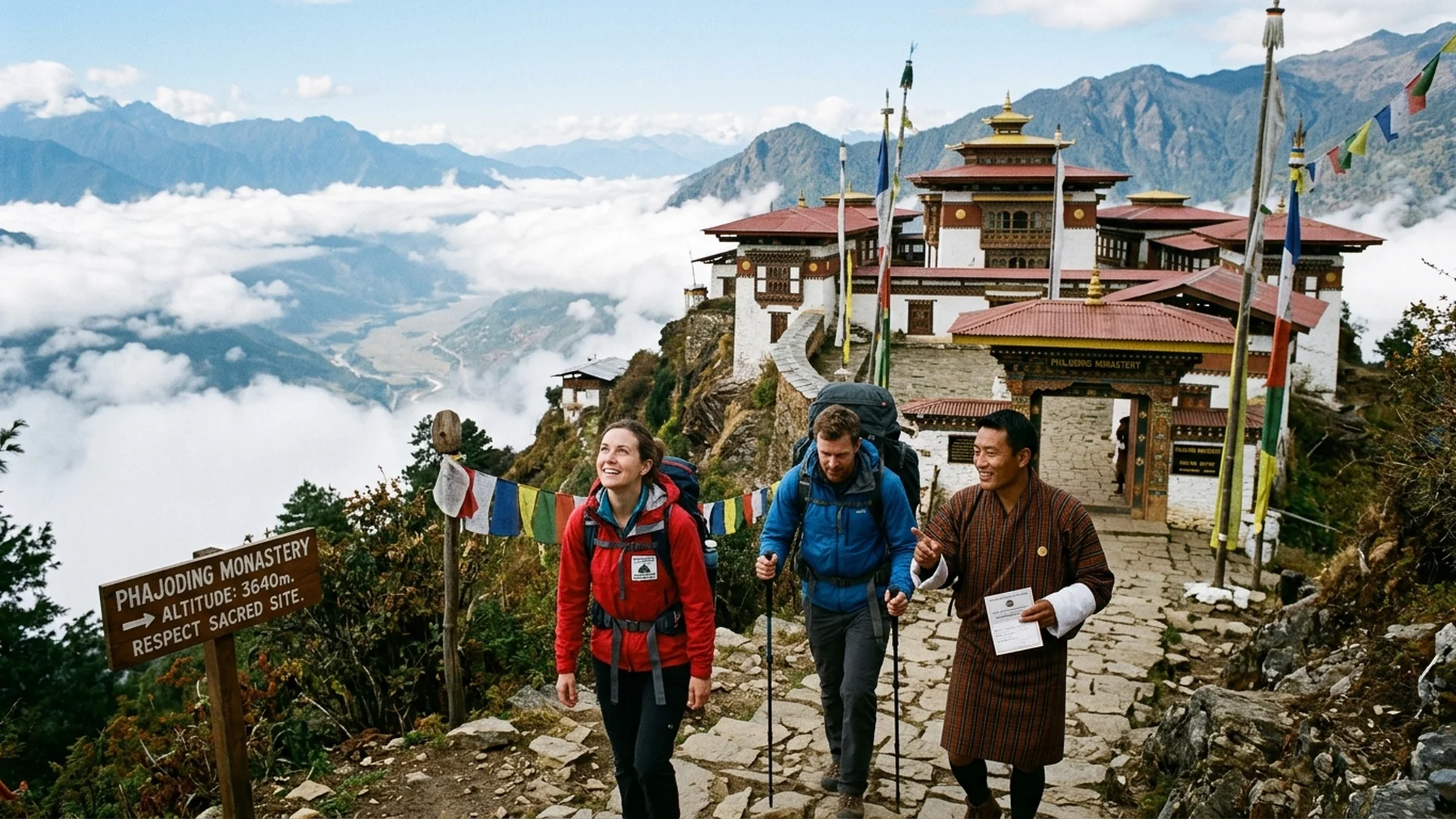
When the heavy morning mist slowly dissolves, the vision that emerges before the traveler is not merely a precipitous peak, but an ancient monastery clinging to an isolated mountain ridge like a citadel suspended in the azure sky, detached from the restless clamor of the world below. For the discerning wanderer seeking depth far beyond conventional itineraries, Phajoding Monastery stands as an ultimate test of both physical endurance and spiritual resolve. Positioned at an elevation exceeding 3,640 meters above the capital of Thimphu, this sacred hermitage transcends ordinary sightseeing, offering an immersive paradigm of active spiritual luxury that pairs the absolute stillness of deep meditative absorption with the raw, untamed majesty of Himalayan pine forests.
Stepping away from more frequented destinations such as the Tiger’s Nest, the historic trekking route to Phajoding offers a quieter, more demanding pilgrimage. Here, the solitary sound of one’s breath harmonizes with the gentle cadence of novice monks chanting in the crisp mountain air, compelling us to transcend physical limits and commune with sacred energies preserved across the centuries.
The Roots of Faith: Footsteps of a Pioneer Yogi and Architecture of the Heights
The chronicle of Phajoding began in the thirteenth century when Phajo Drugom Zhigpo, an accomplished Tibetan bodhisattva and realized yogi, journeyed to pitch his meditation tent upon these vertiginous cliffs. Perceiving this precipitous expanse as a profoundly auspicious power place (Ney), he recognized its rare suitability for subduing the ego and refining the inner consciousness. The collection of temple buildings and meditation quarters (Lhakhang) that subsequently took root here were never designed for worldly ostentation; rather, they were fashioned to yield completely to the severe and unforgiving mountain topography.
Dark granite masonry, intricately carved traditional window frames, and prayer flags fluttering fiercely in the alpine gales all testify to the tireless devotion of ancient artisans and the monastic lineage that preserves their vision. The monastery’s profound isolation has served as an enduring sanctuary, protecting sacred scriptures, ancient rituals, and pristine contemplative traditions from the relentless tides of modernization.
The Trail Above the Tree Line: Testing Limits at 3,640 Meters
A pilgrimage to Phajoding is far more than a scenic mountain walk; it is an intentional journey demanding thorough physical and mental preparation. Most ascents commence near the Sangaygang telecommunications ridge (BBS Tower), winding steadily upward through dense groves of blue pine and cascading rhododendrons that ignite the forest in brilliant crimson tones during the spring.
As the trail ascends deeper into the mountains, the atmosphere thins perceptibly. Every upward step transforms into a moving meditation, where the crisp crunch of dry pine needles beneath boots and the sound of deep, measured breathing establish a rhythmic tempo. Breaking free from the timberline into the sweeping, wind-scoured alpine meadows, the sudden revelation of the monastery against the shifting mists provides an immense reward that instantly dissolves all bodily fatigue.
Life Above the World: Novice Laughter and the Stillness of Deep Absorption
Crossing the threshold of the monastic compound, the traveler is immediately enveloped by an interior quietude unknown in the outside world. This high sanctuary serves as a residence and school of philosophy for young novice monks under the watchful guidance of accomplished masters. The courtyard resonates with purity, carrying the evening echoes of sacred mantras blended with the subtle fragrance of burning juniper and sacred butter lamps.
Observing or engaging in quiet dialogue with these young novices, who mature amidst formidable cold and sublime wilderness, reframes one’s understanding of simple joy and internal fulfillment. There is no superficial luxury here—only the profound warmth of human fellowship and a rich intellectual inheritance passed unswervingly from generation to generation.