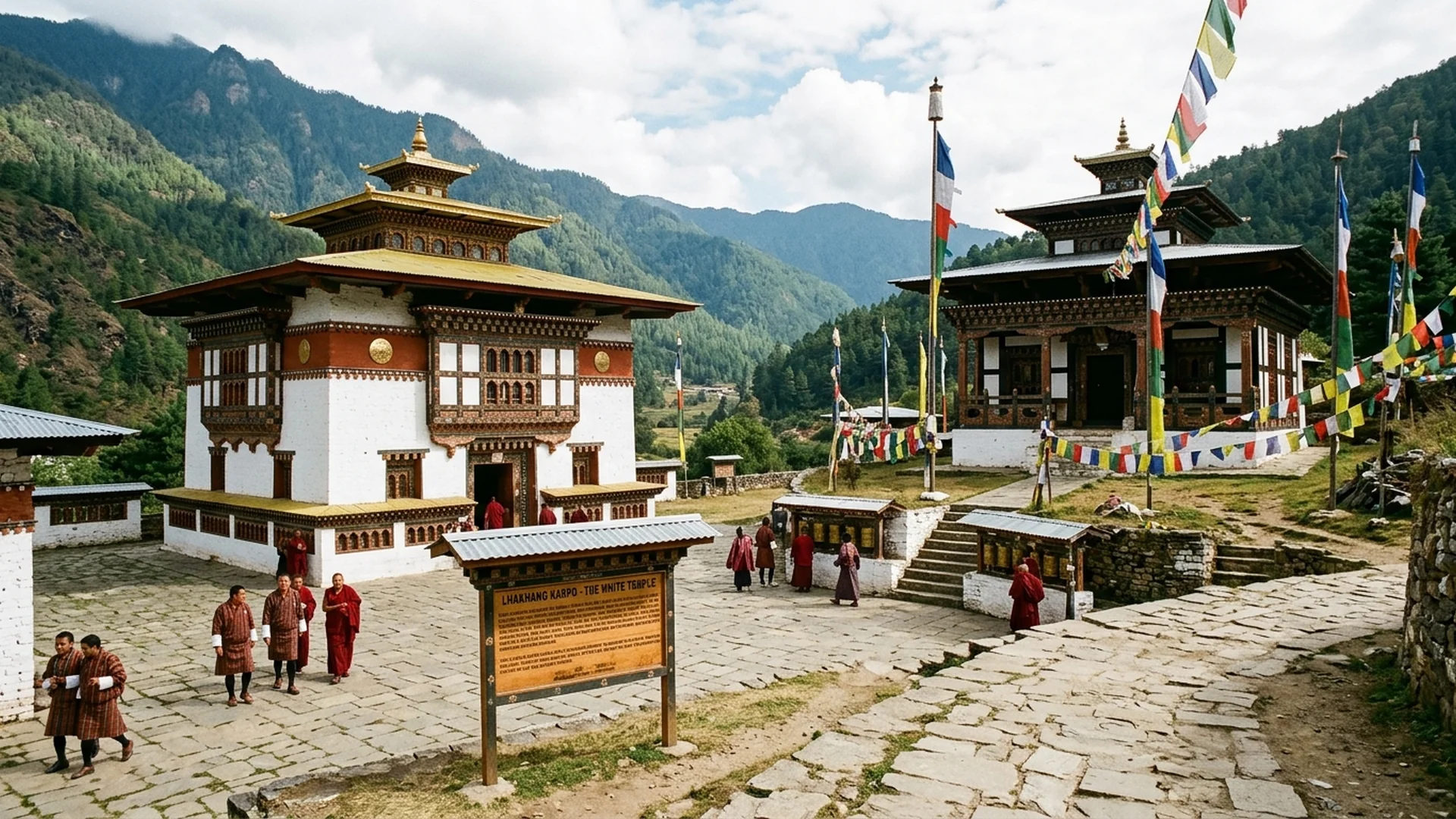
As the thick, crystalline frost gradually lifts along the winding asphalt climbing toward the dizzying heights of the Chele La Pass, the landscape opens to reveal the Haa Valley—one of the most remote and untamed sanctuaries in the Kingdom of Bhutan. Here, time slows to an unhurried cadence, surrendering entirely to the profound silence of the high Himalayas. Resting quietly on the valley floor lie the legendary twin sanctuaries of Lhakhang Karpo and Lhakhang Nagpo. Rooted in seventh-century Tibetan imperial history and bound by the ancient myth of sacred white and black doves released by Emperor Songtsen Gampo, these architectural pillars embody the eternal cosmic balance between light and shadow.
Crossing the threshold of these sacred grounds is far more than a geographical transit across high-altitude mountain passes; it is an unhurried pilgrimage back to the very genesis of Himalayan Buddhism. Here, indigenous animist reverence, mountain spirits, and the profound compassion of Vajrayana philosophy converge seamlessly. Sheltered beneath the majestic guardianship of the Meri Pumsum—the three sacred sibling peaks—the white temple and the black temple stand sentinel against the alpine winds, serving as enduring spiritual anchors for the resilient inhabitants of the Haa Valley.
The Legend of the Dual-Hued Doves and the Genesis of Haa
The roots of Lhakhang Karpo and Lhakhang Nagpo trace back to the seventh century, coinciding with the reign of Songtsen Gampo, the visionary monarch of the Tibetan Empire. According to oral tradition, the emperor sought to commission one hundred and eight Buddhist temples across the Himalayan expanse in a single night, subduing malevolent earth spirits and binding a sprawling demoness who supposedly blanketed the region. To determine the auspicious placement for a sanctuary within the rugged, remote Haa Valley, he released two doves—one white, one black—to scout the terrain.
The white dove descended upon an open, light-filled meadow at the foot of the mountains, giving rise to Lhakhang Karpo, the White Temple. Meanwhile, the black dove ventured deeper into the shadowed, whispering pine forest, settling in profound seclusion to establish Lhakhang Nagpo, the Black Temple. This foundational myth is far more than mere folklore; it illustrates the masterstroke of early Buddhist teachers in harmonizing indigenous animism with the Dharma, transforming a landscape once fraught with supernatural dread into a sanctuary of enduring peace.
Polar Architecture: The Radiance of Karpo and the Mystery of Nagpo
Upon arriving at Lhakhang Karpo, the discerning traveler is immediately struck by its pristine white-washed masonry, sharply framed by traditional hand-carved woodwork characteristic of classic Vajrayana architecture. Situated on an expansive plateau, the temple basks in uninterrupted sunlight throughout the day. The atmosphere hums with the low, resonant chanting of resident monks and the delicate fragrance of smoldering juniper incense, while prayer flags snap rhythmically in the mountain breeze, imbuing the sanctuary with vibrant grace.
In stark contrast, a gentle stroll of a few hundred meters through an ancient pine forest and alongside crystalline streams brings one to Lhakhang Nagpo. Resting in tranquil seclusion near a small, mist-veiled pond, the Black Temple projects an unmistakably solemn and hushed aura. Its dark exterior walls mirror the stillness of the surrounding woods. Within its dim interior rest ancient sacred statues and fading murals depicting fierce guardian deities. Together, the twin temples present a physical manifestation of the cosmic balance of yin and yang—offering intellectual illumination on one hand and quiet introspection on the other.
The Spirit of Haa and the Guardian Deity Ap Chundu
The Haa Valley is much more than a repository for ancient sanctuaries; it is a culturally distinct landscape defined by profound sanctity. Because the valley opened to international travelers relatively late—welcoming its first guests only in 2002—its daily life retains an extraordinary purity, remaining intimately intertwined with the natural world. The local community maintains an unwavering devotion to Ap Chundu, the formidable warrior deity of the valley who resides high upon the craggy peaks to safeguard the land.
This deep-seated reverence for local guardians and mountain spirits coexists harmoniously with orthodox Buddhist teachings, instilling every corner of Haa with an innate sense of sacred etiquette. Discerning travelers are consistently met with unvarnished warmth and genuine hospitality from the local community—the true hallmark of luxury cultural travel, where the pursuit of authentic meaning supersedes superficial spectacle.