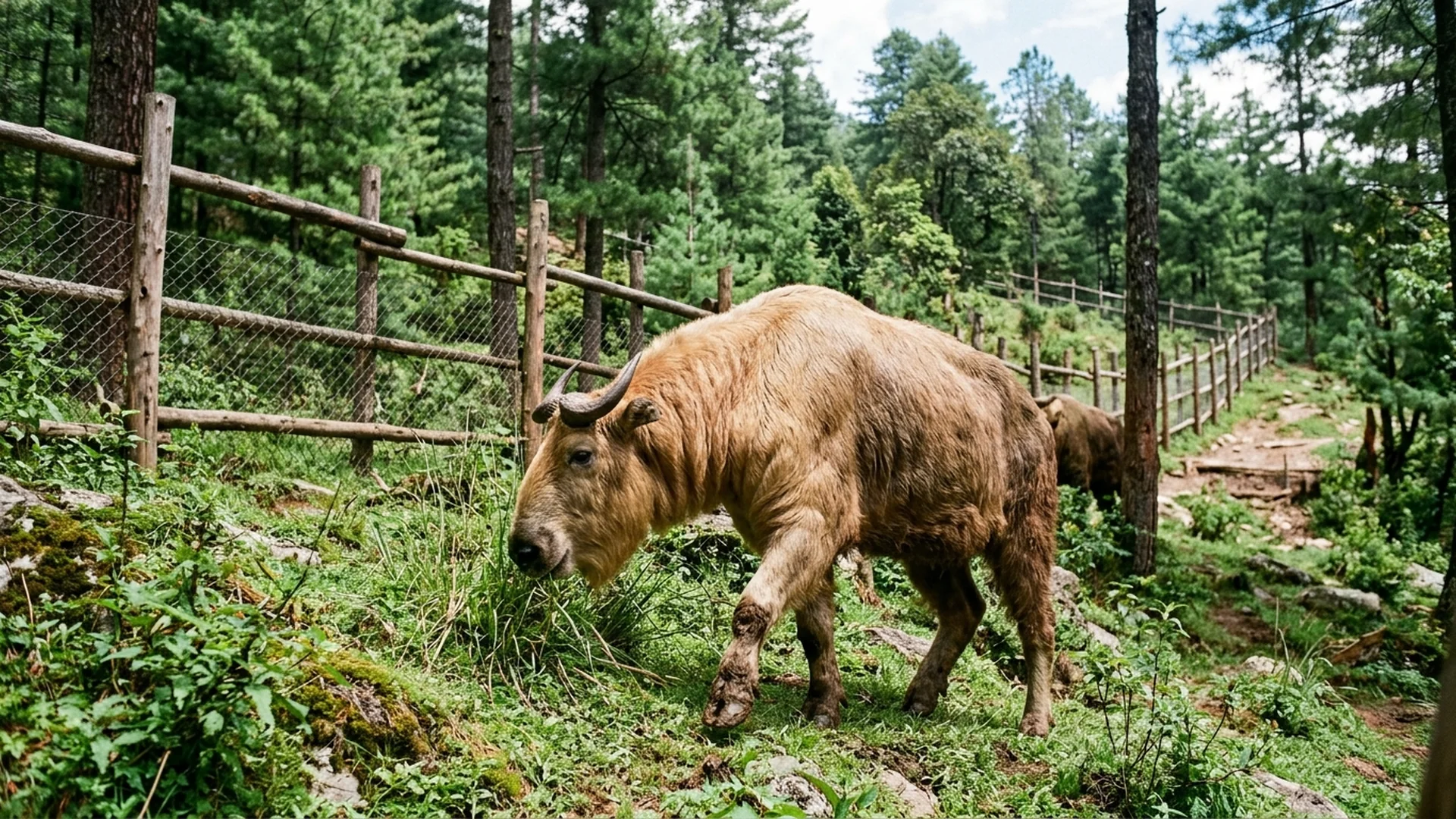
Amidst the mist lingering softly over the needle-laden canopy of the Himalayas, the natural aroma of pine resin mingles with the pristine, crisp air of Thimphu. Deep within the woodlands of the Motithang district emerges the silhouette of a remarkably unusual creature: possessing the head and curved horns of a goat, yet paired with the robust, heavy-set body and sloped back of an ox. This enigmatic beast is the takin, a living being that appears as though it stepped straight out of ancient chronicles and the lore of the Thunder Dragon.
For the discerning global traveler, a visit to the Motithang Takin Preserve is far more than a standard wildlife excursion; it is a contemplative pilgrimage decoding the profound bond between pristine nature and Bhutanese spiritual philosophy. Here, the dialogue between biological reality and sacred mythology dissolves seamlessly into a quiet, transcendent harmony.
From Leftover Feasting Bones to Sacred National Symbol: The Legend of Drukpa Kunley
Back in the 15th century, when the wandering Tibetan tantric master Drukpa Kunley—affectionately and reverently known as the Divine Madman—traveled through Bhutan to propagate the Dharma, skeptical villagers challenged him to demonstrate a miracle. Unfazed, Drukpa Kunley requested a great feast consisting of a whole cow and a whole goat. Once he had consumed the flesh and left only the bare skeletal remains, he famously attached the goat’s head to the cow’s skeleton, uttered a powerful mantra, and snapped his fingers. To the astonishment of all onlookers, the bizarrely conjoined creature came to life, rising to graze peacefully upon the alpine meadows.
This miraculous creature was named in Dzongkha as ‘Dong Gyem Tsey’—the takin (Budorcas taxicolor whitei)—a creature bearing genetic ties closest to Himalayan sheep despite its chimeric appearance. This foundational narrative transcends mere folklore; it serves as a living spiritual emblem that formally crowned the takin as Bhutan’s national animal in 2005.
A Royal Vision: Transcending Captivity to Embrace an Open Sanctuary
The history of the Motithang Takin Preserve mirrors the nation’s guiding philosophy of Gross National Happiness and the Buddhist reverence for all sentient life. Originally established as a modest mini-zoo on the outskirts of Thimphu, the sanctuary underwent a profound philosophical evolution when the Fourth King of Bhutan, Jigme Singye Wangchuck, visited the facility. Perceiving that confining wild animals within rigid cages contradicted both Buddhist tenets and royal governance, he immediately ordered the enclosures opened and the takin released back into the wild.
Yet, accustomed to human proximity, the animals refused to retreat into the dense interior forests. Instead, they wandered leisurely along the roadways and markets of Thimphu in search of forage. To protect the takin while honoring their natural inclinations, the Bhutanese government transformed 8.4 acres (3.4 hectares) of natural blue pine forest on the slopes of Motithang into an open-air sanctuary, securing their habitat while preserving their freedom.
The Aesthetics of the Motithang Forest: A Mindful Wander
Upon stepping onto the elevated wooden boardwalks of the Motithang sanctuary, the surrounding environment instantly shifts into a profound, hushed stillness. Dappled sunlight filters through the towering canopy of Himalayan blue pines, releasing a clean, invigorating fragrance into the mountain air. Positioned at an elevation exceeding 2,500 meters above sea level, the crisp climate invites travelers to naturally slow their pace and attune their senses.
Along the gently sloping boardwalks that hug the forested hillside, visitors can observe herds of takin grazing on fresh shoots, browsing foliage, or resting beneath ancient trees without causing disruption. Beyond the takin, this protected woodland provides a secure haven for other indigenous fauna, including sambar deer, barking deer, and numerous rare forest birds, turning every quiet step into a restorative encounter with nature.