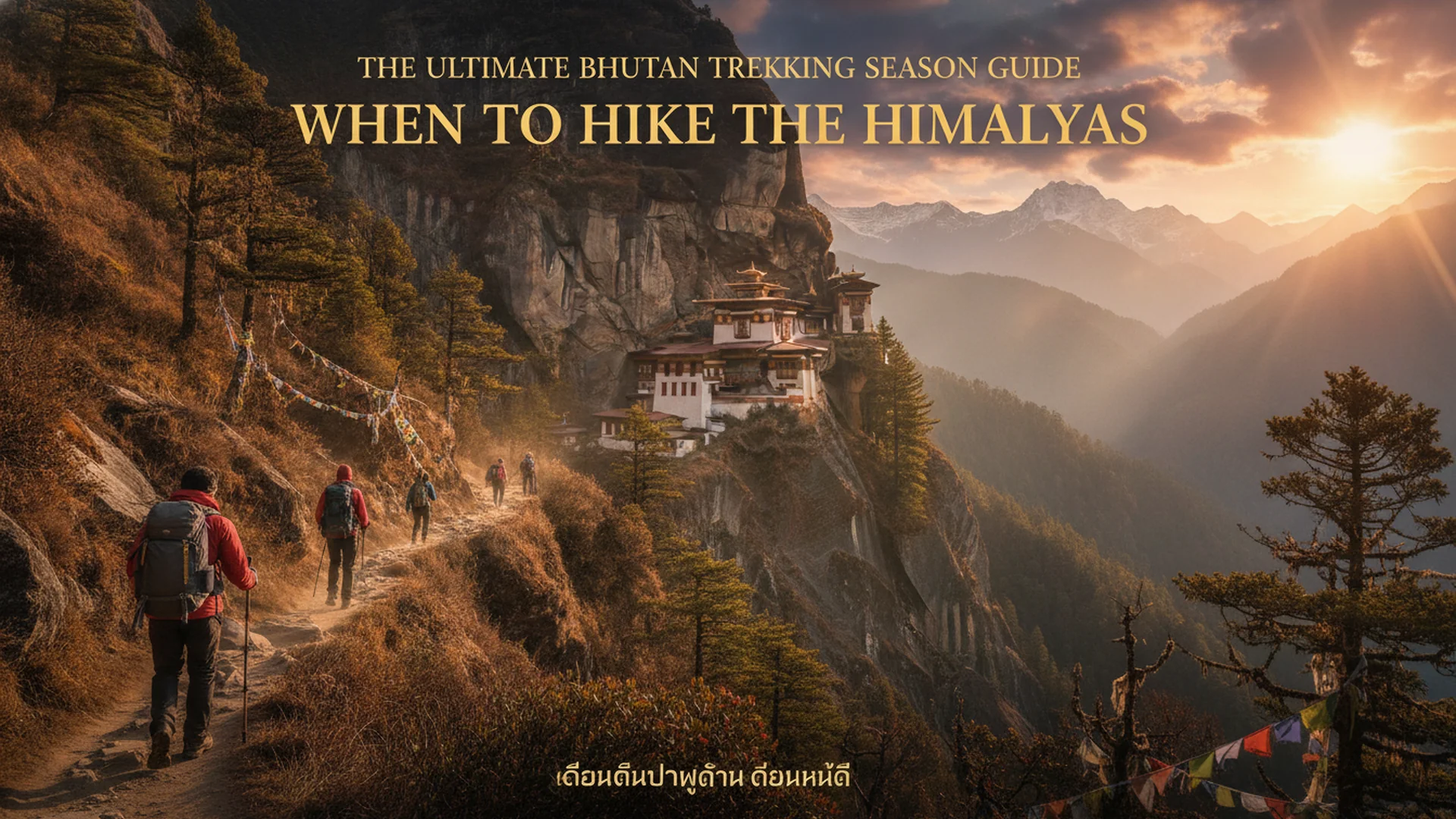
Amidst the jagged contours of the Eastern Himalayas, the Thunder Dragon Kingdom of Bhutan does not merely measure time by the turning of the calendar; it orchestrates existence according to a delicate cadence of silence, untouched wilderness, and Gross National Happiness (GNH). For the discerning traveler curating an elite high-altitude expedition, the perennial inquiry concerning the finest trekking window transcends simple meteorology. It is an aesthetic choice: whether one wishes to wander through valleys washed in the brilliant pigments of spring or witness snow-clad summits slicing into sapphire-clear autumn heavens.
The alchemy of hiking in this sovereign sanctuary is defined by two distinct golden chapters. Spring (March through May) breathes life into the slopes with a riot of wild blossoms and ancient rhododendrons, while autumn (September through November) strips away the monsoon mists, laying bare crystalline vistas of monumental ice peaks.
Executing a world-class trekking itinerary demands a profound synthesis of seasonal awareness, altitude acclimatization, and topography. From the approachable elegance of the Druk Path Trek to the grueling, epic endurance required for the legendary Snowman Trek, pinpointing your exact temporal window transforms an alpine journey into an indelible legacy of memory.
Spring (March – May): The Botanical Awakening and the Reign of Rhododendrons
As the biting grip of winter loosens its hold, the high-altitude forests of the Bhutanese Himalayas gradually reawaken in a palette of painterly hues. Spring commences in March and reaches its sensory zenith between April and May. During this window, valleys erupt in a vivid tapestry of over forty varieties of rhododendrons, shifting from pristine whites and delicate blushes to incandescent crimsons, artfully interspersed with alpine flora and wild Himalayan orchids.
Climatic conditions during these months are remarkably benign, making intermediate routes such as the Druk Path Trek or the Bumthang Cultural Trek exceptionally rewarding. Daytime temperatures hover comfortably between 12°C and 18°C, preventing physical exhaustion during ascents across ridge lines. While brief afternoon squalls occasionally sweep through to baptize the pine canopy, the enduring clarity and chorus of migratory forest birds sustain travelers until twilight paints the horizon.
Autumn (September – November): Sapphire Skies and Uncompromising Himalayan Vistas
Should your expeditional objective be an uninterrupted communion with titanic, snow-crowned monoliths, autumn stands uncontested as the golden age of Bhutanese mountaineering. Following the final retreat of the monsoon in late September, the atmospheric veil that shrouds the upper elevations dissolves entirely, revealing a vault of deep cobalt blue of staggering transparency.
Spanning October and November, the air grows crisp, dry, and exceptionally stable. Sacred summits such as Jomolhari, Jitchu Drake, and Gangkar Puensum emerge in pristine isolation, free from the shrouding veils of summer clouds. Beyond the sheer visual majesty of the terrain, this period coincides with major sacred monastic festivals (Tshechus) across historical dzongs, allowing travelers to seamlessly bridge the wilderness immersion with the profound spiritual gravity of Mahayana Buddhist culture.
Altitude and Itinerary Analysis: From the Druk Path to the Snowman Trek
Executing a flawless trek through Bhutan requires matching topographical ambition with strict temporal boundaries:
- Druk Path Trek (Maximum Altitude ~4,210 meters): Linking Paro and Thimphu over 4 to 5 days, this accessible route suits novices and intermediates alike. While viable across multiple months, it achieves its aesthetic peak during April–May and October–November.
- Jomolhari Trek (Maximum Altitude ~4,930 meters): A premier route dedicated to the formidable southern face of Mount Jomolhari. It demands the high-stability weather windows found in late spring or deep autumn.
- Snowman Trek (Altitudes exceeding 5,000 meters across 11 high passes): Widely regarded as one of the most punishing and elite trekking achievements on earth, this 24-to-30-day odyssey must be compressed strictly within the narrow corridor of late September through October before heavy winter snows seal the Lunana passes indefinitely.
Navigating the Extremes: The Realities of Monsoon and Deep Winter
While Bhutan retains an unyielding allure across all twelve months, respecting physical and meteorological boundaries remains paramount for high-altitude safety. The summer monsoon (June through August), while painting the lower valleys in emerald brilliance, delivers relentless precipitation, slippery trails, and active leech populations, rendering it suitable only for low-altitude cultural touring rather than alpine traverses.
Conversely, deep winter (December through February) offers brilliant blue skies in the lower valleys, yet unleashes punishing sub-zero temperatures at altitude—often plunging below -15°C after nightfall. Heavy snowfall routinely closes mountain passes exceeding 3,500 meters. Honoring these natural boundaries is the ultimate hallmark of a well-prepared traveler.