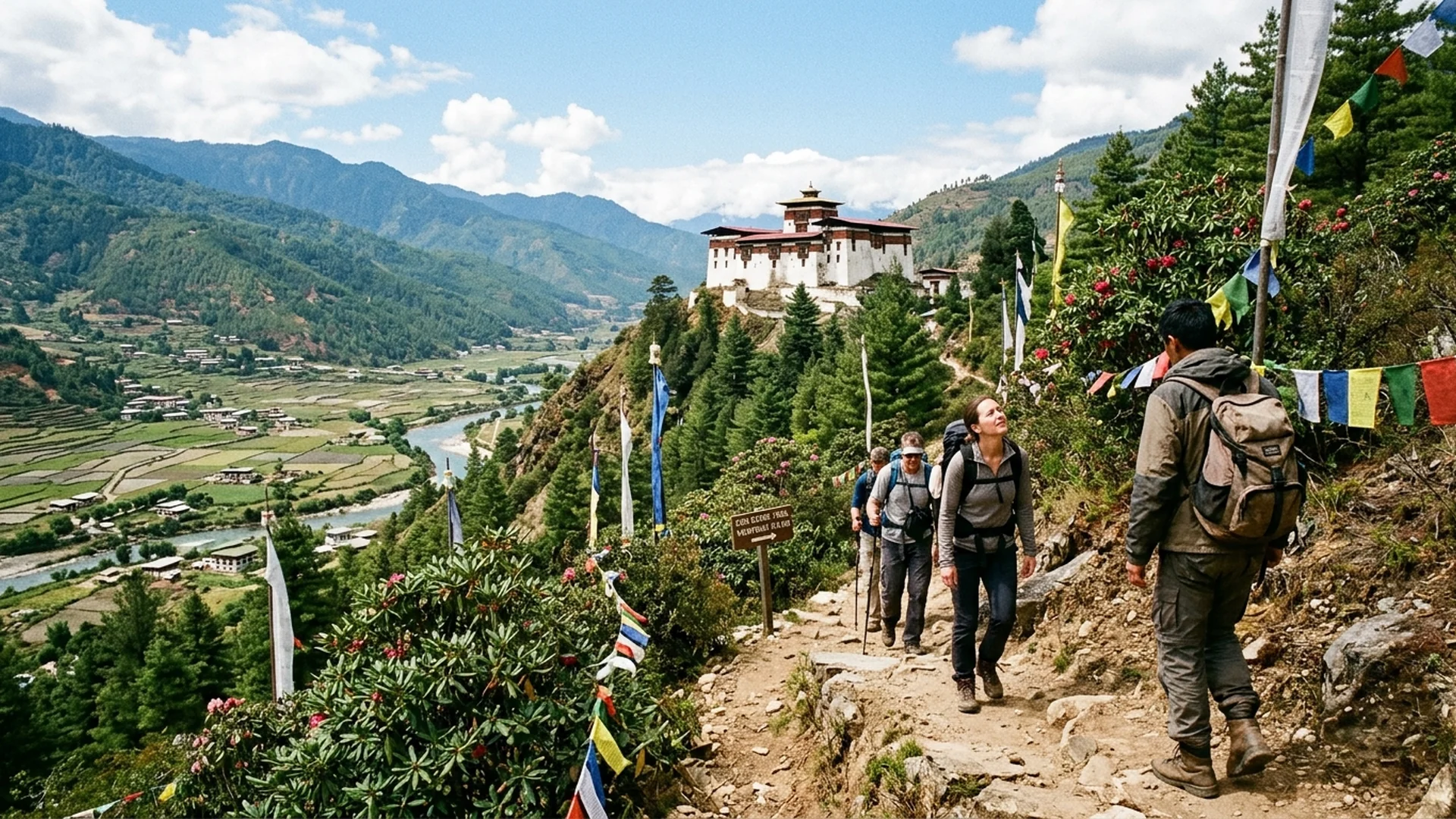
As the morning mist slowly lifts from the valley floor below, the Paro Valley reveals itself like an ancient painted scroll, adorned with shimmering rivers and emerald-green fields. While most travelers flock directly to the legendary Tiger’s Nest, or Taktshang Goempa, a quieter and deeply magical sanctuary hides along the opposing ridge: Zuri Dzong. Built in the 14th century, this historic fortress-monastery is not merely a treasured historical jewel; it is one of the most private and breathtaking bird’s-eye viewpoints in all of Bhutan.
The ascent to Zuri Dzong demands no grueling physical exertion, offering instead a gentle, meditative stroll through fragrant forests of tall cypress and Himalayan pine. It is a light trekking route that allows the traveler’s heartbeat to synchronize effortlessly with the surrounding wilderness, where sacred stillness and slow travel converge harmoniously. For the discerning global traveler seeking aesthetics and depth far beyond standard sightseeing, Zuri Dzong is a living poem written in earth, stone, and quiet devotion.
Fourteenth-Century Roots and the Sacred Footprint of Guru Rinpoche
Behind the rammed-earth walls and traditional architecture of Zuri Dzong lies a deep historical tapestry dating back to 1352. This fortress served not only as a strategic defensive stronghold in turbulent eras, but also as a powerful spiritual anchor. Within its main tower, ancient tantric Buddhist mural paintings whisper tales of the Mahayana lineage alongside statues honoring Zhabdrung Ngawang Namgyel, the historic unifier of Bhutan.
What elevates Zuri Dzong above other fortresses is the sacred cave situated at its lowest level. Tradition holds that Guru Rinpoche—Padmasambhava, who brought tantric Buddhism across the Himalayan realms—meditated within this very alcove during the 8th century. The palpable stillness enveloping this diminutive sanctuary can be felt the moment one crosses the threshold. Far from the commotion of the modern world, the quiet ambiance is punctuated only by the soft chanting of resident monks and the gentle flicker of butter lamps, intensifying the palpable aura of sacred isolation.
The Pine and Mist Trail: The Art of Mindful Walking
The trail to Zuri Dzong begins discreetly behind the National Museum of Bhutan, known as Ta Dzong, ascending gradually through a towering forest of cypress. Early morning sunlight filters through the needle-laden boughs, casting elongated shadows across the forest floor while the crisp scent of damp earth and mountain mist awakens every sense. Spanning roughly 2.7 kilometers with minimal steep inclines, the route earns its modest difficulty rating of two out of five.
Over the course of a leisurely 1.5 to 2-hour walk, travelers encounter vibrant prayer flags fluttering briskly in the mountain breeze, carrying silent prayers of compassion across the valley. Walking this path transcends physical exercise; it becomes a moving meditation, aligning one’s breathing naturally with the high-altitude atmosphere. It serves as the ultimate physiological preparation before embarking on more rigorous Himalayan treks later in the journey.
An Elevated Perspective: The Paro Valley as Living Art
Reaching the summit ridge of Zuri Dzong delivers an expansive, cinematic reward. From this elevated vantage point, the graceful, meandering curves of the Paro Chhu river become vividly apparent as they snake past emerald rice terraces and traditional homesteads.
Adding an unexpected touch of modern drama to the ancient landscape is the bird’s-eye view of Paro International Airport, widely regarded as one of the world’s most challenging aviation approaches. Witnessing an aircraft gracefully thread its way through deep canyon walls against a backdrop of snow-capped peaks offers a visual contrast unattainable from the valley floor. Furthermore, the majestic architecture of Rinpung Dzong reveals its flawless proportions under the golden afternoon sun, making this sanctuary an undisputed haven for photographers and nature connoisseurs alike.