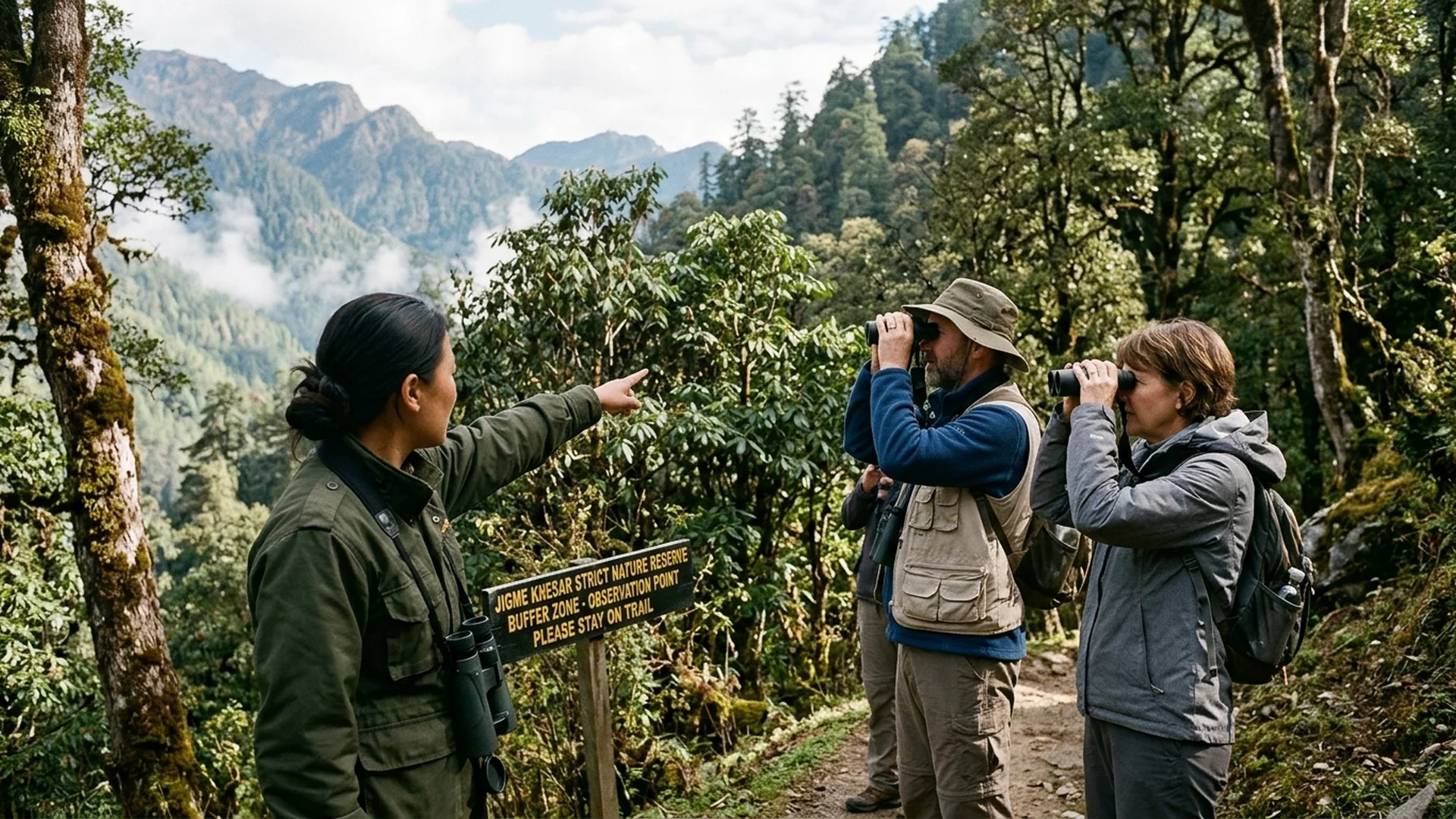
As morning mists slowly drift across the ridges of the western Himalayas, a subtle rustling of wings marks the awakening of the forest. This is the pristine borderland surrounding the Paro buffer zone in Bhutan, far removed from the clamor of mainstream travel. Serving as a grand gateway to the Jigme Khesar Strict Nature Reserve—the country’s most stringently protected wilderness, devoid of permanent human settlement in its core—this landscape preserves an astonishingly intact ancient ecosystem.
For discerning global travelers, wildlife photographers, and nature enthusiasts yearning for profound silence and deep ecological connection, a journey into the Paro valley for birdwatching offers the pinnacle of experiential travel. It blends physical challenge, dramatic geography, and utter exclusivity, all under Bhutan’s guiding philosophy of ‘High Value, Low Volume’ tourism, which safeguards the natural world while delivering uncompromising aesthetic grace.
The Silent Frontier: The Pristine Ecosystem of the Western Himalayas
The forests enveloping the Paro sanctuary function as a vast, wall-less amphitheatre of natural history. The singular distinction of this buffer zone lies in its dramatic altitudinal gradient, stretching from valley floors to sheer mountain crests draped in ancient cedar, fir, and moss-draped rhododendron forests. The quiet here is punctuated only by the calls of forest birds and the crisp mountain wind, wrapping visitors in an otherworldly stillness where time slows its pace. Free from intrusive architecture or urban noise, the resident wildlife and migratory avian populations move entirely by ancient instinct, untroubled by fear—an intimacy increasingly rare in the modern travel landscape.
Tracking Mountain Jewels: Chele La Pass and the Forest Buffer
Avian exploration in this high-altitude theater centers on Chele La Pass, perched at nearly 3,988 meters above sea level. Bridging the Paro and Haa valleys, this high-altitude corridor frames sweeping panoramas of snow-crowned Mount Jomolhari. In the crisp light of dawn, birdwatchers are frequently rewarded with the brilliant plumage of the male Himalayan Monal, its iridescent feathers flashing emerald green, sapphire blue, and burnished gold. Meanwhile, dense underbrush along the steep slopes conceals the elusive Blood Pheasant and the Satyr Tragopan. Along the pristine glacial streams of the Paro Chhu below, the solitary Ibisbill picks its way silently along gravel bars, instantly recognizable by its long, gently decurved crimson bill.
The Aesthetics of Conservation: Embracing ‘High Value, Low Volume’
Journeying through this sanctuary transcends standard leisure; it is an immersion into a philosophy of living in harmony with the natural world. Guided by Bhutan’s pioneering sustainable tourism framework, the government and local communities jointly enforce rigorous stewardship of these buffer zones. Discerning travelers who choose to visit directly contribute to this conservation economy, with tourism revenues funding ranger patrols and rural community development. Exploring these forested trails in the company of expert local naturalists reveals the subtle grammar of the wilderness—identifying animal tracks, learning rare botanical names, and understanding the delicate ecological balance maintained by the Bhutanese spirit.