As the winter wind whispers through towering pine forests and ancient prayer flags flutter against high mountain ridges, silence is never merely emptiness. It is a profound, resonant energy that purifies the spirit. In a kingdom where national progress is measured by Gross National Happiness (GNH), holistic well-being is not treated as a superficial remedy, but as an ancient, unhurried journey back to internal equilibrium.
Amidst mystical valleys and the pristine, crisp air of the Himalayas, the art of restoration has evolved into a refined discipline. It bridges centuries-old traditional medicine with the quiet serenity of ultra-luxury sanctuaries. This is an invitation to the beating heart of Bhutanese wellness, where the radiant warmth of river-sculpted stones, intuitive acupressure, and rare high-altitude botanicals converge into a timeless elixir for the healing of body and soul.
Sowa Rigpa: Ancient Medical Philosophy and Elemental Equilibrium
In the worldview of the Bhutanese, the human body is an exquisite microcosm of the universe. The traditional medical science known as ‘Sowa Rigpa’, which translates poetically to the ‘Science of Healing’, forms the foundational pillar of the kingdom’s healthcare paradigm. Drawing deep historical roots from Indian Ayurveda and Tibetan medicine, Sowa Rigpa posits that physical ailments arise when the four fundamental elements of the body—earth, water, wind, and fire—fall out of harmonic alignment.
Following a meticulous diagnostic consultation with a traditional physician, known as a Drungtsho, practitioners employ pulse-reading, urine analysis, and lifestyle evaluations to prescribe remedies crafted from high-altitude medicinal herbs, rare alpine wildflowers, and pristine natural minerals. Healing in Bhutan, therefore, transcends conventional muscle relaxation; it is a profound recalibration of one’s internal rhythm with the majestic, living nature that surrounds us.
Dotsho: The Mystique of Traditional River-Stone Baths and Menchu Herbs
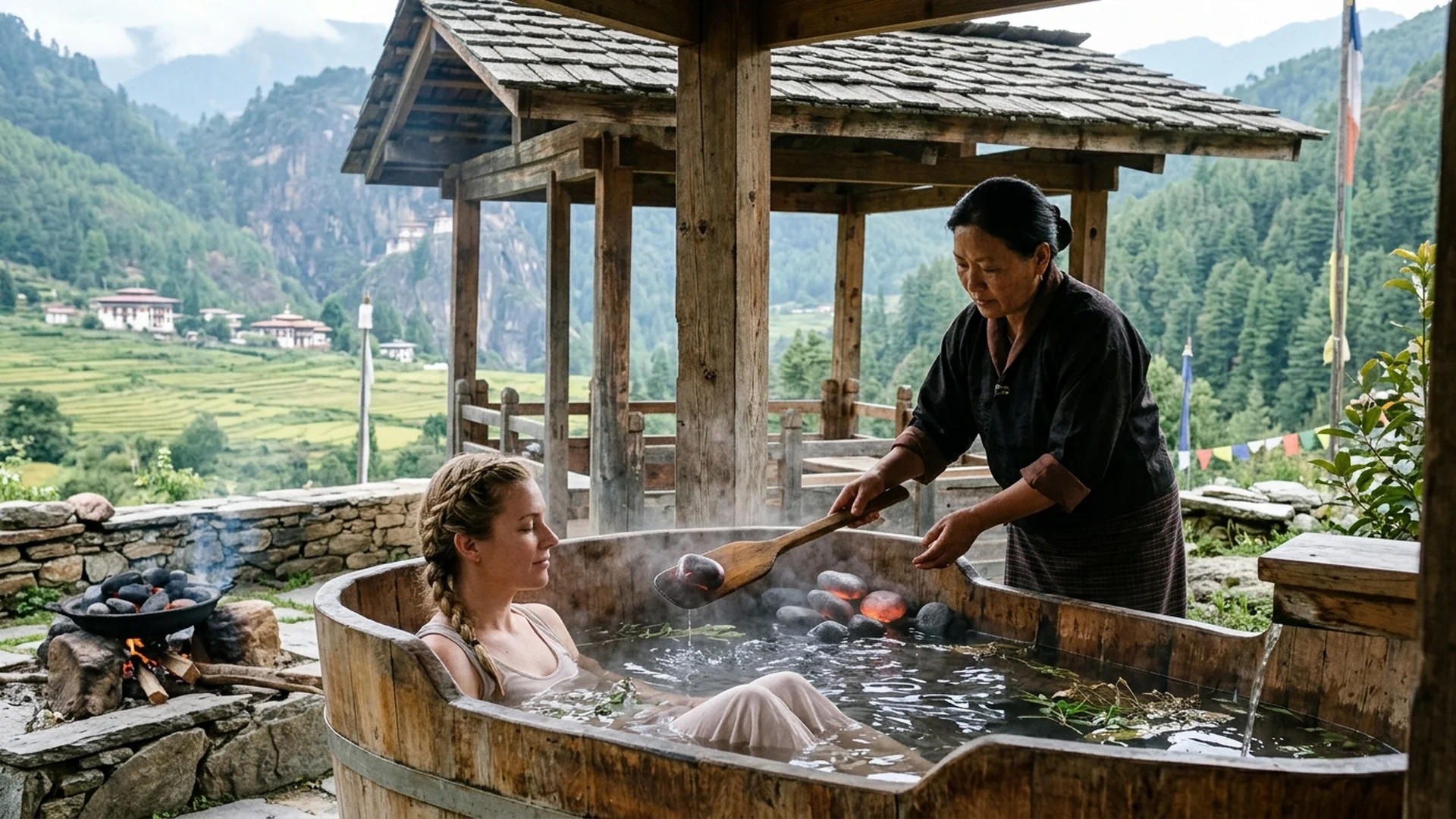
No exploration of Bhutanese wellness is complete without experiencing ‘Dotsho’, the venerable art of the traditional hot-stone bath. This ritual begins by harvesting river stones—typically rounded granite or blue river rocks—and firing them in an open wood flame until they glow a fierce, incandescent red. The searing stones are then carefully transferred into deep pine-wood tubs filled with cool spring water and an aromatic assortment of wild botanicals known as ‘Menchu’.
Most notably featuring fresh Artemisia leaves and native medicinal plants prized for their bone-knitting and tension-relieving properties, the water hisses and steams into life as the stones are submerged. The resulting thermal infusion releases a rich, earthy aroma while mineral ions dissolve into the water. The enveloping heat and therapeutic steam work in unison to dilate blood vessels, stimulate micro-circulation, and melt away muscular knots accumulated from long journeys across mountain passes.
Sanctuaries of Silence: World-Class Wellness Retreats
Modern Bhutan’s greatest luxury lies in its seamless preservation of ancestral wisdom paired with world-class hospitality. Premier wellness sanctuaries such as COMO Uma Paro, Amankora, and Bhutan Spirit Sanctuary have transformed secluded Himalayan landscapes into restorative temples. Here, treatment pavilions open directly onto breathtaking vistas of pine-clad gorges and misty valley floors.
Master therapists curate tailora-made wellness journeys that integrate warm herbal oil massages, guided meditation, and dawn yoga practices amidst an absolute, profound quietude that is increasingly rare in the modern world. Every considered detail is designed to anchor the traveler firmly in the present moment, restoring vitality and inner peace in equal measure.