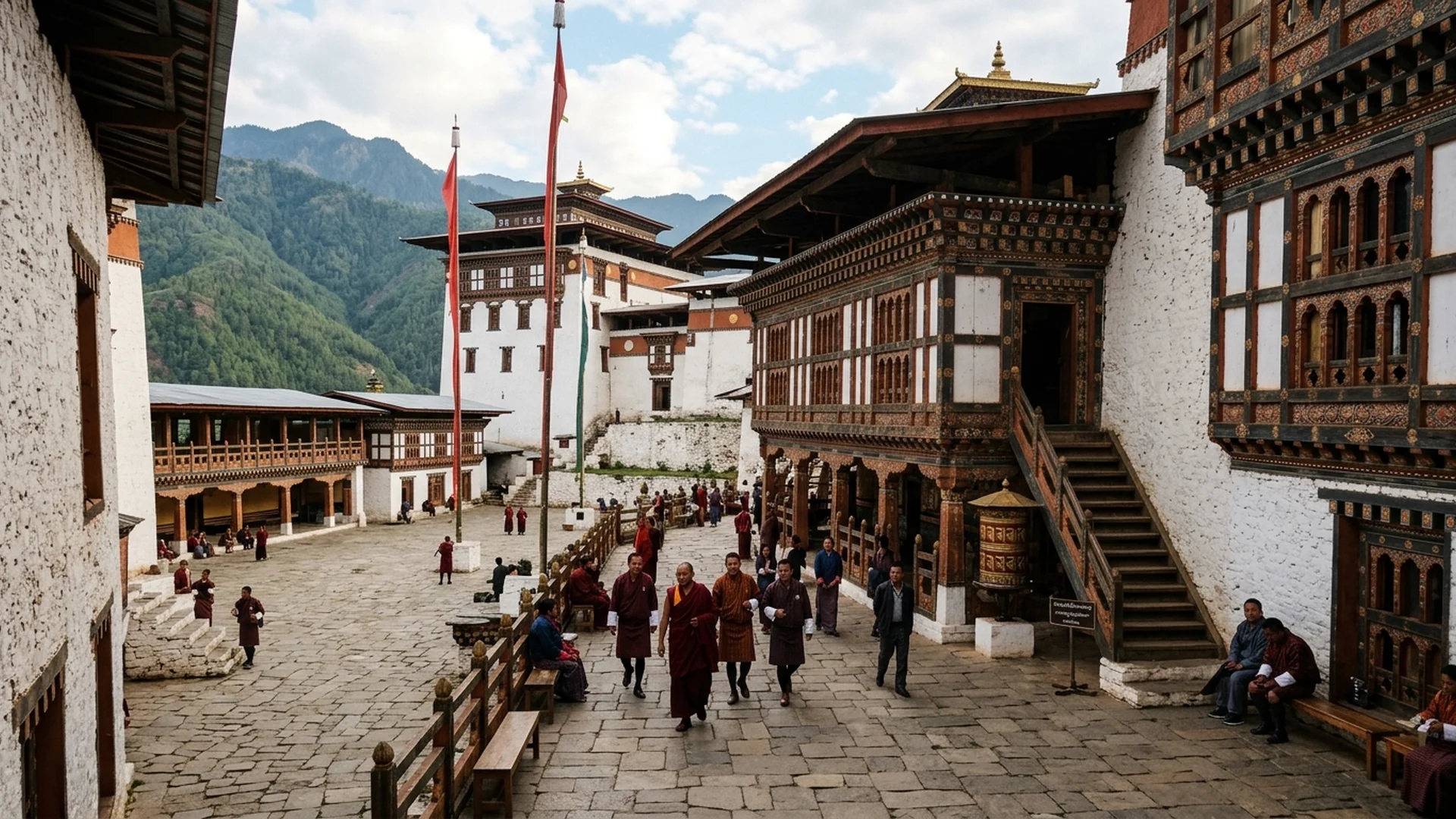
If any single landmark in the Kingdom of Bhutan embodies the convergence of military might, political hegemony, and Vajrayana Buddhist sanctity, it is undeniably Trongsa Dzong—officially known as Chökhor Rabtentse Dzong. Perched dramatically upon a precipitous ridge high above the yawning gorges of the Mangde Chhu river, this colossal fortress occupies the absolute geographical heart of the nation.
Historically, the staggered tiers of Trongsa Dzong cascading down the mountain spine not only struck terror into the hearts of invaders but served as the sole geopolitical gateway connecting western and eastern Bhutan. Anyone traversing the realm was compelled to pass through its stone-paved courtyards and towering portals. Consequently, the ruler of Trongsa, known as the Trongsa Penlop, wielded absolute authority over the kingdom’s commerce, military, and economy.
More profoundly, this formidable stronghold is the undisputed cradle of the Wangchuck dynasty. Before any Crown Prince ascends the Raven Throne as the Druk Gyalpo (Dragon King), ancient royal tradition mandates that he first serve as the Trongsa Penlop. Thus, Trongsa Dzong is far more than an architectural marvel of timber and stone; it is the beating heart of Bhutan’s modern unification and royal lineage.
Cascading Cliffside Architecture: The Masterpiece of Nail-Less Carpentry
The foundations of Trongsa Dzong were first laid in 1543 by Lama Ngagi Wangchuk, who heard the celestial conch of prophecy echoing from beneath the earth while deep in meditation. It was later expanded into a grand fortress in 1644 by Chogyal Minjur Tempa, the first governor of Trongsa, acting under the decree of Zhabdrung Ngawang Namgyal. The complex encompasses more than 23 distinct temples, tiered courtyards, and a labyrinthine network of corridors conforming seamlessly to the undulating contours of the ridge.
Remarkably, the entire construction adheres to ancient Bhutanese architectural canons, executed without blueprints and entirely devoid of iron nails. Massive whitewashed stone walls contrast sharply with intricately carved woodwork adorned with Vajrayana motifs in cinnabar, gold, and deep indigo. The sloping roofs shield the structure from alpine snows and monsoonal downpours, while its dizzying perch 800 meters above the roaring Mangde Chhu river allows the fortress to merge with the surrounding mountains in a display of awe-inspiring majesty.
The Geopolitical Chokepoint: Controlling the Destiny of a Nation
In an era before paved highways and modern motor vehicles, the only arterial path connecting western Bhutan—such as Paro and Thimphu—with the eastern territories of Bumthang and Trashigang was a ancient foot trail cutting straight through the heart of Trongsa. The strategic placement of Trongsa Dzong was masterfully calculated; its entrance gates and central courtyards were positioned directly across this narrow mountain passage, allowing authorities to instantly open or seal off transit between the country’s two halves.
Leveraging this unassailable vantage point, the Trongsa Penlop could effortlessly levy tariffs, command troop movements, and arbitrate tribal disputes. This supreme strategic leverage ultimately elevated the Trongsa Penlop to the most powerful political office in the realm second only to the Zhabdrung, providing the indispensable power base that unified Bhutan into a sovereign nation.
From Penlop to Druk Gyalpo: The Sacred Traditions of the Wangchuck Dynasty
Modern Bhutanese political history was forged within these venerable walls when Sir Ugyen Wangchuck, while serving as the Trongsa Penlop, successfully quelled regional factions and civil conflicts, culminating in his coronation as the first hereditary monarch of Bhutan in 1907. Since that pivotal era, Trongsa Dzong has been revered as the spiritual and symbolic birthplace of the Bhutanese monarchy.
In accordance with sacred royal tradition, every heir to the throne must be formally invested as the Trongsa Penlop within the dzong’s hallowed halls, mastering the arts of governance, empathy for the citizenry, and the preservation of spiritual heritage. His Majesty King Jigme Khesar Namgyel Wangchuck served as the 16th Trongsa Penlop in 2004 before assuming the throne, underscoring the unbreakable bond uniting this fortress with the destiny of the nation.
Ta Dzong Royal Heritage Museum: Regalia Above the Clouds
Perched on a commanding spur high above the main fortress stands Ta Dzong, an ancient circular watchtower erected in 1652 to scan the horizons for invading armies. Today, this historic bastion has been meticulously restored through international collaboration to house the Tower of Trongsa Royal Heritage Museum, one of Bhutan’s most treasured repositories of history.
The museum unfolds across eleven exhibition galleries containing over 300 priceless antiquities and sacred artifacts. Notable highlights include the original Raven Crown worn by the first king, 500-year-old garments belonging to Lama Ngagi Wangchuk, and sacred statuary and weaponry of former governors. A visit to Ta Dzong offers both profound historical perspective and breathtaking bird’s-eye panoramas of Trongsa Dzong sprawling across the canyon far below.