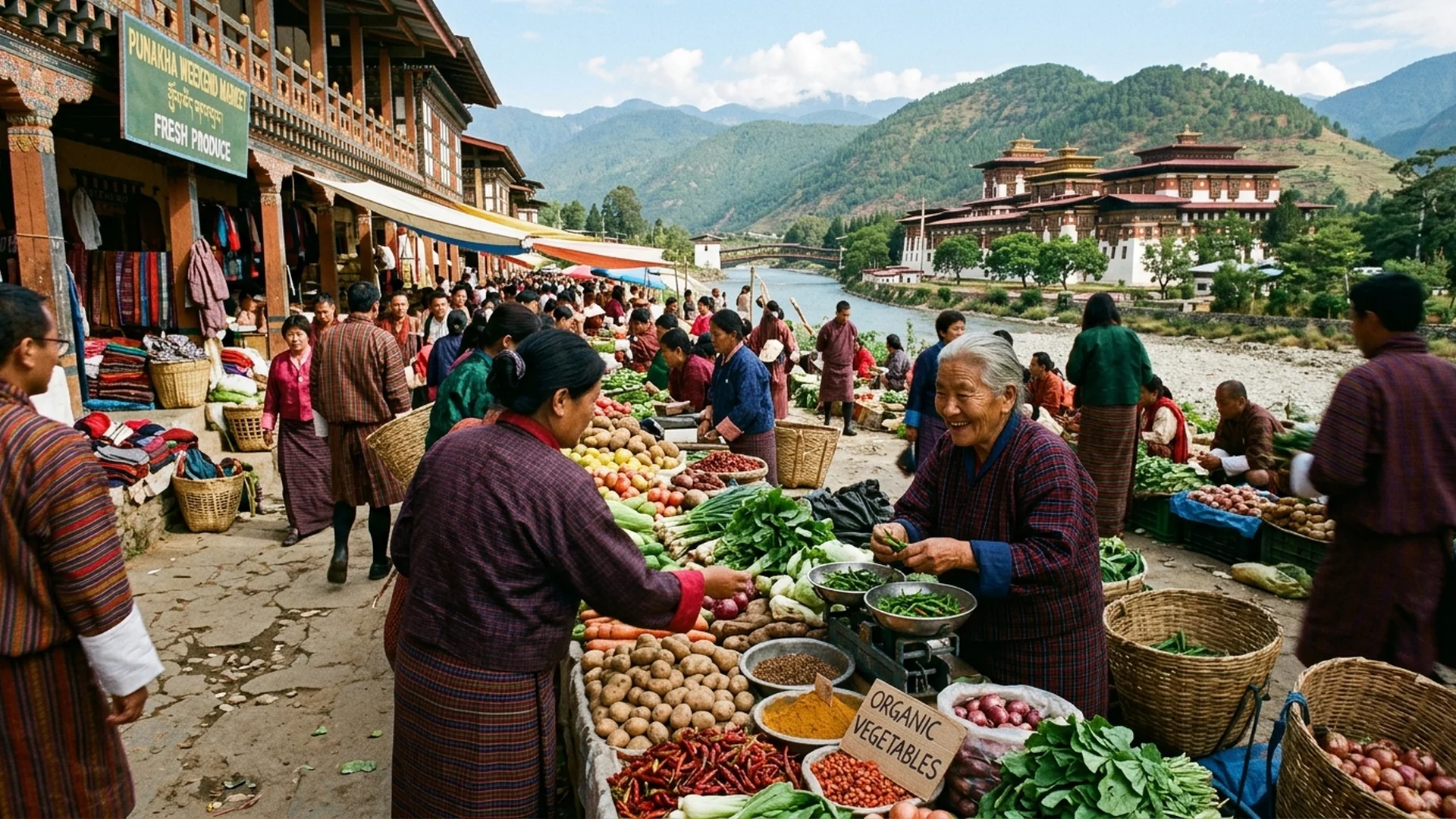
As the morning mist gently lifts from the emerald ridges of the Punakha Valley, soft laughter and conversational echoes in Dzongkha awaken the bustling riverside market once more. While the global imagination of Bhutan is often inextricably tied to the monumental grandeur of ancient monastic fortresses, or dzongs, these sacred citadels serve merely as the prologue to a much richer story. For travelers seeking the genuine heartbeat of this Himalayan kingdom, the Punakha Weekend Market offers an intimate pilgrimage into authentic local existence.
Within this vibrant arena of cultural exchange and unhurried trade, no elaborate rituals separate the visitor from the raw abundance of the land. Blessed with a subtropical microclimate, the fertile Punakha Valley stands as one of the nation’s most bountiful agricultural breadbaskets, sustaining generations with sun-drenched harvests. To wander leisurely among the rustic stalls is to turn the pages of a living manuscript, one that records the timeless rhythms of Bhutanese life through vivid colors, earthy aromas, and the warm, unfeigned smiles of the merchants.
Tastes of the Valley: Organic Harvests and Mountain Aromas
The sensory journey of the Punakha Weekend Market begins at the produce stalls, where seasonal vegetables display a brilliant, unpolished spectrum of natural color. Because this valley enjoys a milder climate than the capital of Thimphu, Punakha functions as the nation’s premier garden, cultivating crops in pristine soil nourished by glacier-fed streams entirely free of synthetic chemical inputs.
Venturing deeper into the market reveals sacks of short-grain Bhutanese red rice, which turns a delicate pinkish-rose upon steaming, yielding a satisfyingly nutty chew and profound nutritional value. Nearby, vendors display rounds of concentrated yak cheese, prized for its robust, distinct aroma and traditionally simmered into the beloved national dish, Ema Datshi. Fresh bundles of wild fiddlehead ferns, harvested from damp riverbanks high in the surrounding mountains, add a tender, forest-fresh element to a culinary tradition defined by wholesome simplicity.
The Art of the Loom: Heritage Crafts and Community Wisdom
Beyond its agricultural bounty, the market serves as an open-air gallery of traditional craftsmanship. Masterfully loomed textiles command deep appreciation, with elaborate kira and gho garments displaying intricate geometric motifs unique to the region. The extraordinary patience required to weave these patterns over months or even years reflects the tranquil mindfulness embedded within Bhutanese artistic culture.
To run one’s fingers across these hand-spun fabrics is to recognize the irreplaceable value of human touch in an automated world. Alongside textiles, carved wooden containers and antique silver ornaments whisper tales of Buddhist cosmology and indigenous folklore, ensuring that every handcrafted piece carries the living breath and quiet devotion of its maker.
The Aesthetics of Simplicity: Daily Life Against a Majestic Backdrop
A visit to the Punakha Weekend Market transcends mere commerce; it is an invitation for the senses to absorb a profound sense of ease. Locals dressed in brilliant, tailored national attire greet one another with courtly bows and gentle humor, while the air carries the subtle, contemplative fragrance of burning herbal incense dedicated to local protective deities.
When paired with the surrounding geography—where the masculine river, Po Chhu, and the feminine river, Mo Chhu, converge in quiet majesty before the imposing walls of the Punakha Dzong—this market experience achieves perfect equilibrium. It gracefully bridges the gap between monumental historical legacy and the enduring, graceful beauty of everyday human existence.