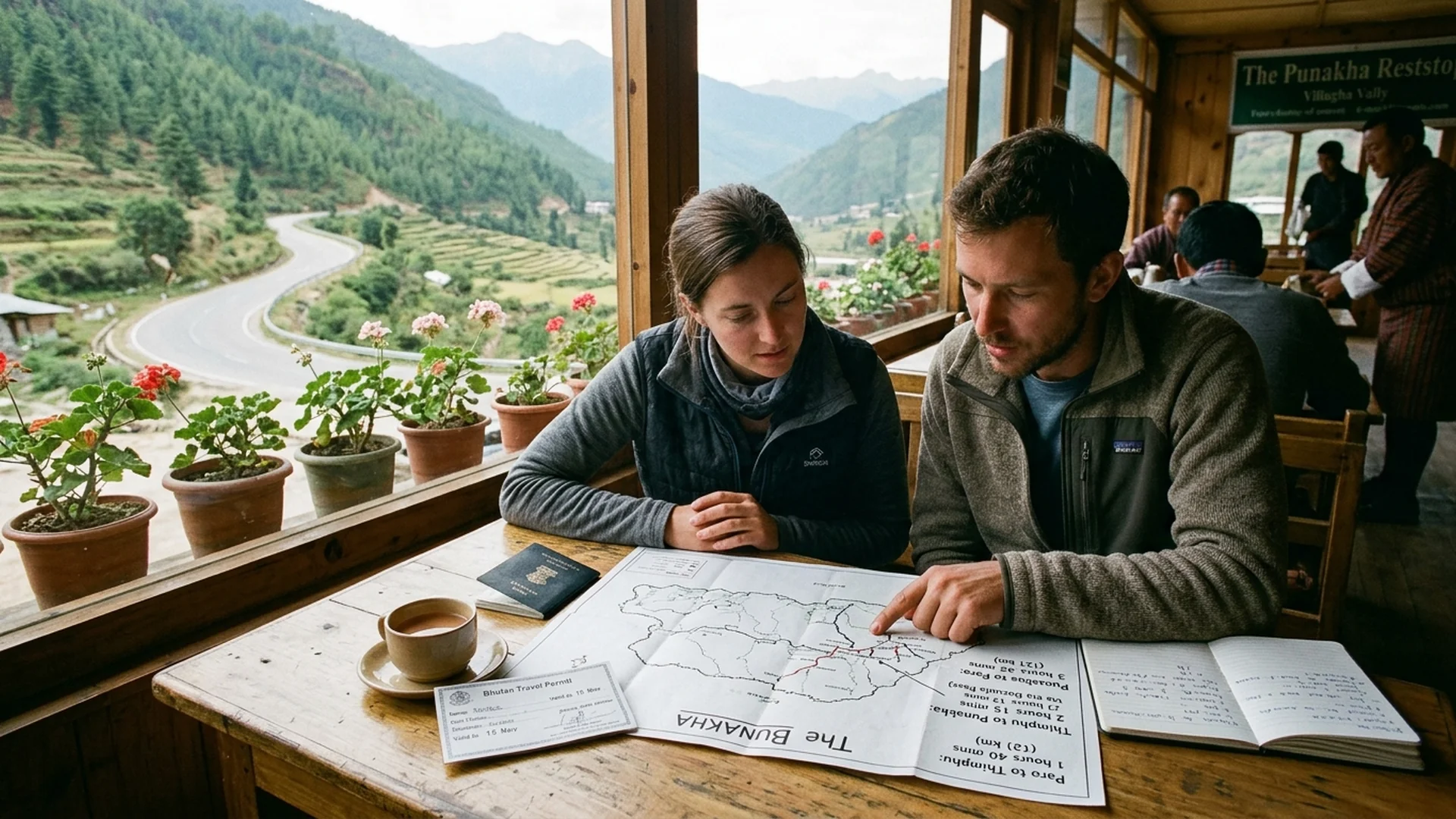
When speaking of the Thunder Dragon Kingdom, the numbers mapped out on paper are often an illusion. Across a landscape folded by complex Himalayan ridges, a distance of fifty or seventy kilometres does not translate to a fleeting moment as it might on the tarmac of a metropolis. Rather, it is a quiet invitation to patience, a gentle lesson in aligning one’s internal rhythm with the majestic scale of the earth.
Journeying through Bhutan is never about racing the clock to outpace the horizon; it is an aesthetic of release—letting go of urgency to surrender completely to winding cliffside routes, deep river gorges, and untamed pine forests. Comprehending the true pulse of transit times across these valleys is the foundational key that transforms a taxing itinerary into an immaculate spiritual pilgrimage defined by profound stillness and grace.
The Truth of the Himalayan Road: Why Fifty Kilometers Demands More Than an Hour
For the first-time visitor, map coordinates can easily mislead the uninitiated. The connective arteries linking the three foundational hubs of Paro, Thimphu, and Punakha carve directly through high mountain spines and glacial river chasms sculpted by time itself. Every thoroughfare hugs the contour of the hillside without the luxury of sprawling expressways, naturally capping vehicular velocities to uphold the highest standards of safety.
Embracing this geographic reality allows the discerning traveler to shift their gaze from the ticking clock to the subtle shifts of the wild terrain. Before you, mountain mists caress the crown of towering conifers; far below, glacial rivers etch ancient canyons that have flowed for millennia. Each sharp curve unveils an entirely fresh panorama, ensuring that hours spent upon the road remain endlessly captivating—an irreplaceable chapter of the broader Himalayan encounter.
Navigating the Lifelines: From Paro to Thimphu and Onward to Punakha
The inaugural passage awaiting every traveler is the transition from Paro International Airport to the capital city of Thimphu. Spanning roughly fifty kilometres, the journey typically takes an hour along the most forgiving and level asphalt in the kingdom, running parallel to the Paro and Wang Chhu rivers as the eyes gradually attune to the serene embrace of the valley.
Turning outward from Thimphu toward Punakha—the revered former winter capital renowned for its architectural masterpieces—the seventy-five-kilometre route demands two and a half to three hours. This expedition climbs steadily toward a critical mountain gateway, steering passengers through a striking ecological metamorphosis. Dense, cool temperate pine forests give way to the warmer, subtropical cradle of the lower valley, brimming with lush botanical diversity.
The Art of Pacing: Cultivating an Unhurried Expedition
For discerning travelers and family groups navigating the kingdom, the secret lies in resisting the urge to over-curate the itinerary. Carving out moments of fluid flexibility enables the human body to gracefully adjust to high-altitude atmospheric shifts without strain. Selecting immaculate, late-model all-wheel-drive vehicles paired with seasoned chauffeurs intimately fluent in mountain navigation guarantees absolute peace of mind and elevated comfort.
This passage should be approached as a true luxury road trip, entirely receptive to the poetry of the roadside. Pausing to stretch one’s limbs, exchange quiet pleasantries with villagers, or sip freshly brewed tea amidst crisp mountain air breathes enduring meaning and cherished memory into the transition from one sanctuary to the next.