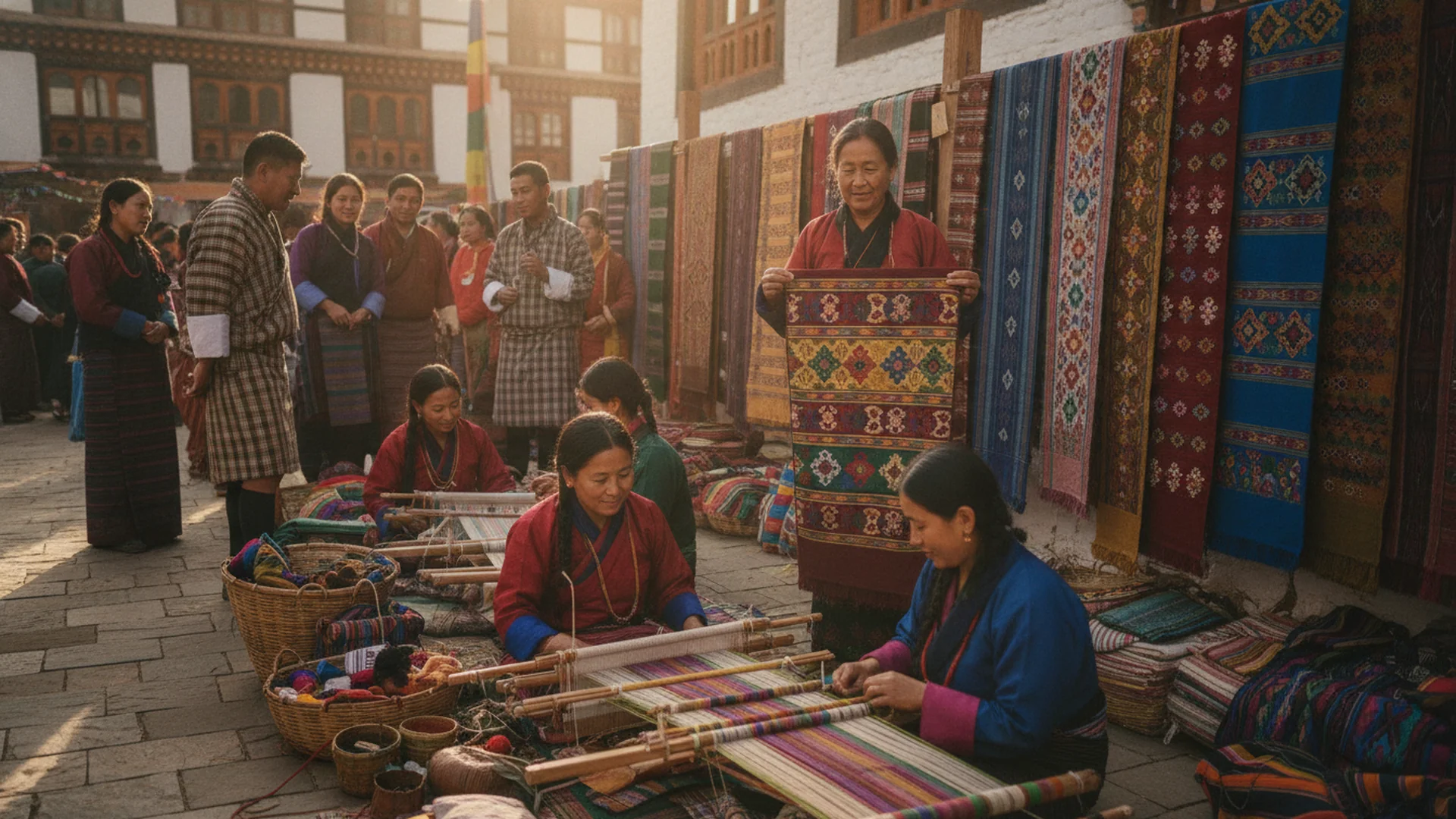
Where deep Himalayan mists meet snow-crowned summits, the rhythmic tap-and-clatter of wooden shuttle against raw silk echoes from low-slung timber homesteads. This is no ordinary cadence of labor; it is a timeless poem measured in natural fibers. In a sovereign realm where national prosperity is measured by Gross National Happiness, Bhutanese handwoven textiles represent the ultimate expression of the haute couture of the mountains. Far from mere garments, they are elevated works of art requiring months—sometimes over a year—of meditative creation on humble backstrap looms.
For discerning art collectors and connoisseurs of timeless craftsmanship, ancient textiles and traditional Bhutanese attire embody tangible cultural heritage. The labyrinthine complexity of motifs hidden within silk Kishuthara masterpieces and esoteric weaving techniques imbues each piece with a distinct living soul. They serve as tactile chronicles of history, devotion, and an unbroken communion between humanity and the rugged majesty of the Himalayas.
The Backstrap Loom & Trima Technique: Translating Buddhist Philosophy into Silk
Beneath the captivating surface beauty of Bhutanese handwoven textiles lies a meticulous production process that entirely rejects industrial machinery. The weavers are predominantly Bhutanese women who inherit their encyclopedic knowledge across generations. Sitting cross-legged on polished wooden floors, they employ traditional backstrap looms, utilizing their own physical posture and body tension to dictate the tautness of the silk threads. The master-level difficulty lies in the ‘Trima’ technique, where individual colored threads are meticulously inserted row by row by hand, leaving no floating threads or loose cuts on the reverse side. This allows intricate geometric motifs and floral iconographies to rise in miraculous relief. These patterns are far from mere visual decoration; every strand serves as a sacred visual code rooted in Vajrayana Buddhism, requiring profound inner stillness and unbroken concentration from the artisan. Consequently, a truly exceptional Kishuthara demands months of meditative patience to achieve flawless perfection.
Botanical Palettes & Auspicious Motifs: A Heritage of the High Himalayas
Another layer of profound depth in Bhutanese textiles is their color palette, completely devoid of synthetic chemicals. Weavers steadfastly adhere to ancestral methods of extracting pigments from mountain flora, botanical roots, and tree barks thriving at extreme altitudes. Deep, contemplative indigos are coaxed from wild indigo plants, vibrant reds emanate from the life-giving roots of madder, and soothing amber tones arise from Himalayan rhubarb. These extraction methods require an intuitive mastery of seasonal rhythms and thermal dynamics during fermentation. When paired with the Eight Auspicious Signs (Tashi Tagye) and ancient cosmological geometries symbolizing universal balance and spiritual protection, the results are extraordinary. When these botanical dyes meet lustrous raw silk that catches the subtle alpine light, the outcome is the purest expression of quiet luxury—steeped in intellectual and cultural gravitas.
Sacred Geography: From Royal Centers to Remote Himalayan Valleys
A genuine journey of discovery and acquisition begins in the vibrant capital of Thimphu at the Gagyel Lhundrup Weaving Centre, where visitors witness royal artisans engaging in their intricate craft. Nearby, the National Textile Museum serves as a world-class sanctuary housing historical court robes, royal garments, and priceless antique textiles that chronicle societal evolution through thread. For the uncompromising collector seeking a raw, unadulterated source, however, a pilgrimage deep into Khoma village within the northeastern Lhuntse district is the ultimate destination. Here, nestled amidst dramatic mountain folds, lies the legendary birthplace of authentic Kishuthara. In this remote enclave, every homestead operates as an open-air weaving studio, and the ancient clatter of wooden looms continues to echo an uninterrupted Himalayan legacy.