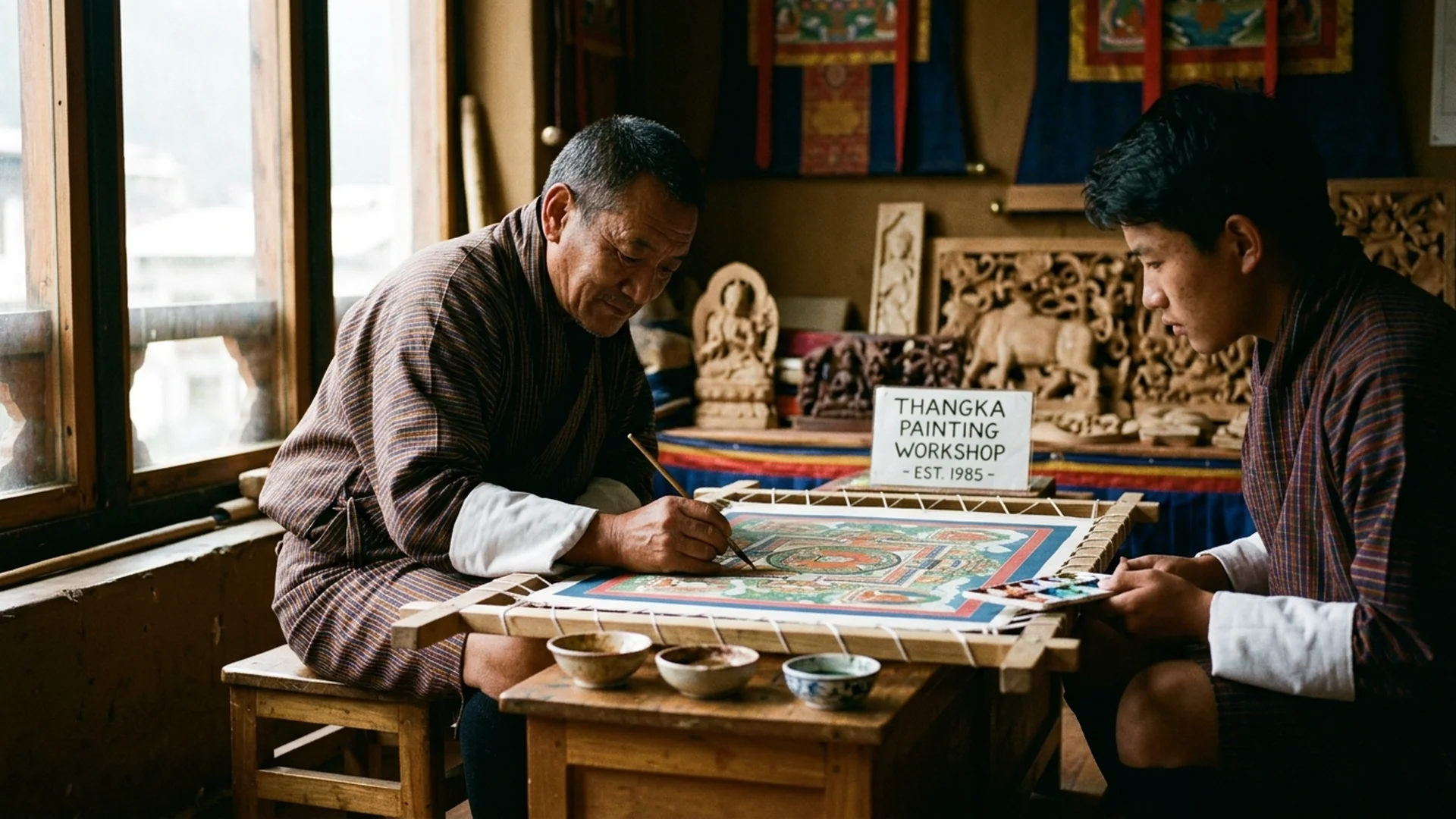
Amidst the crisp Himalayan air, the precise stroke of a mineral-tinted brush on a sacred prayer canvas and the quiet rhythm of a chisel shaping fragrant sandalwood echo an enduring legacy: the living heritage of the Kingdom of Bhutan. In this sovereign realm, art is never merely decorative or confined to sterile museum galleries; it is a contemplative practice and an unbroken lineage of Vajrayana Buddhism passed down through generations of master practitioners.
Deep beneath the eaves of majestic dzongs, Bhutan’s fine arts have been systematically classified since the 17th century by Zhabdrung Ngawang Namgyal and later codified by Gyalse Tenzin Rabgye under the system known as Zorig Chusum, or the Thirteen Traditional Arts. From sacred Thangka scrolls to intricate Kishuthara silk weaves, each creation exists far beyond ordinary handicrafts, serving instead as a luminous bridge connecting the physical body, the mind, and the sacred cosmology of the Dharma.
For discerning travelers and connoisseurs of exquisite craftsmanship, engaging with Bhutanese artistry offers a journey far beyond material acquisition. It is an invitation to decode spiritual philosophies, honor legendary patience, and support indigenous artisan communities so that this powerful cultural heritage may continue to illuminate generations to come.
The Spirit of Zorig Chusum: When Craftsmanship Becomes Meditation
The term Zorig Chusum derives from three Dzongkha words: Zo (skill or ability to create), Rig (science or knowledge), and Chusum (thirteen), collectively translating to the ‘Thirteen Sciences and Crafts.’ This system took definitive shape during the reign of Zhabdrung Ngawang Namgyal, the unifier of Bhutan in the 17th century, and was systematically organized by Gyalse Tenzin Rabgye, the fourth secular ruler.
Within Bhutanese culture, these thirteen disciplines do not exist to elevate individual egos or court personal renown. Rather, they form a devotional path for accumulating spiritual merit and perfecting patience. Traditional artists rarely sign their works; the ultimate purpose of their vocation is to manifest ultimate truth and sacred iconography. The thirteen crafts encompass every dimension of life: Lhazo (painting and Thangka creation), Jimzo (clay sculpture), Parzo (wood and stone carving), Thagzo (weaving), Tshozo (natural dyeing), Troezo (gold and silversmithing), Garzo (blacksmithing), Lugzo (bronze and metal casting), Shingzo (carpentry and architectural woodworking), Dozo (masonry), Shagzo (wood turning), Dezo (traditional paper-making), and Tshemzo (tailoring and sacred embroidery).
Every stroke begins in profound mental stillness. A Lhazo painter may spend days in prayer and meditation before touching brush to canvas, because within Vajrayana tradition, the proportions of a deity or mandala are strictly dictated by sacred canonical texts. A deviation of a single millimeter can disrupt the spiritual efficacy of the work. This absolute purity of intent allows discerning collectors to tangibly feel an abiding sense of serenity when standing before authentic Bhutanese art.
Masterworks of the Masters: From Luminous Thangkas to Seamless Kishuthara
Among Bhutan’s most celebrated masterworks, two artistic traditions captivate international observers through their extraordinary refinement: Thangka paintings (Lhazo) and Kishuthara textiles (Thagzo).
Thangkas are sacred scroll paintings on cotton or silk depicting Buddhas, guardian deities, or mandalas. A master-grade Thangka distinguishes itself through the use of natural mineral pigments ground from precious stones—such as deep lapis lazuli for blues, malachite for greens, cinnabar for reds, and finely beaten pure gold leaf for radiant halos. Artisans undergo at least six years of rigorous study to memorize the sacred architectural proportions. These organic pigments retain their vibrant luminosity for centuries without fading.
Simultaneously, in the realm of textile arts, Kishuthara from Lhuentse in eastern Bhutan reigns as the crown jewel of Himalayan weaving. This luminous silk textile features intricate geometric motifs and auspicious symbols created via Thrima, a complex supplementary-weft technique where colored silk threads are intricately looped by hand onto the warp. The resulting textured patterns resemble delicate embroidery yet are entirely woven on a backstrap loom. A single heirloom-quality Kishuthara fabric can demand anywhere from six months to a full year of continuous labor by a master weaver, embodying the pinnacle of royal and ceremonial elegance.
Anchoring in Thimphu: Experiencing the Artisanal Heartbeat at the National Institute
For travelers seeking an intimate encounter with this heritage, the National Institute for Zorig Chusum, nestled on a hillside in northern Thimphu, is an indispensable destination. Established in 1971, the institute stands as a vital bulwark protecting and transmitting the thirteen traditional arts against the homogenizing tides of modernity.
Crossing the threshold into the institute’s halls feels akin to stepping across dimensions. The rhythmic tap of chisels from the woodcarving (Parzo) department, the earthy fragrance of sandalwood and natural clay from the sculpture rooms (Jimzo), and the profound silence of the painting studios (Lhazo) coalesce into a living symphony. Students sit cross-legged on polished wooden floors, painstakingly drawing fine lines under natural light filtering through intricately carved wooden windows.
Visitors are welcome to observe the curriculum progress from foundational exercises to advanced masterclasses—watching instructors demonstrate how mineral rocks are pulverized into pigments, how clay is sculpted into serene divine visages, or how dragon motifs emerge from raw timber. The profound privilege here lies not merely in observation, but in bearing witness to an unbroken master-apprentice tradition anchored in deep reverence for teachers.
Ethical Acquisition: Curating Authentic Bhutanese Art with Integrity
Acquiring authentic Bhutanese art offers profound aesthetic enrichment while actively participating in the preservation of a living culture. However, distinguishing true masterworks from mass-produced souvenirs requires a discerning eye and a firm adherence to evaluative criteria.
1. Verify Traditional Materials and Methods: Premium Thangkas utilize natural cotton canvases framed in high-grade silk brocades, painted entirely with mineral pigments and herbal binders rather than synthetic chemical paints. Authentic Kishuthara textiles are woven from raw silk on traditional backstrap looms, displaying an even, tactile Thrima texture across the entire expanse.
2. Validate Iconographic Accuracy: Sacred Buddhist art must strictly adhere to scriptural proportions. The eyes of deities should radiate compassion and deep meditative stillness, while gold leaf halos must maintain unbroken, seamless precision.
3. Support Ethical Channels: Secure pieces directly through the National Institute for Zorig Chusum’s gallery, official artisan welfare shops, or direct weaving cooperatives in Lhuentse. Direct sourcing ensures that financial rewards return fairly to the makers and their families, inspiring younger generations to carry forward the legacy of the thirteen arts.