When conjuring the Land of the Thunder Dragon, the imagination readily summons visions of untouched valleys, ancient fortresses clinging precariously to sheer granite cliffs, and the quiet resonance of Gross National Happiness (GNH). Yet beyond its profound spiritual landscape, Bhutan operates one of the world’s most thoughtfully calibrated tourism models, anchored firmly in a High-Value, Low-Impact ethos that steadfastly rejects mass tourism.
Navigating this Himalayan sanctuary requires understanding more than simple arithmetic; it demands an appreciation of a national framework that translates every investment into cultural preservation, refined hospitality, and ecological guardianship. For the discerning global traveler, the all-inclusive tour package is designed to offer seamless elegance, ensuring every detail is orchestrated with precision from arrival to departure.
This editorial journey decodes the anatomy of Bhutanese travel planning, examining the Sustainable Development Fee (SDF), dedicated private guiding, bespoke vehicular logistics, and the distinct tiering of accommodations—from authentic heritage boutique retreats to world-class ultra-luxury sanctuaries like Aman and Six Senses.
The Architecture of Transparency: Six Pillars of the All-Inclusive Journey
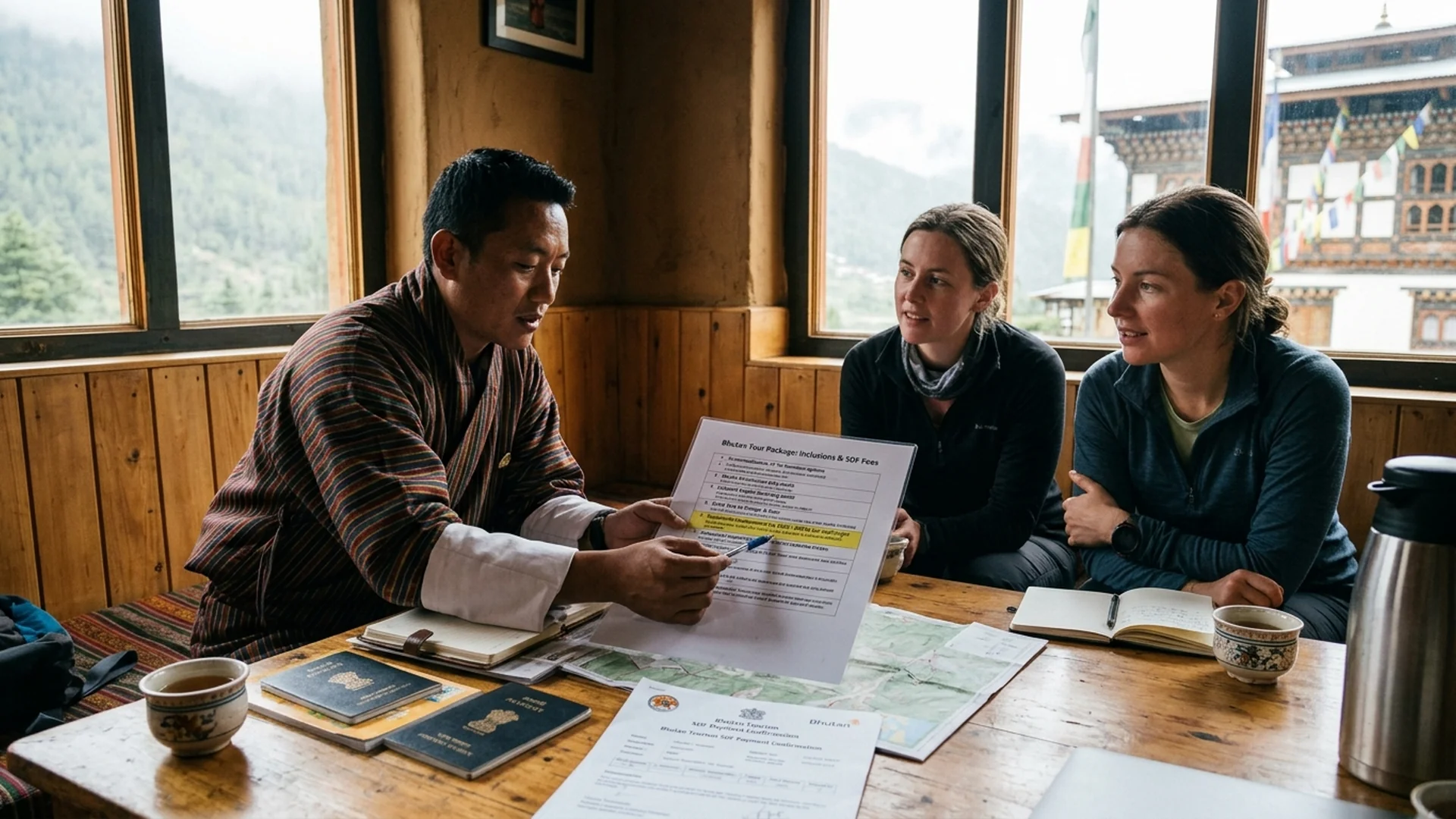
Traveling through the pristine valleys of Bhutan is engineered to be an utterly seamless, frictionless experience. When engaging a reputable, high-tier tour operator, pricing structures are mapped with absolute transparency across six essential components. The journey begins with official visa clearance handled digitally prior to arrival, immediately paired with the mandatory Sustainable Development Fee. Next comes meticulously vetted accommodations, followed by daily gastronomy celebrating fresh organic local harvests paired with international fare. A dedicated private vehicle and seasoned driver navigate the dramatic mountain switchbacks with consummate skill, while a licensed cultural guide serves as both storyteller and bridge to the community, elevating every encounter with profound historical context and immaculate safety.
Decoding the Sustainable Development Fee (SDF): The Cornerstone of Conservation
At the heart of international curiosity regarding Bhutan’s travel economy lies the Sustainable Development Fee (SDF). Currently fixed at $100 USD per person per night for international visitors paying in foreign currency—a rate officially locked through August 31, 2027—this levy functions far beyond a standard tourist tax. It serves as the financial lifeblood of the world’s only carbon-negative nation, funding free education and healthcare for citizens, the meticulous restoration of ancient temples, and expansive reforestation initiatives. For the conscious traveler, this structure offers quiet reassurance: every night spent in the kingdom directly safeguards a fragile, precious ecosystem and a living heritage against the homogenizing tides of modernity.
The Spectrum of Hospitality: From Heritage Boutiques to Global Ultra-Luxury
Bhutan’s contemporary hospitality landscape gracefully accommodates diverse aesthetic sensibilities without compromising authenticity. Travelers may elect intimate boutique lodges that celebrate traditional Bhutanese architecture—characterized by intricately carved timber frames, earthen rammed walls, and meditative courtyards—or elevate their stay within the portfolio of the world’s finest ultra-luxury names. Properties such as Six Senses Bhutan, scattered across contemplative valleys, and COMO Uma Paro offer refined sanctuary complete with holistic Himalayan wellness therapies, private butler service, and culinary programming that reimagines ancient recipes into modern gastronomy. Naturally, package valuations scale fluidly in accordance with the tier of accommodation selected.