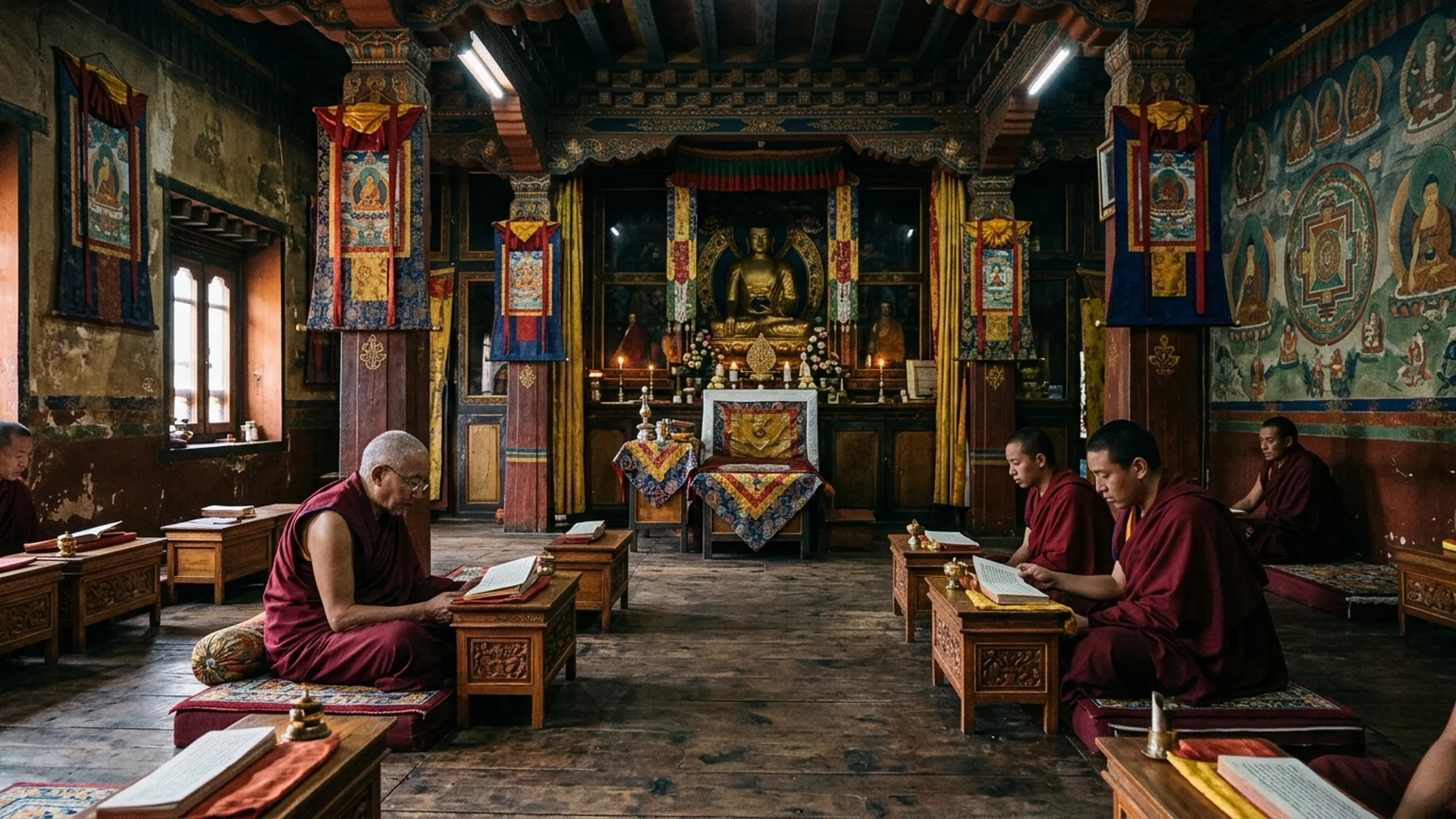
Amidst the gossamer mists that gently caress the high peaks north of the Thimphu Valley, the resonant cadence of quiet breathing and soft chanting drifts across the crisp mountain air, grounding the senses in a realm where time itself appears suspended. While the casual traveler flocks to the downstream landmarks of the capital, a far more profound sanctuary conceals itself high above the dense pine forests: Tango Monastery. This treasured jewel is far more than an ancient place of worship; it stands as one of the Kingdom of Bhutan’s most vital monastic universities, or Shedra, where profound solitude and unwavering devotion coalesce into an unforgettable spiritual tapestry.
To journey to Tango Monastery is to step beyond the margins of standard tourist itineraries and enter a genuine dimension of pilgrimage and mindful contemplation. The site greets the visitor not with superficial grandeur, but with centuries of rich history stretching back to the thirteenth century, wrapped in mystical legends of guardian deities and framed by striking fortress-like architecture perched at an elevation exceeding 2,800 meters. For the discerning global traveler seeking the true essence of sacred geography, this pilgrimage offers an authentic resonance that lingers long after the descent.
Thirteenth-Century Roots: From the Footsteps of a Lama to a Center of Higher Learning
The story of Tango Monastery unfurls in the thirteenth century, when the accomplished Tibetan master Phajo Drugom Zhigpo—the pioneering figure who planted the seeds of the Drukpa Kagyu lineage in western Bhutan—arrived in this serene woodland. He utilized the elevated rock caves as a secluded retreat for rigorous meditation before the fourth temporal ruler of Bhutan, Gyalse Tenzin Rabgye, later restored and expanded the sanctuary into its present architectural form in 1688.
Today, Tango’s significance extends far beyond its historical architecture. It functions actively as a Shedra, an advanced college of Buddhist philosophy where young monks undergo rigorous selection to spend six to nine intensive years studying scriptural canons, logic, and metaphysics. The monastery’s halls echo continuously with resonant chanting and the quiet brilliance of ancient manuscripts, keeping the living flame of Buddhist scholarship vibrantly alive.
The Legend of the Horse-Headed Deity and Menlug Artistry
The Dzongkha name ‘Tango,’ translating literally to ‘Horse Head,’ derives from sacred lore holding that this steep precipice was once the site where Avalokiteshvara manifested in the wrathful aspect of Hayagriva (known locally as Tandin) amidst visionary flames. This spiritual pedigree was further sanctified when Zhabdrung Ngawang Namgyal, the unifier of Bhutan, later meditated within the exact same sacred cave.
Upon entering the inner sanctum, visitors encounter exquisite traditional sacred art crafted according to the ancient Menlug school. Murals and statues rendered from pure natural mineral pigments depict cosmic mandalas and fierce protectors, illuminated softly by butter lamps and fragrant incense. This atmospheric interior draws connoisseurs of Eastern philosophy and art into a mesmerizing exploration of sacred symbolism.
The Dharma Trail: Mindful Walking Among Himalayan Pines
The ascent to Tango Monastery serves as an intentional moving meditation. Traversing the steep, shaded trail through ancient oak and Himalayan pine forests for roughly two to three kilometers—taking between one and two hours—acts as a bridge between the clamor of the outer world and the stillness within. The pathway is lined with colorful prayer flags fluttering in the mountain breeze and traditional water-driven prayer wheels.
Every step along this verdant route offers an immersive experience of forest bathing. The symphony of wind in the canopy, forest birds, and the rhythmic crunch of gravel clears physical fatigue and quiets the mind, preparing the traveler to receive the uplifting tranquility characteristic of Bhutan’s sacred sanctuaries.