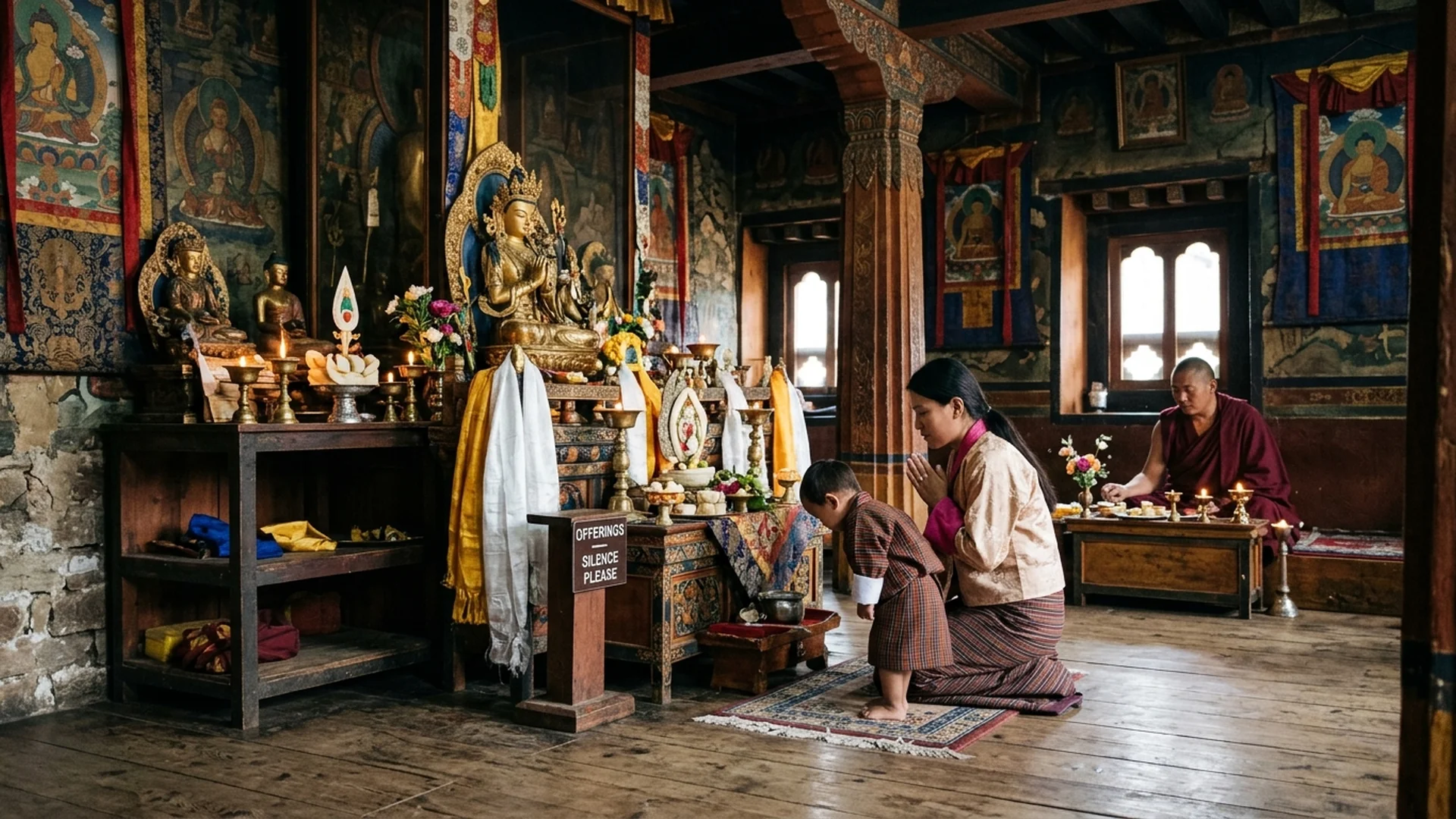
Above the bustling capital of Thimphu, perched upon a ridge that catches the crisp mountain winds, stands Changangkha Lhakhang—a twelfth-century spiritual fortress rooted deep in the Bhutanese earth long before the nation’s unification in the seventeenth century. This ancient sanctuary is far more than a historical monument; it is the beating heart of Thimphu, where the threads of faith, family, and timeless tradition are meticulously woven together each passing day.
As you ascend the stone pathways to the courtyard, the gentle murmur of wooden prayer wheels spinning clockwise blends with the bright Himalayan prayer flags snapping in the crisp mountain air. Here, there is no hurried commercial pulse, only the quiet grace of Bhutanese parents dressed in traditional gho and kira, cradling newborns as they seek auspicious names and lifelong protection. It is a vivid reminder that faith in Bhutan does not merely reside in ancient chronicles; it begins the very moment a human eye opens to the world.
Twelfth-Century Footprints: From Wandering Lama to Fortress of Wisdom
The history of Changangkha Lhakhang strikes deep roots into Bhutan’s medieval epoch. Founded in the twelfth century by Lama Phajo Drugom Zhigpo, a Tibetan master who followed prophecies southward to establish the Drukpa Kagyu lineage in western Bhutan, the site was later expanded by his son, Nyima Chog, into a formidable spiritual outpost atop a strategic ridge.
The architecture exemplifies traditional Bhutanese aesthetics, merging the commanding presence of a dzong—a fortified monastery-fortress—with the intimacy of a sacred shrine. Thick white-washed stone walls catch the early morning alpine sun, while intricately carved window frames display natural earth pigments of antiquity. The veranda is lined with slate carvings depicting bodhisattvas and the eight auspicious symbols, running parallel to hundreds of prayer wheels that visitors spin in unison, casting benevolent aspirations into the universe.
The Eleven-Faced Chenrezig and Genyen Domtsangpa: Anchors of Devotion
Inside the main sanctuary, the atmosphere hangs heavy with the soothing scent of herbal incense and yak butter lamps, charged with centuries of unbroken prayer. At the focal point of utmost reverence stands a towering gilded bronze sculpture of Chenrezig, the Bodhisattva of Compassion, manifested in an eleven-faced form. Bhutanese faithful revere this image as rangjung—self-arisen rather than crafted purely by human hands—having once served as the personal devotional icon of Lama Phajo Drugom Zhigpo.
Further within lies the goenkhang, the guardian deity chapel housing Genyen Domtsangpa and Tamdrin, who watch over the Thimphu valley and serve as the guardian patrons for children born in the capital. Uniquely, the four guardian kings are depicted standing rather than seated, an architectural and artistic rarity in Bhutanese monastic design.
The Blessing of Beginnings: Naming Ceremonies for Bhutanese Newborns
Every morning, the courtyard of Changangkha Lhakhang vibrates with tender domestic life. Bhutanese parents and grandparents arrive bearing newborn infants swaddled in vibrant hand-woven textiles, seeking audience with the senior resident lamas. The monks consecrate the children with holy water, bestow sacred protective threads, and touch the phurba—a ritual dagger—gently to the child’s crown to ward away malevolent forces.
Most enchanting is the bestowal of auspicious names, often incorporating the syllable ‘chang’ or honoring the temple’s guardian deities, weaving a generational bond across the city’s populace. Witnessing these tender familial gatherings amidst such enduring serenity offers discerning travelers an unfiltered portal into the authentic inner life of Bhutan.
Panoramic Perspectives: The Equilibrium of Quietude and Transformation
Stepping out onto the wooden veranda reveals sweeping vistas of the entire Thimphu valley. From this elevated vantage point, sages and travelers across generations have contemplated the evolution of the capital. Traditional homesteads nestled amidst pine forests alongside the meandering Wang Chhu river demonstrate a rare urban expansion that stubbornly preserves its spiritual core.
Sitting quietly on the temple’s balcony as the afternoon sun washes the white walls in liquid gold, accompanied by the low hum of distant chanting, offers a rare suspension of time in the modern era. Changangkha Lhakhang reveals itself not merely as a geographical coordinate, but as a profound sanctuary for the wandering soul.