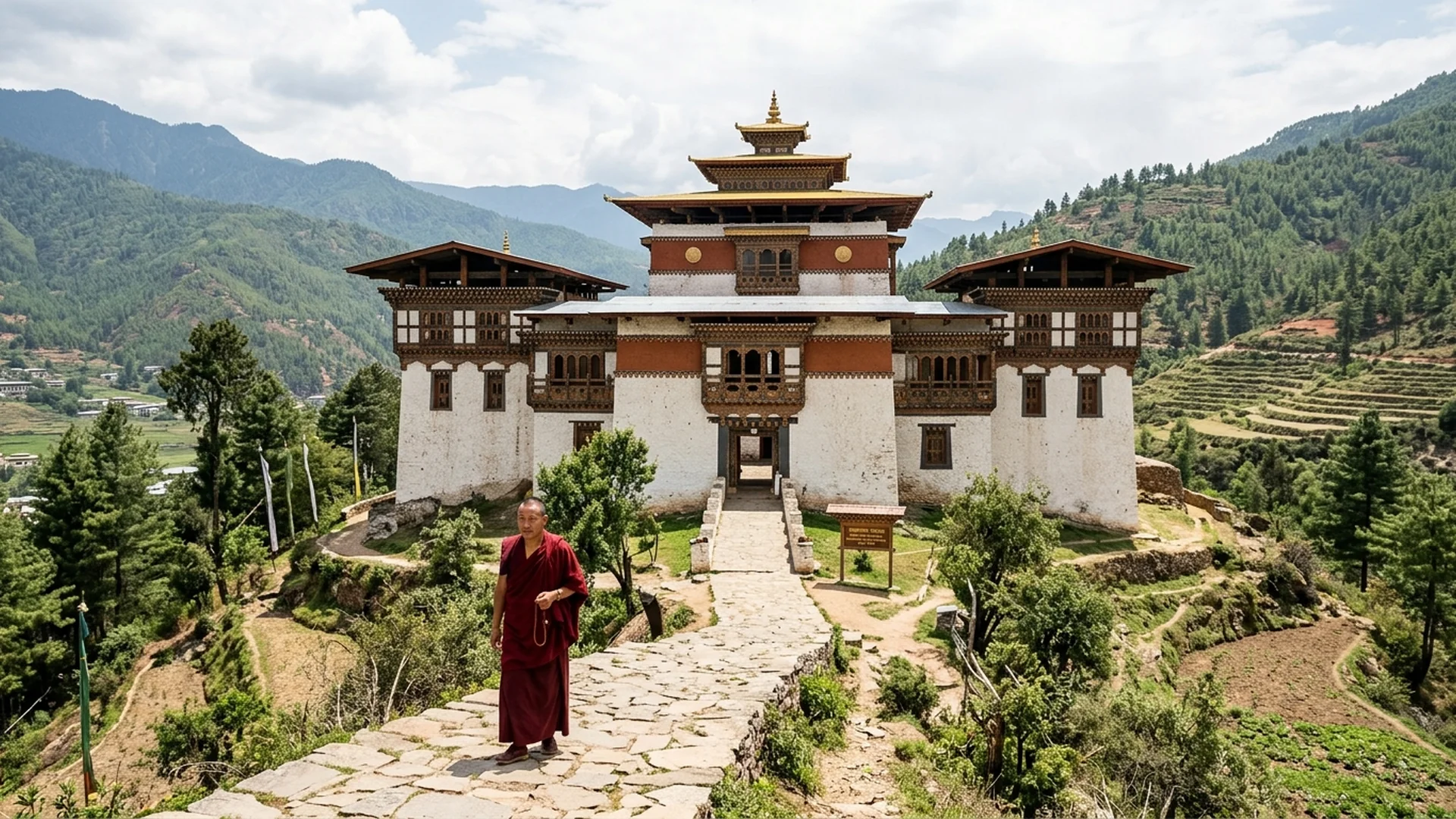
Amidst the mountain winds sweeping across the vital crossroads connecting Thimphu, Paro, and Punakha, the stark white fortress walls of Simtokha Dzong stand in quiet dignity along the ridge. As the gentle light of dawn illuminates its timber eaves and intricately carved woodwork, casual travelers often mistake the citadel for a mere passing landmark on the threshold of the capital. Yet for those attuned to intellectual depth and historical resonance, Simtokha Dzong remains the true prologue to the Kingdom of Bhutan.
Officially designated as Sangak Zabdhon Phodrang, translating to the ‘Palace of Profound Meaning in Secret Mantras,’ the stronghold was established in 1629 by Zhabdrung Ngawang Namgyal, the visionary statesman who united the disparate valleys of the Himalayas into a single sovereign realm. Simtokha Dzong is not merely the earliest military fortress to survive intact to the present day; it served as the foundational archetype for the distinctive dzong architecture that seamlessly merges secular governance with sacred Mahayana monastic life under one majestic roof.
Crossing the threshold into this four-century-old stone enclosure transcends a standard heritage tour. It is an unhurried passage across a temporal threshold to decode ancient spiritual philosophies, delicate slate carvings, and the enduring imprints of faith that continue to shape the identity of the Land of the Thunder Dragon.
The Prologue of the Thunder Dragon: The Zhabdrung and the Genesis of the First Fortress
Before the seventeenth century, the valleys of Bhutan existed as fragmented territories devoid of central authority, until the arrival of Zhabdrung Ngawang Namgyal, an exalted lama who crossed the formidable Himalayan passes from Tibet. Embarking on a monumental mission to consolidate the autonomous valleys, the Zhabdrung established a revolutionary architectural paradigm known as the dzong—a dual-purpose sanctuary fulfilling both defensive military requirements and spiritual cultivation.
In 1629, the Zhabdrung selected a commanding promontory overlooking the expanse of the Thimphu Valley to raise Simtokha Dzong as his primary stronghold. Throughout its construction, the fortress endured repeated sieges and assaults from allied Tibetan forces and domestic rivals. Through tactical brilliance and impenetrable siting, Simtokha Dzong withstood every trial by fire, establishing an unshakeable anchor of national security that endures to this day.
The Subjugation of the Demoness and the Geopolitics of Unification
The etymology of Simtokha traces back to local vernacular terms: simmo, denoting an evil demoness, and do, signifying stone. According to oral tradition, the ridge was once haunted by a malevolent spirit that waylaid travelers traversing the high passes. Zhabdrung Ngawang Namgyal performed profound spiritual rites to subjugate the entity beneath an immense foundational boulder, subsequently raising the fortress directly atop the stone to permanently seal the malevolent force beneath the shelter of the Dharma.
Strategically, the citadel controlled the convergence of three primary thoroughfares leading toward Thimphu, Paro, and the eastern valleys via the Dochu La pass. Possessing Simtokha Dzong meant commanding all supply lines and communication routes across western Bhutan, cementing its role as the indomitable gatekeeper of the capital throughout turbulent historical eras.
Four-Centuries of Slate Carvings and Sacred Murals
Among the most compelling artistic treasures awaiting discerning visitors at Simtokha Dzong is the extraordinary collection of over 300 ancient slate carvings lining the exterior ambulatory corridor. Each panel is meticulously chiseled with representations of enlightened masters, bodhisattvas, and celestial guardians of the Vajrayana tradition, retaining traces of ancient mineral pigments. This collection remains one of the most complete repositories of Himalayan stone artistry in existence.
Within the central lhakhang, or temple sanctuary, a profound stillness envelops the visitor. The sanctum is anchored by a monumental statue of Shakyamuni Buddha, flanked by the eight principal bodhisattvas. Overhead, silk victory banners catch the drafts, while the surrounding walls glow with centuries-old murals depicting Chenrezig alongside the White and Green Taras, preserved with exceptional reverence.