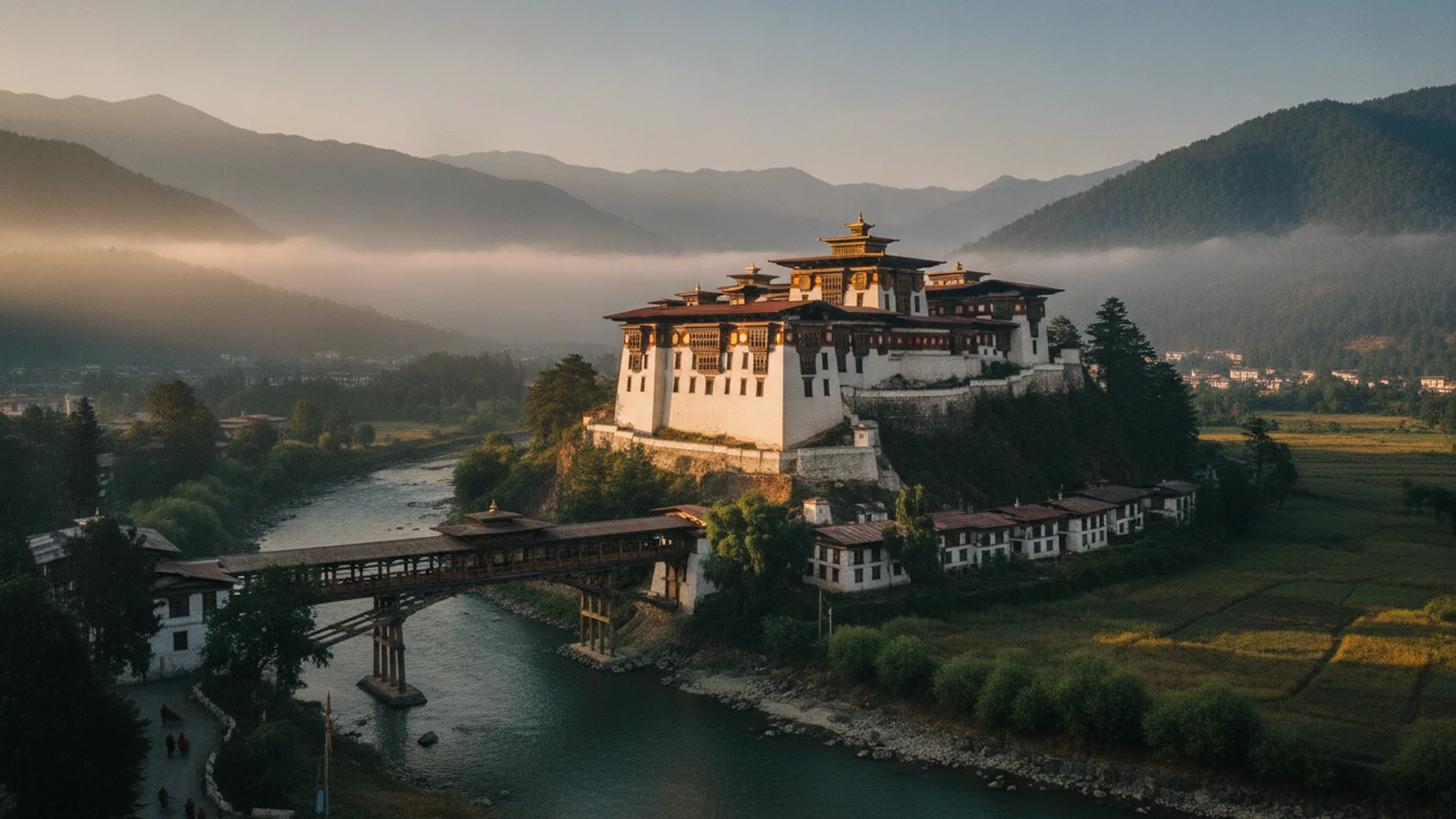
As translucent mists drift across the dark pine ridges guarding the Paro Valley, Rinpung Dzong emerges like a white granite apparition carved from the mountain itself. Rising steeply above the glacial waters of the Paro Chhu, this monumental fortress-monastery has stood for centuries as both the administrative anchor of western Bhutan and a living sanctuary of the kingdom’s spiritual endurance.
For the discerning traveler seeking cultural depth over simple spectacle, passing through the heavy timber gates of Rinpung Dzong offers an unhurried passage into the seventeenth century. Here, high aesthetic artistry, unyielding Buddhist faith, and visionary Himalayan engineering converge without a single steel nail or paper blueprint—a masterwork of sacred craft suspended between earth and sky.
From Sacred Cliff to Sacred Citadel: The Genesis of Rinchen Pung
The origin of Rinpung Dzong traces back to the fifteenth century, when Lama Drung Drung Gyal was gifted a sheer, sacred cliff known as Hungrel to erect a modest monastic sanctuary. Two centuries later, in 1644, Zhabdrung Ngawang Namgyal—the unifier of Bhutan—recognized the commanding military and spiritual topography of the rock. Dismantling the original structure, he commissioned a formidable fortress designed to defend the valley against fierce invasions from Tibet.
Upon its consecration in 1646, the citadel was officially christened Rinchen Pung Dzong, translating to ‘Fortress on a Heap of Jewels.’ The title reflected both the unwavering faith of the valley’s inhabitants and its status as a repository of priceless spiritual knowledge. Though weathered by catastrophic fires in subsequent centuries, meticulous restorations carried out by Bhutanese master craftsmen have preserved its archaic dignity and timeless atmosphere into the modern age.
The Masterpiece Without Blueprints: Timber, Stone, and Sacred Craft
To stand beneath the soaring stone ramparts of Rinpung Dzong is to encounter an ancient triumph of structural harmony. Built without a single metal nail, the architectural marvel relies entirely on intricate mortise-and-tenon wooden joinery, hand-fitted beams, and thick walls of whitewashed stone that slope inward to absorb seismic movement.
What renders this five-story complex extraordinary is that it was raised entirely without drawn architectural plans. Every balcony, pillar, and lintel was conceived through visual memory and oral tradition governed by Zorig Chusum—Bhutan’s thirteen traditional arts and crafts. Intricately carved wooden window frames (rabsel), painted with natural mineral pigments, contrast dramatically against the pristine lime walls. Within the interior, fourteen sanctuaries (lhakhang) house delicate Mahayana murals and cosmos-reflecting mandalas of exceptional artistic rarity.
Nemi Zam: The Cantilever Bridge of Cinematic Renown
The approach to Rinpung Dzong unfolds with the measured grace of an ancient ritual. The main path guides visitors across Nemi Zam (also written as Nyamai Zam), a traditional covered timber cantilever bridge bridging the rushing glacial waters of the Paro Chhu. The structure represents one of the finest surviving examples of classical Bhutanese river architecture.
Owing to its cinematic composure, Nemi Zam and the towering white backdrop of the dzong served as a central location for Bernardo Bertolucci’s 1993 film Little Buddha, starring Keanu Reeves. As late afternoon sunlight warms the weathered timber trusses and casts a shimmering mirror image of the fortress onto the river’s surface, the site remains one of the most evocative vistas in the entire Himalayan region.
Paro Tshechu: Sacred Drama and the Dawn of Liberation
Each spring, during the second lunar month, the spacious paved courtyard of Rinpung Dzong transforms into a sacred theater for the Paro Tshechu, one of Bhutan’s most revered monastic festivals.
During these auspicious days, monks and lay practitioners dressed in hand-woven silk brocades and carved wooden masks perform the Cham—sacred dances that evoke protector deities, banish malevolent influences, and embody esoteric Buddhist teachings. The spiritual crescendo occurs at dawn on the final day, when a colossal embroidered silk scroll (Thongdrel), spanning over twenty meters, is unfurled down the central tower of the dzong. Local belief holds that catching sight of the sacred image of Guru Rinpoche before the first rays of sunlight hit the canvas cleanses a lifetime of negative karma.