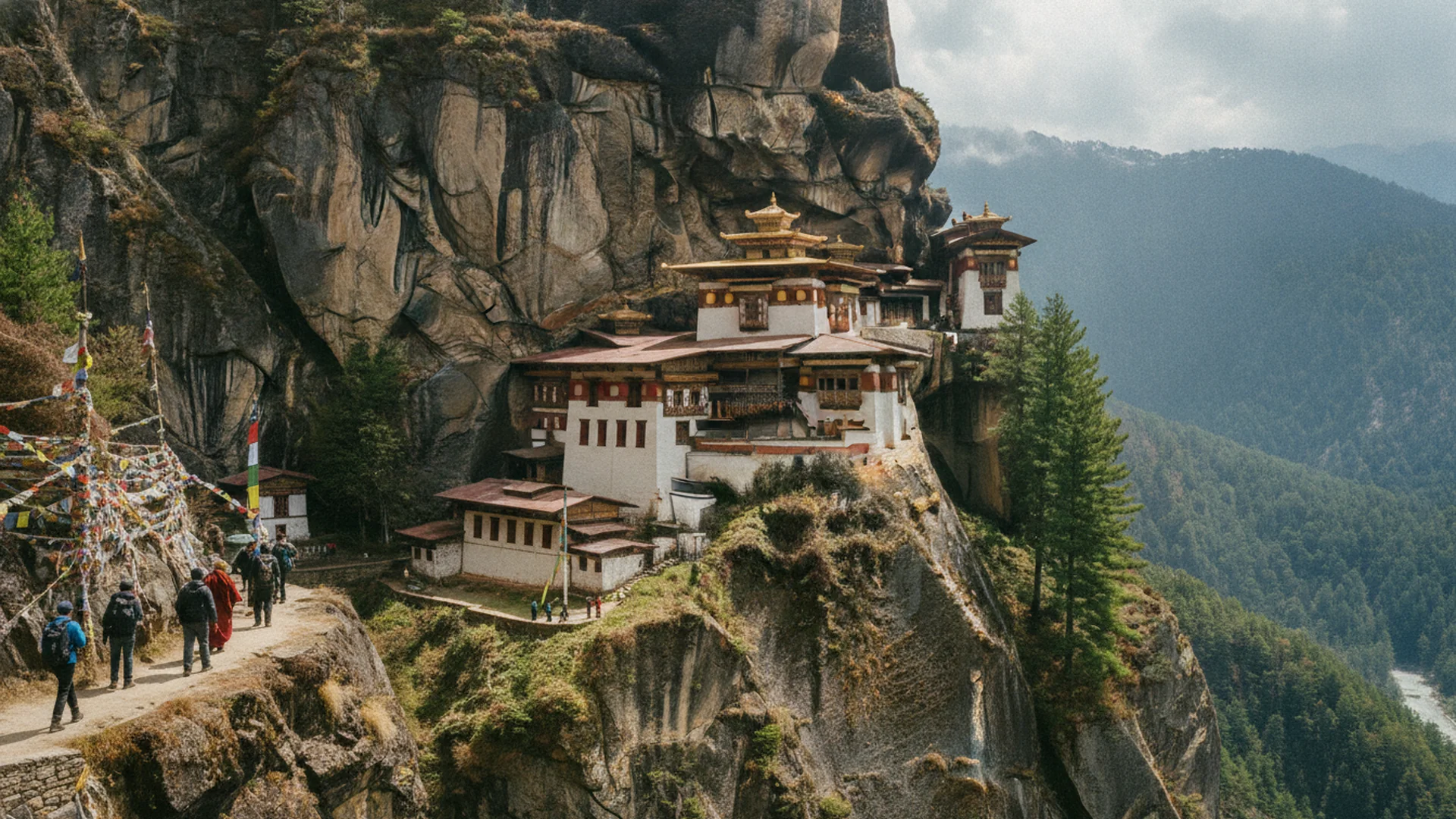
As the morning mist slowly dissolves, an ethereal vision emerges from the sheer granite cliffs of the Paro Valley: pristine white walls and gleaming golden roofs suspended between earth and sky. Paro Taktsang—universally revered as the Tiger’s Nest—is far more than a celebrated trekking destination; it is the spiritual heartbeat of the Dragon Kingdom. To ascend to its precipitous perch at 3,120 meters above sea level is to embark on a profound interior journey, guided by crisp mountain winds, the scent of wild pine, and an unbroken lineage of Buddhist devotion that spans over a millennium.
For the discerning global traveler, mastering the pilgrimage to Taktsang is an art of refined pacing. It demands an intentional choreography: setting out in the hushed stillness of dawn to outpace the world, matching one’s stride to the rhythm of the mountain, and surrendering entirely to a landscape where silence and sacred power reign supreme.
Deciphering the Legend of the Tiger’s Nest: Faith Carved into Granite
The history of Paro Taktsang is inextricably anchored in the esoteric traditions of Vajrayana Buddhism. According to eighth-century lore, Guru Rinpoche—revered across the Himalayas as the Second Buddha—manifested in a wrathful form upon the back of a soaring tigress, crossing from Tibet directly to this vertical precipice to subdue malevolent forces and consecrate the dharma. The monastery subsequently anchored itself around the sacred meditation cave where he practiced, transforming a treacherous abyss into an eternal sanctuary of spiritual awakening. The architecture, clinging precariously to the dark granite face, stands as a breathtaking testament to the courage and genius of Bhutanese master builders who forged sacred beauty from the raw elements of the wild.

The Geometry of Ascent: A Pilgrimage Toward Inner Stillness
The pilgrimage to Paro Taktsang begins on the valley floor at approximately 2,150 meters, culminating at the monastery’s threshold 3,120 meters above sea level across a round-trip distance of roughly 4.8 to 6 kilometers. The initial phase winds gently through dense, fragrant pine forests. For travelers wishing to conserve their energy for the technical climbs ahead, local equestrian support remains available for the first half of the ascent, carrying guests steadily upward to the forested ridge cafeteria. From this vantage point, the monastery appears suspended in breathtaking proximity. Beyond the terrace, the route transforms into a labyrinth of carved stone staircases plunging toward dramatic chasms and ascending past the mist of a sixty-meter waterfall, an ethereal veil of crystalline mountain water.
Sanctuary Etiquette: The Quiet Elegance of Inner Temple Reverence
Crossing the threshold into the innermost precincts of Paro Taktsang requires strict adherence to timeless protocols designed to preserve its sanctity. All electronic devices, cameras, and mobile phones must be securely checked at the designated security checkpoint prior to entry, as photography is strictly prohibited within the sacred shrines. Attire must reflect the utmost modesty and respect; both ladies and gentlemen are required to wear traditional national garments or attire that fully covers the shoulders and ankles. Wandering through dimly lit assembly halls illuminated by the golden glow of yak butter lamps, accompanied by the resonant drone of monks chanting ancient mantras, offers a transcendent, contemplative encounter that no photograph could ever capture.