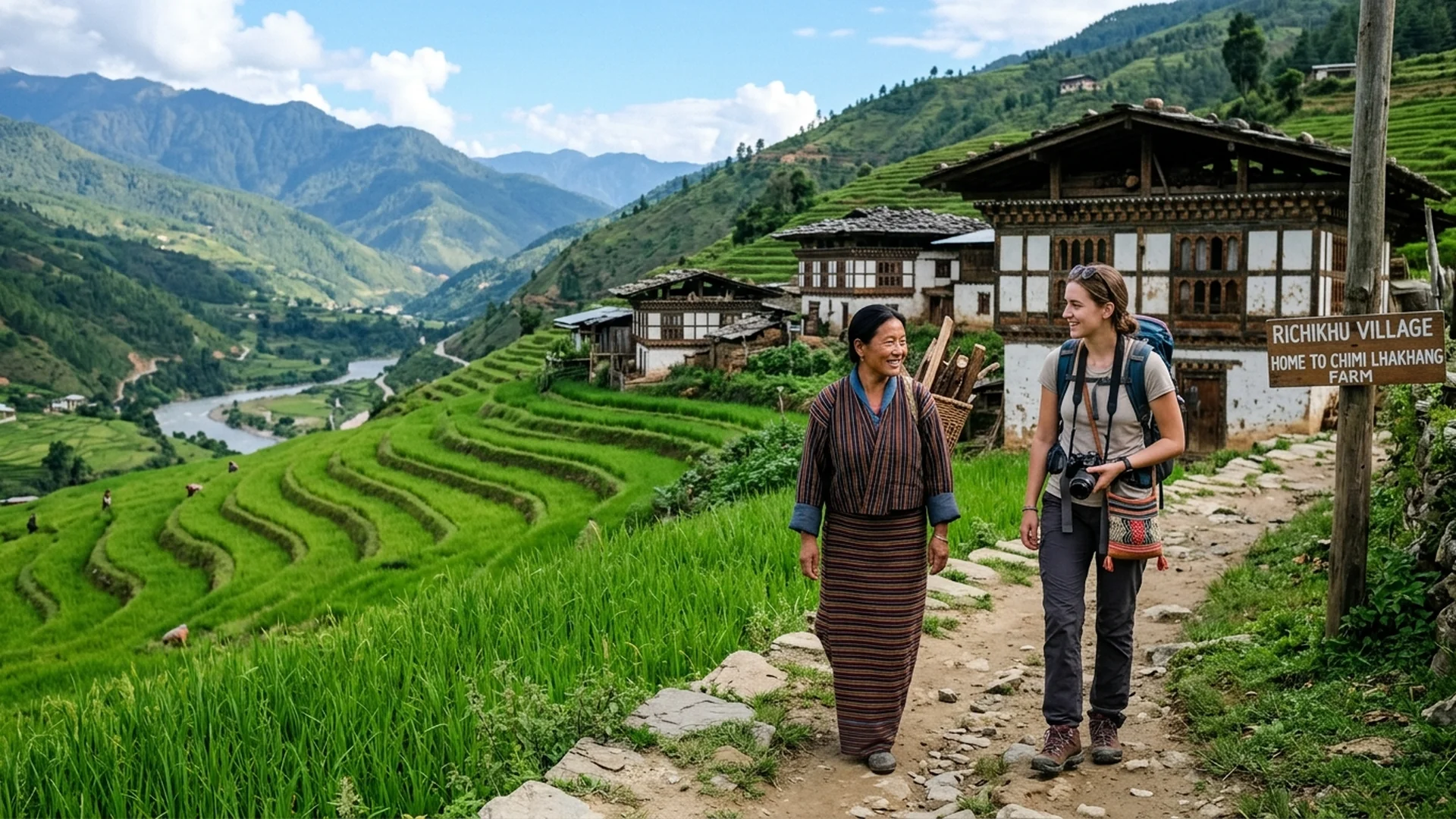
As golden light spills across the Himalayan crests, touching ancient forests and terraced agrarian fields, the wind whispering through the Wangdue Phodrang valley feels like an uncorrupted echo from antiquity. While travelers often chase the heavily charted landmarks, a quiet sanctuary exists where time has seemingly chosen to rest, leaving the hurried anxieties of the modern world far behind. Hidden with utmost humility amidst majestic nature, Richikhu Village opens its doors to those seeking the unadorned, profound spirit of authentic Bhutan.
Journeying to Richikhu is far more than a mere change of scenery; it is an invitation to decelerate the rhythm of existence until it aligns with the heartbeat of the earth. Here, towering skyscrapers and digital noise are replaced by organic farm plots, ancestral earthen dwellings passed down through generations, and the genuine, radiant smiles of villagers who live the philosophy of Gross National Happiness in its purest form. It is a rare experience that standard guidebooks frequently overlook, yet one that mindful travelers will carry with them forever.
The Timeless Art of Rammed-Earth Architecture: Building Without Nails
Upon first stepping into Richikhu Village, the most arresting feature is the residential architecture born of astonishing ancestral wisdom: the traditional Rammed Earth House. These dwellings are forged from clay, mud, and stone compressed densely within timber frameworks to create thick, earth-toned exterior walls that harmonize flawlessly with the surrounding topography. The true marvel lies in the structural integrity, achieved entirely without iron nails. These thick earthen walls provide remarkable natural insulation, warding off biting winter chills while maintaining a cool, breathable sanctuary during the height of summer. Traditional timber-carved windows, embellished with vibrant pigments according to ancestral cosmology, lend the structures a quiet, breathing vitality—a tangible testament to a profound understanding of natural materials and deep-rooted spiritual beliefs.
Organic Agriculture and the Philosophy of Gross National Happiness
Beneath the apparent simplicity of Richikhu lies a remarkably self-sustaining social ecosystem. The villagers live in intimate harmony with the seasonal agricultural cycle, cultivating rice, crisp greens, and heirloom grains through traditional organic methods entirely free of synthetic chemicals. Every drop of sweat shed upon these terraced fields reflects a deep reverence for the soil and all living things, honoring the foundational ethos of Gross National Happiness—a philosophy prioritizing holistic inner balance over material accumulation. To walk softly along the ancient irrigation ridges, breathe in the crisp, unblemished air, and converse gently with local farmers is to remember just how uncomplicated genuine contentment truly is.
Butter Tea and Hearthside Tales: The Heart of Bhutanese Hospitality
As mountain mists descend over the valley and evening temperatures gently tumble, receiving an invitation to sit by the hearth inside a Richikhu home offers an incomparable warmth. The comforting aroma of ‘Suja’, traditional salted butter tea, is served alongside roasted local puffed rice (Zow) in an atmosphere wrapped entirely in quiet fellowship. Even when language boundaries exist, genuine eye contact and shared smiles speak volumes. Elders often recount local legends, ancestral histories, and the nuances of Vajrayana Buddhist philosophy that infuse every facet of daily life, illuminating why this treasured kingdom is so often revered as the final sanctuary of happiness on earth.