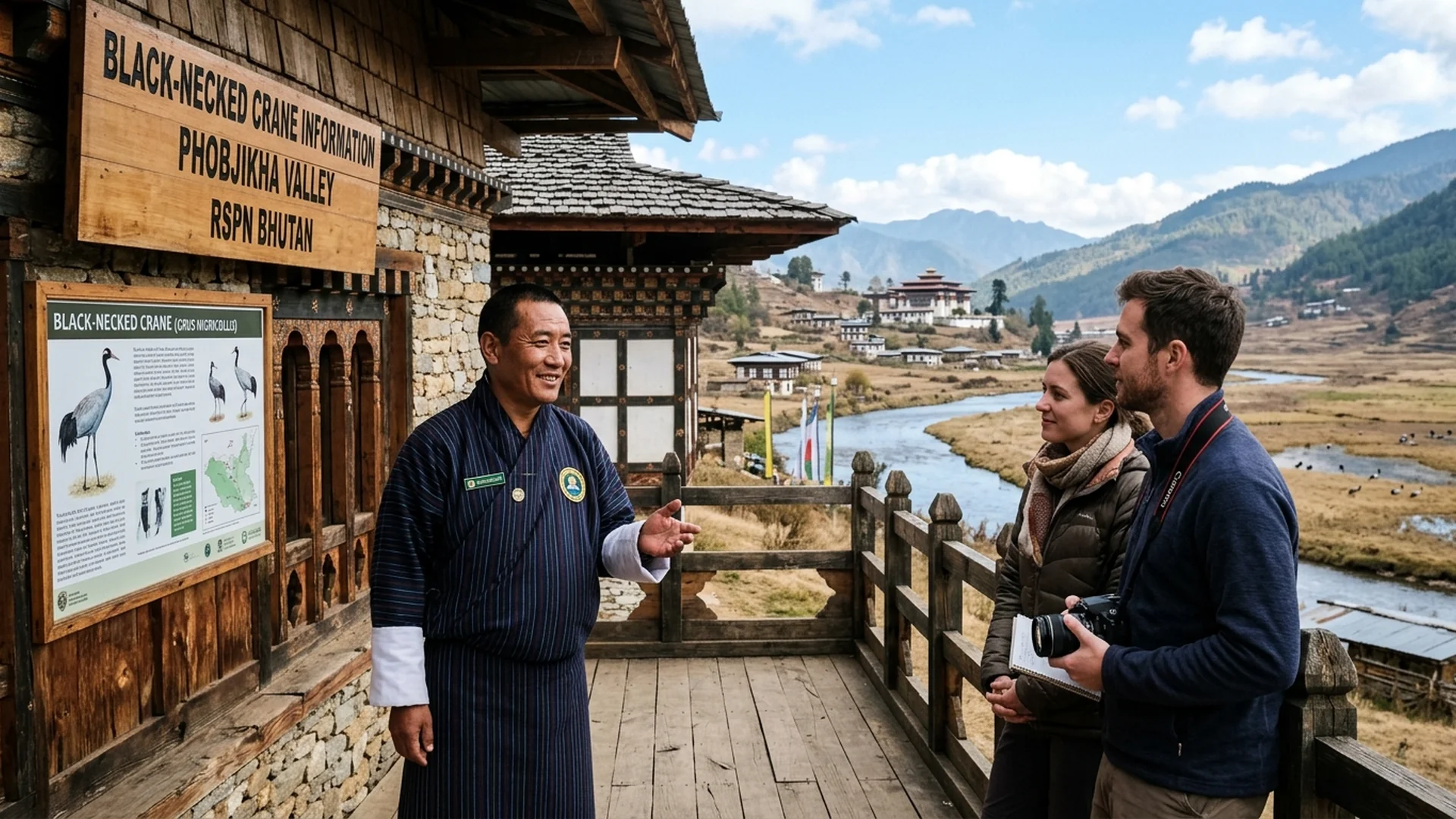
As winter’s first pristine frost crowns the majestic Himalayan peaks, the sprawling glacial expanse of the Phobjikha Valley does not merely welcome the changing season in deep silence. It heralds the arrival of extraordinarily revered guests that have journeyed across the roof of the world from the Tibetan plateau: the Thrung Trung Karmo, or black-necked cranes. The Bhutanese people do not view these magnificent visitors merely as migratory wildlife, but as living emblems of grace, unyielding loyalty, and the sacred spirit of this pristine realm.
Journeying to the Black-Necked Crane Information Centre transcends conventional wildlife observation. It is an intentional pilgrimage into a profound cultural dimension, where a rural community willingly foregoes industrial advancement and short-term economic gains to safeguard this protected wetland as an eternal sanctuary. This profound harmony between humanity and nature stands as a luminous, living testament to Bhutan’s philosophy of Gross National Happiness (GNH), proving that ecological preservation and mindful existence can thrive as one.
The Enchantment of Phobjikha Valley and the Crane’s Circumambulation
Nestled in the western reaches of Bhutan, the horseshoe-shaped Phobjikha Valley is embraced by wide, undulating meadows and dense evergreen pine forests. Every October, when the high Himalayan passes turn biting and austere, flocks of black-necked cranes descend to forage and winter here until March. One of the most enchanting phenomena witnessed by travelers and monks alike is the timeless tradition of the cranes: upon touching down in the valley, they invariably circle the historic Gangtey Goemba monastery three times, repeating the sacred circumambulation before departing back toward Tibet in spring. This profound, inexplicable spiritual bond leads local villagers to regard these birds as heavenly emissaries bearing peace, prosperity, and auspicious blessings to the soil.
The Information Centre: Architecture of Sanctuary and Ecological Enlightenment
Architecturally integrated into the surrounding sweeping landscape, the interpretation centre serves as an exemplary hub for ecological education and preservation. Inside, permanent exhibitions illuminate the biology, intricate migration patterns, and delicate ecology of the black-necked cranes. The crown jewel of the facility is its quiet observation room, outfitted with precision spotting scopes that allow visitors to admire the stately elegance of the birds from a respectful distance without intruding upon their feeding grounds. Guests also have the moving opportunity to learn about ‘Karma’, an injured crane finding refuge under expert care within the facility, serving as a gentle ambassador bridging human empathy and the natural world.
Community Stewardship and Conservation: A Lesson in Sacred Sacrifice
The true distinction of the Phobjikha Valley lies far beyond its biodiversity; it rests resolutely within the collective ethos of its guardians. The local community collectively resolved to bury all electrical grid lines entirely underground, ensuring that low-hanging cables would never obstruct or imperil the flight paths of the cranes. Agricultural practices throughout the valley are strictly regulated to protect the delicate hydrology of the wetland ecosystem, ensuring modern development never compromises ancestral heritage. Travelers privileged enough to walk these grounds absorb timeless lessons in sustainable stewardship that remain rare in our modern world.