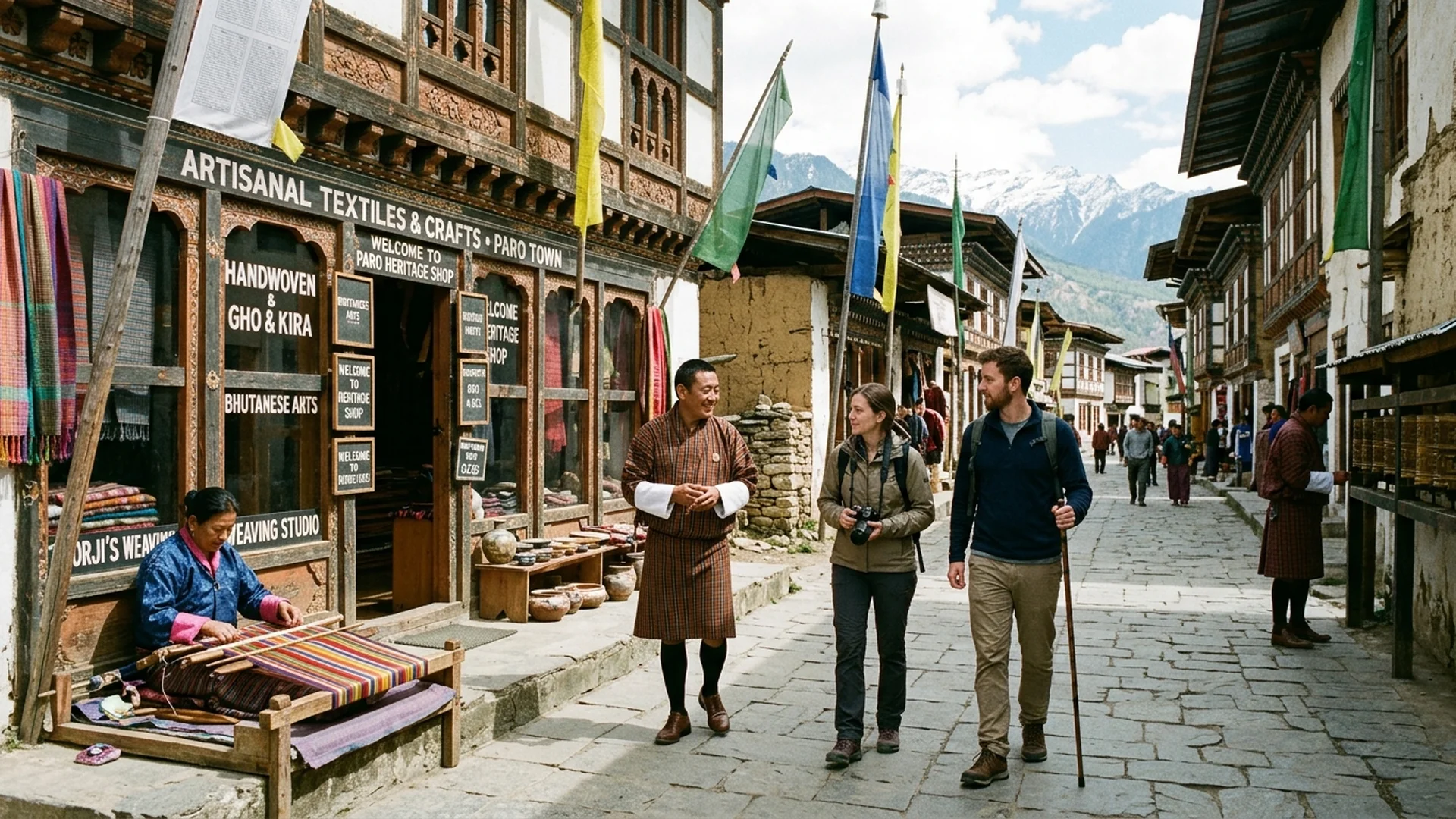
For most global travelers, Paro is remembered primarily as the breathtaking mountain portal to the Kingdom of Bhutan, or the essential basecamp before embarking on the revered trek to Tiger’s Nest Monastery (Taktsang Goempa). Yet if you gently decelerate your pace and allow your footsteps to wander along the principal thoroughfares of Paro Town, a profound realization unfolds. This charming valley settlement is far more than a mere transit point; it is a living museum preserving the delicate, enduring spirit of the Dragon Kingdom with exquisite grace.
The atmosphere of Paro Town is steeped in classic refinement. Pristine white two-story timber structures line both sides of the avenue, distinguished by intricately carved traditional wooden window frames known as rabsey, embellished with auspicious motifs and Mahayana Buddhist symbols. In the afternoon, when the warm Himalayan sunlight casts a golden glow across the timber facades, the subtle fragrance of sacred agarwood and local lemongrass essential oil drifts upon the breeze, mingling with the gentle, welcoming laughter of locals attired in the stately gho and kira.
Here lies a sanctuary where discerning collectors can discover museum-grade masterpieces: hand-loomed Yatras textiles from Bumthang, ancient filigree silver, delicate Dapa wooden bowls, and contemporary boutique cafes pouring artisanal roasted coffee and organic herbal infusions. Exploring Paro Town transcends ordinary sightseeing; it is an invitation to immerse oneself fully in an unhurried, deeply contemplative way of life.
Carved Timber Architecture: The Old Quarter as a Living Heritage
A leisurely stroll through Paro Town feels akin to stepping backward into an era where artistic craftsmanship was inseparably bound to daily existence. Every structure within the historic core is erected in strict adherence to traditional Bhutanese architectural codes, constructed entirely without the use of iron nails in the primary framework. They are celebrated for their ornate, curved wooden window frames—known as rabsey—and hand-painted natural mineral pigments depicting the Eight Auspicious Symbols (Ashtamangala) or mythical beasts drawn from Mahayana Buddhist cosmology.
As you meander along the main street, the seamless continuity between past and present becomes strikingly apparent. The lower levels of these timber buildings house boutiques and contemplative cafes, while the upper tiers remain ancestral family homes. In the afternoon, low-angled sunlight sweeps across the flat shingle roofs, casting dynamic shadows and rich textures against whitewashed masonry walls. The result is a streetscape of serene visual poetry, perfectly suited for architectural contemplation and meditative street photography.
A Connoisseur’s Guide to Fine Craftsmanship: Sourcing Treasures in Paro
Paro is widely esteemed as a preeminent center for Bhutanese fine arts. For the discerning collector, acquiring souvenirs in Paro offers an experience vastly removed from conventional retail; each artifact represents generations of refined ancestral wisdom. Boutique craft shops along the main avenue showcase hand-loomed Yatras—natural-dyed wool textiles featuring geometric motifs spun from yak and sheep fleece—alongside complex, highly prized Kishuthara weaves that require months of meticulous labor to complete.
Beyond textiles, the locality is renowned for antique silverwork, intricately pierced amulets (gau), polished Dapa wooden bowls carved from natural burls, and luminous Thangka paintings rendered in pure gold and mineral pigments by master artisans of the Zorig Chusum Institute. Furthermore, travelers will discover refined botanical aromatics, Himalayan lemongrass essential oils, and organic herbal soaps that embody the crystalline purity of the Bhutanese wilderness.
Boutique Cafes and Slow Living: Organic Infusions in the Himalayan Rhythm
Following an afternoon of architectural appreciation and craft discovery, retreating into one of the town’s thoughtfully designed local cafes provides an ideal moment of repose. Many of these establishments have been lovingly restored within historic timber buildings, harmoniously merging contemporary interior design with heirloom wooden furnishings. Here, one may sip freshly roasted Arabica coffee or organic ginger and saffron herbal infusions harvested directly from the high-altitude valleys.
Within these welcoming spaces, soft acoustic folk melodies mingle with the gentle hum of conversation between residents and global travelers alike. The enveloping ambiance encourages one to cast aside urgency, surrendering entirely to the rich, comforting aromas of steaming momos (Bhutanese dumplings) or freshly churned yak cheese. Independent exploration of this neighborhood unlocks a profound sense of tranquility and enduring creative inspiration.
Evening Twilight: The Romantic Metamorphosis of the Valley
As dusk descends and the sun slips below the jagged horizon of the Himalayan range, Paro Town undergoes a poetic atmospheric transformation. The warm, amber illumination of lanterns from doorways and shopfronts awakens, casting soft reflections against ancient timber walls. The main avenue, bustling during daylight hours, grows hushed and contemplative, while a crisp alpine breeze drifts in from the nearby Paro Chhu river.
This twilight hour provides the supreme occasion for a restorative walk toward the historic cantilevered wooden bridge known as Nyamai Zam, situated just moments from the town center. From this vantage point, one gazes out toward the majestic fortress-monastery of Paro Rinpung Dzong, illuminated brilliantly against the darkening hillside. This serene nighttime panorama serves as the quintessential culmination of an immersive journey into the spirit of Paro.