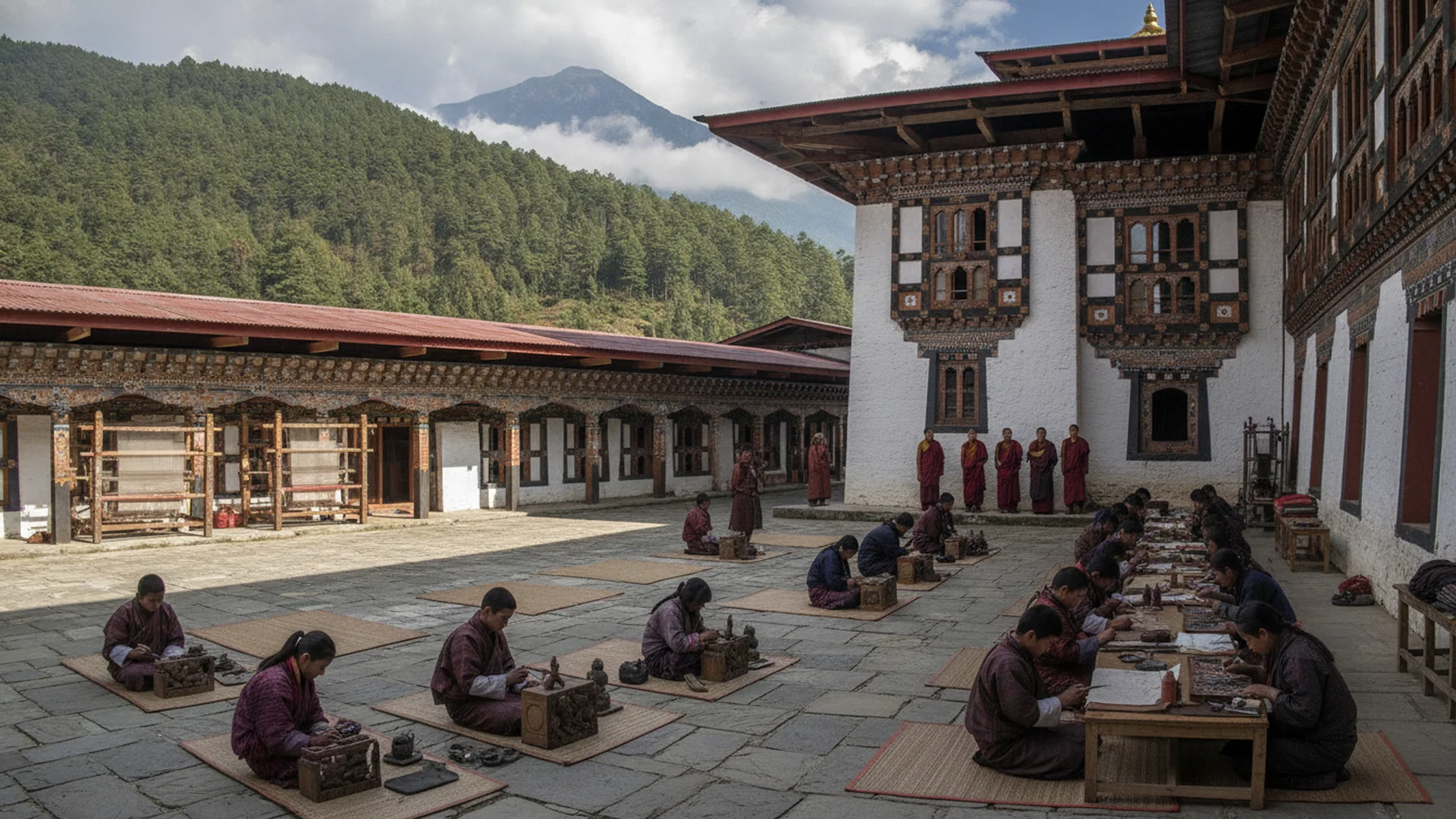
Amidst the high-altitude valleys of Thimphu, the gentle tapping of chisels, the earthy aroma of natural mineral pigments, and a profound, enveloping silence bear witness to a living heritage. Here, cultural legacy is not merely preserved behind museum glass; it breathes, evolves, and flourishes at the National Institute for Zorig Chusum.
This sanctuary transcends the typical tourist itinerary. It operates as a living temple of transmission, where young Bhutanese spend years perfecting their craft across the thirteen traditional arts known as Zorig Chusum. Every stroke and sculpted contour is far more than a visual spectacle—it is a moving prayer, executed through brush, chisel, and clay, binding Buddhist devotion seamlessly with aesthetic grace.
Zorig Chusum: Decoding the Thirteen Arts of the Thunder Dragon Kingdom
The term ‘Zorig Chusum’ represents the pulsating heartbeat of Bhutanese identity. These thirteen traditional crafts encompass every conceivable dimension of daily existence and sacred architecture—ranging from the meticulous rendering of Thangka paintings and intricate woodcarving to clay sculpting, metal casting, textile weaving, and gilded lacquerware.
In earlier eras, this profound knowledge was passed down strictly within families or through royal master-apprentice lineages. As the modern world accelerates, the threat of losing these ancestral arts prompted the royal government to establish this institution. Here, systematic education thrives without ever compromising the foundational spiritual principles of experiential learning and profound scriptural understanding.
Inside the Living Classroom: Where Brushstrokes Meet Breath
Crossing the threshold into the institute’s ateliers feels like stepping into a timeless sanctuary. Students attired in traditional national dress sit quietly at their workbenches. Some guide fine-tipped brushes across canvas, executing the precise geometric details of deities with millimeter accuracy—a mastery requiring years of drawing straight lines before touching a single drop of pigment.
Down the hall, a rhythmic tapping echoes from the woodcarving studio, where complex auspicious motifs and celestial flora gradually emerge from fragrant timber. The atmosphere is steeped in the scent of cedar and earth. Every motion reflects unwavering perseverance and patience, qualities that the instructors prize far above mechanical skill alone.
The Aesthetics of Devotion: Art Free from Ego
For discerning travelers seeking intellectual depth, one striking reality defines the institute: Bhutanese artists never sign their work. These creations are never fashioned to broadcast personal renown or inflate the ego of the creator. Instead, they serve as sacred bridges connecting the mortal realm to the divine.
The creative process is treated as a form of active meditation. Artisans must maintain purity of mind and intention while working, infusing every molecule of their artwork with positive energy and tranquility. This infuses Bhutanese craftsmanship with a subtle, magnetic gravity that effortlessly calms the minds of all who behold it.