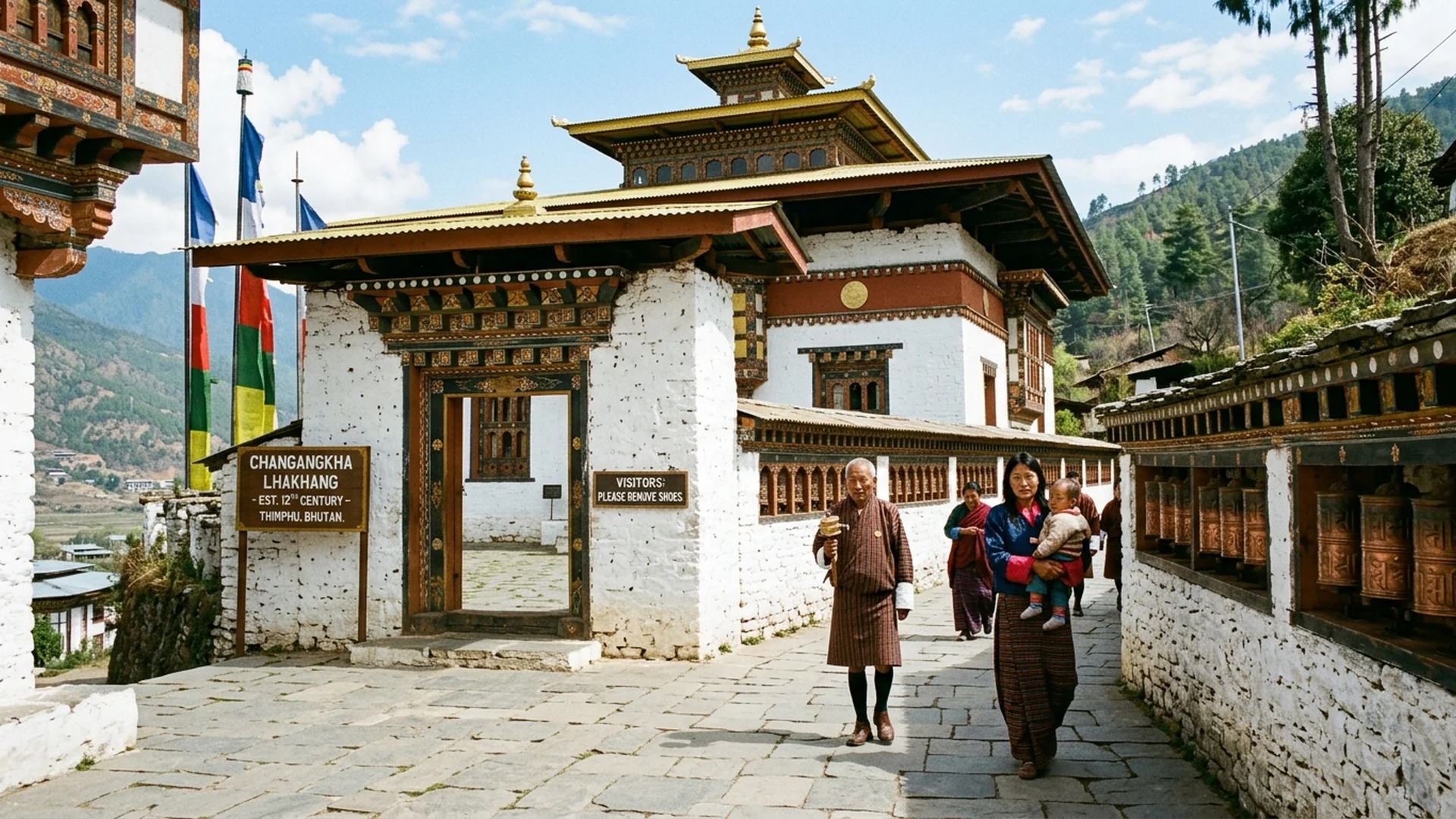
Amidst the soft mountain mists drifting across the high-altitude valley, resonant chants echo from the stone ridges above. The gentle coos of newborn infants blend with the rhythmic, deep-toned hum of turning prayer wheels—an eternal bridge connecting the very dawn of human life with an unbroken spiritual lineage spanning more than eight centuries. This is the profound allure of Changangkha Lhakhang, a sanctuary that transcends mere historic monument status to serve as the beating heart of Thimphu, where every family in the valley initiates their generational journey on these very flagstones.
Tracing its origins back to the 12th century, this sacred landscape was forged during an era when Bhutanese spirituality was newly blossoming into a vibrant tapestry of faith. Founded by an accomplished master lama from Tibet, crossing the threshold of this sanctuary is not merely an architectural excursion, but a deliberate entry into a dimension where devotion, domestic life, and Himalayan gentleness exist in timeless harmony.
Twelfth-Century Roots: Footsteps of Lama Phajo Drugom Zhigpo
The chronicle of Changangkha Lhakhang commences around 1216 AD, when the revered Drukpa Kagyu master, Lama Phajo Drugom Zhigpo, traversed the high Himalayan passes to establish his spiritual stronghold in the Thimphu valley. Recognizing the profound geomantic power of this prominent ridge, he consecrated the site to safeguard the inhabitants from malevolent forces. The original architecture reflects classic fortress-like principles, merging rugged masonry walls with delicate woodwork and centuries-old mural artistry. Faded yet radiant depictions of protective deities and sacred mandalas continue to narrate ancient cosmological teachings, testifying to the exceptional mastery of medieval artisans who poured their absolute devotion into every timber and stone.
First-Light Devotion: Life Beginning Under Changangkha’s Aegis
What distinguishes Changangkha Lhakhang from other sacred sites across the kingdom is its deeply intimate role as an anchor for Thimphu’s young families. Every morning, new parents wrapped in traditional woven textiles ascend the stone pathways to present their infants for a vital naming and protection ceremony. They seek the benevolence of Genyen Domtsangpa, the fierce yet protective deity of the temple who watches over children and youth. The resident lama performs sacred rites to ward off negative energies, confers an auspicious name drawn from sacred scriptures, and bestows a protective amulet. This timeless ritual weaves newborns into the fabric of the community and faith from their very first days.
Sacred Architecture and the Thousand-Armed Protector
Passing through the heavy wooden doors into the inner sanctum, visitors are immediately embraced by the rich, warming scent of burning yak butter and ancient incense. The principal deity enshrined within is Chenresig, the eleven-faced, thousand-armed Bodhisattva of Compassion, meticulously sculpted according to classical Himalayan iconography. Countless eyes gaze downward with boundless, all-encompassing mercy. Surrounding the altar, pilgrims revolve massive golden prayer wheels while softly chanting the universal mantra, Om Mani Padme Hum. Outside, the open circumambulation walkway frames sweeping views of the Thimphu valley floor below, where winding rivers trace emerald fields and quiet hamlets.