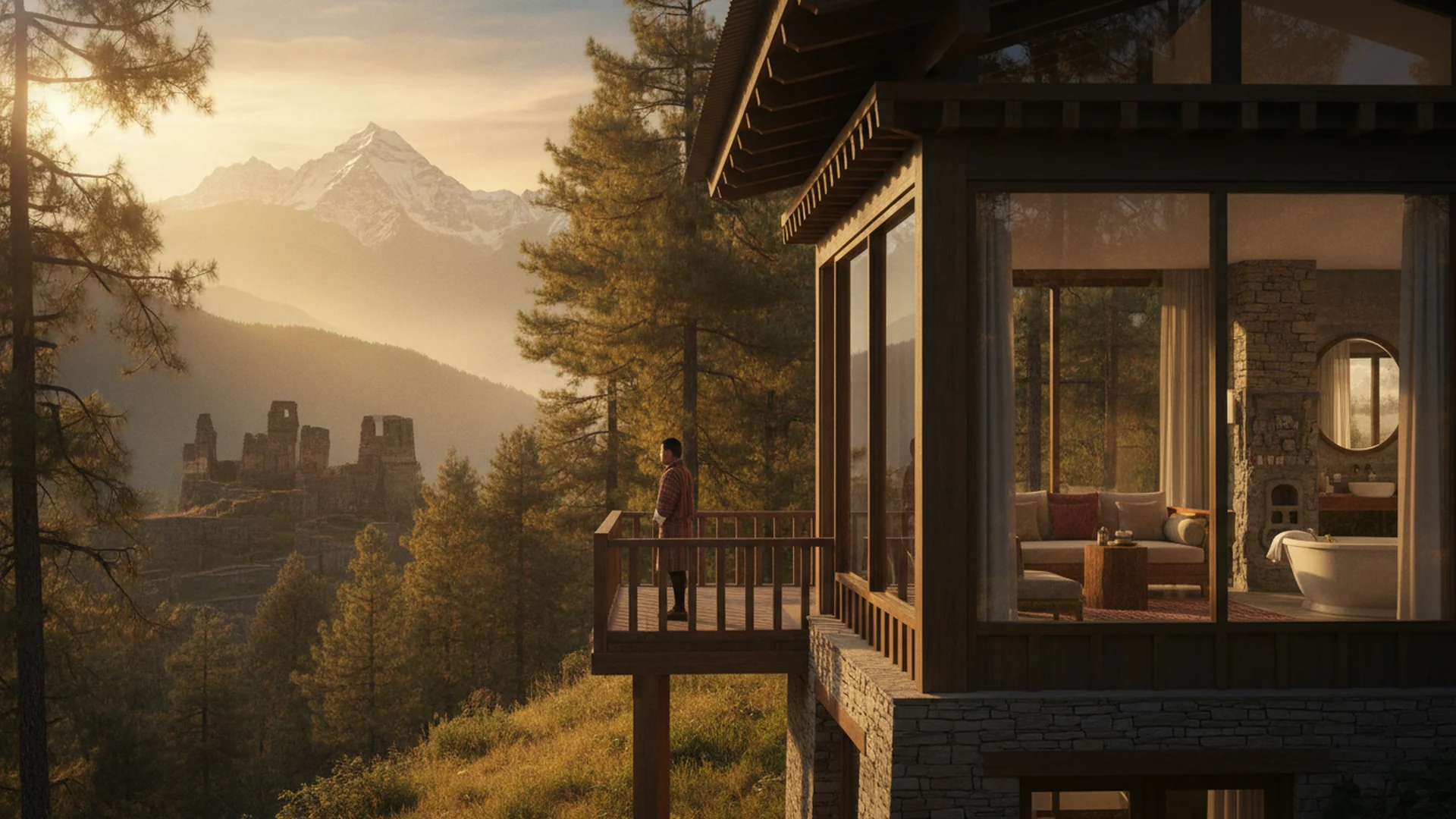
As the morning mist gently unfurls over secluded valley walls and the distant, melodic chime of an ancient cliffside monastery bell drifts upon the crisp mountain air, the essence of travel gracefully shifts from mere sightseeing to a profound return to the inner self. The Dragon Kingdom of Bhutan does not greet its guests with the jarring spectacle of neon or noise; rather, it enfolds them in a powerful, restorative silence. In a realm where time itself appears to decelerate, ultra-luxury hospitality has redefined modern opulence through the visionary concept of the ‘Valley-to-Valley Journey.’ Here, legendary sanctuaries such as Amankora and Six Senses transcend traditional accommodation to become destinations in their own right, where vernacular architecture, spiritual awakening, and untamed nature seamlessly converge.
Traversing Bhutan’s dramatic, intricately folded topography—from Paro and Thimphu to Punakha and Gangtey—is far more than a simple change of lodging. It is an editorial narrative woven through architectural forms inspired by ancestral fortress-monasteries, or dzongs, deftly re-imagined with minimalist contemporary restraint. These refined retreats serve as ethereal bridges connecting the frantic outside world with the unadorned truths of the high Himalayas, inviting discerning travelers to absorb local life, spiritual devotion, and sublime landscapes through a lens of uncompromising elegance.
The Multi-Lodge Circuit: The Art of Valley-to-Valley Travel with Amankora and Six Senses
The philosophy of the ‘Valley-to-Valley Journey’ forms the beating heart of an elite sojourn through Bhutan via legendary hospitality houses like Amankora and Six Senses. Amankora, translating poetically to ‘peaceful circular dwelling,’ is thoughtfully dispersed across five foundational valleys: Paro, Thimphu, Punakha, Gangtey, and Bumthang. Each distinct location is meticulously calibrated to its specific topography, whether it is dark-timbered gable suites quietly nestled within a fragrant apple orchard in Paro or expansive residences framing terraced paddy fields and glacial rivers in Punakha.
Simultaneously, Six Senses Bhutan articulates an equally visionary ethos under the guiding theme of ‘Five Lodges, One Journey,’ wherein every property projects a distinct persona and architectural narrative. Consider the dramatic ‘Palace in the Sky’ perched high above Thimphu to offer sweeping panoramas of the capital, or the immersive ‘Forest Oases’ in Gangtey, which place guests in intimate proximity to migratory black-necked cranes traversing the vast marshlands. Traversing between these refined sanctuaries yields an evolving panorama of climate, architectural detail, and cultural strata that a single stationary hotel could never replicate.
Architecture of Sustainability: Where Contemporary Design Meets Ancestral Soul
Perhaps the most astonishing achievement of Bhutan’s ultra-luxury tier is its effortless harmonization of world-class creature comforts with uncompromising environmental and cultural mandates. The architecture of these sanctuaries deliberately eschews foreign aesthetics that might disrupt the visual harmony of the sacred landscape. Instead, they champion native timber, rough-hewn granite, and generational masonry techniques, pairing them with soaring floor-to-ceiling glass that invites the majestic exterior wilderness directly into the living space.
Sustainability is woven into the very fabric of daily operations, from eco-conscious radiant floor heating and sophisticated graywater recycling systems to partnerships with local agrarian communities supplying organic produce to the chef’s table. Design is thus elevated beyond mere visual pleasure; it becomes an active expression of profound reverence for the sacred earth and its surrounding communities, fully aligned with the nation’s guiding philosophy of Gross National Happiness (GNH).
Spiritual Wellness and Healing: Restorative Sanctuaries in the Land of the Thunder Dragon
Spiritual rejuvenation represents the deepest, most transformative dimension of residing within these premier retreats. Properties like Amankora and Six Senses have curated wellness programs that draw directly upon ancient Bhutanese traditional medicine, seamlessly blending it with contemporary therapeutic mastery. A crowning highlight is the traditional Bhutanese hot stone bath, or dotsho, where river stones fired over aromatic pine logs until incandescent are submerged into wooden troughs infused with local medicinal artemisia leaves, melting away deep-seated muscular tension in the crisp valley air.
Furthermore, guests are granted rare opportunities to engage in private guided meditation, yoga, or philosophical dialogues with resident monks in centuries-old sanctuaries. Sitting in silent contemplation amidst the soft flicker of butter lamps and resonant ritual chanting within a consecrated temple quietens the restless mind, offering travelers the most priceless gift this rarefied landscape can bestow: absolute inner stillness.