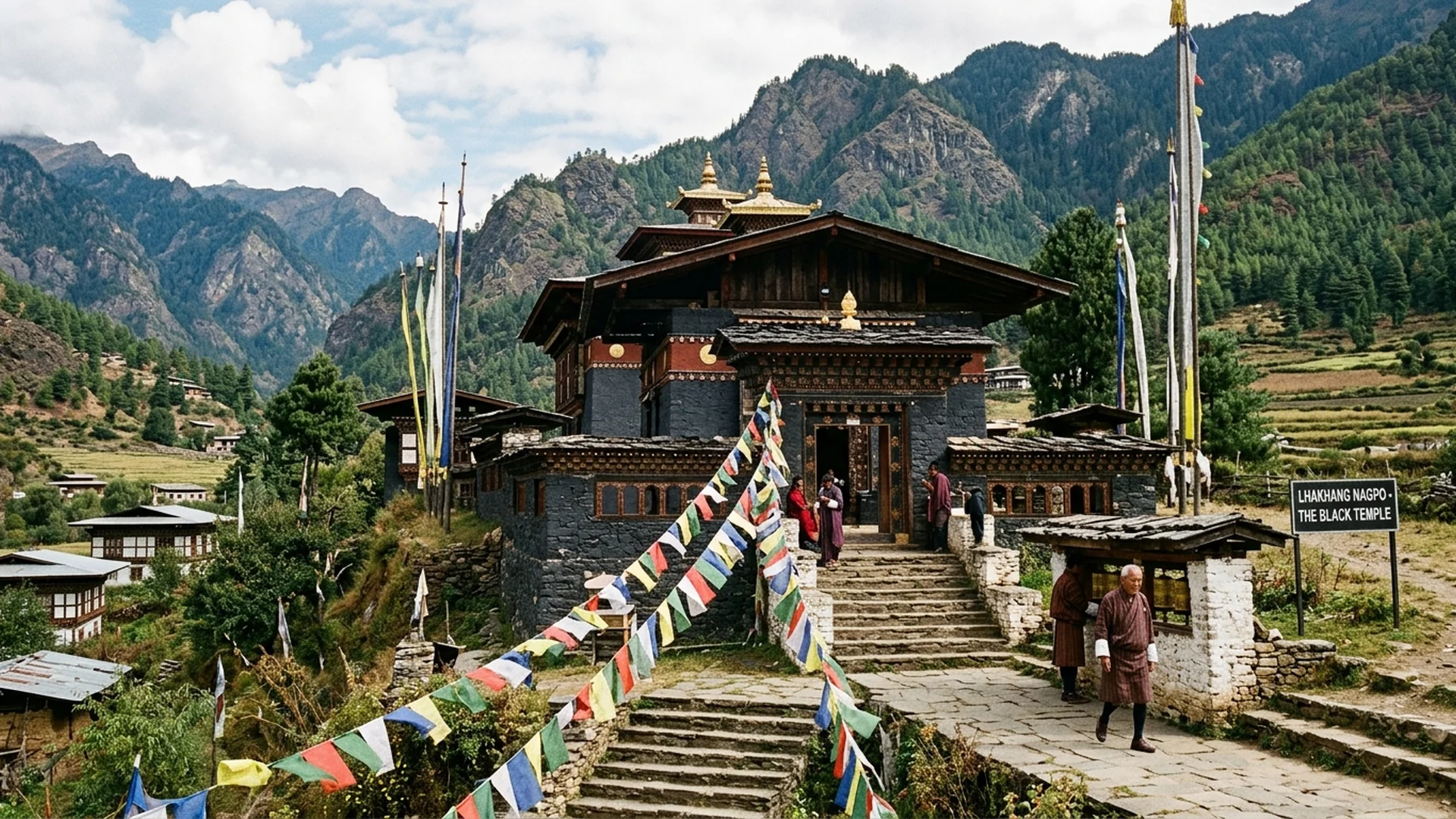
As morning mist weaves through the dense pine forests of the Haa Valley—a pristine and unhurried sanctuary in the rugged southwestern reaches of Bhutan—the ancient whispers of a thousand years resonate through the alpine air. This is the realm of Lhakhang Nagpo, or the ‘Black Temple,’ an archaic sanctuary established in the seventh century by the formidable Tibetan Emperor Songtsen Gampo. More than a mere monument of faith, this sacred site serves as a portal connecting humanity to ancient mythology, primeval natural forces, and the unblemished spiritual heritage of the Himalayas.
Arriving at this distinguished Bhutanese heritage site feels akin to decoding an arcane historical manuscript. Far removed from the well-trodden tourist corridors, the Haa Valley welcomes discerning travelers with raw, unvarnished beauty. Behind the weathered rammed-earth walls and timeworn wooden pillars of the Black Temple lie centuries of lore, recounting the subjugation of restless spirits and the unyielding devotion that has anchored this mountainous realm through the ages.
1. The Geometry of Subjugation: The Legend of the Black Dove and the 108 Sanctuaries
The historical lineage of Lhakhang Nagpo is profoundly intertwined with the monumental reign of Emperor Songtsen Gampo, the sovereign who first ushered Buddhist philosophy into Tibet. According to Himalayan lore, the primordial terrain of the high mountains was once restrained by a supine ogress whose body stretched across Tibet and its surrounding frontiers. To pacify these turbulent energies and harmonize the elemental forces of the earth, the emperor decreed the simultaneous construction of 108 temples across his domains within a single day. A sacred black dove was dispatched to designate the precise foundation point for the Black Temple in the Haa Valley. Consequently, the sanctuary transcends conventional religious architecture; it functions as a spiritual acupuncture point, pressed deep into the earth’s meridians to protect the land and radiate compassion to all sentient life.
2. Secrets Beneath the Floorboards: The Subterranean Spring and Its Guardian Spirits
What continually captivates historians and scholars of Tibetan-Bhutanese culture within Lhakhang Nagpo is the hidden marvel residing beneath its foundations. Within the sacred assembly hall, a specialized opening grants a glimpse into a natural subterranean spring flowing silently beneath the temple’s base. For generations, Bhutanese tradition has held that this underground water source is not merely hydrological, but rather the sacred domain of Tshomen—water nymphs and protective feminine deities safeguarding the valley. The faint, echoing murmur of water filtering through ancient stone beneath the prayer hall evokes a profound reverence for animist traditions harmoniously integrated with Buddhist cosmology, imbuing the sanctuary with an atmosphere of awe-inspiring mysticism.
3. The Dual Pillars of Faith: The Twin Sanctuaries Guarding the Haa Valley
Any comprehensive contemplation of the Haa Valley must account for the profound symmetry shared between Lhakhang Karpo (the White Temple) and Lhakhang Nagpo (the Black Temple), positioned mere distances apart. These twin sanctuaries operate as spiritual yin and yang, jointly stabilizing the peace and agrarian prosperity of the valley. While the White Temple was founded under the augury of a white dove, symbolizing illumination and auspicious beginnings, the Black Temple embodies depth, enduring stability, and an intimate connection to chthonic roots. Traversing the footpaths that link these two sacred structures amid terraced barley fields and soaring mountain backdrops offers an authentic masterclass in mindful, high-net-worth cultural exploration.