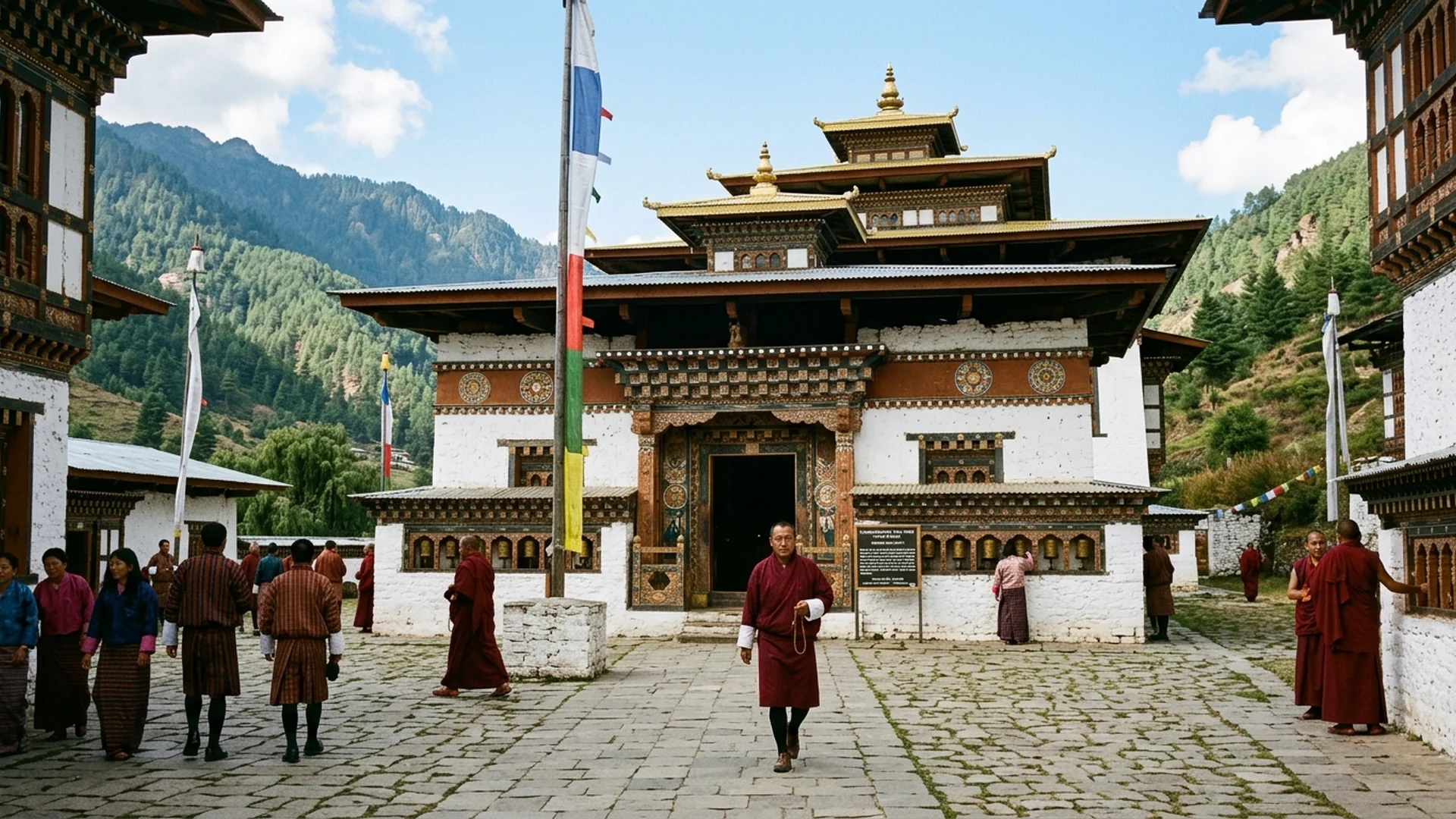
As the morning mist gradually lifts from the towering peaks of the Meri Puensum mountain range, the Haa Valley—a pristine enclave hidden behind the Himalayan barrier—reveals its untouched splendor. This is not a conventional thoroughfare crowded with restless itineraries, but a consecrated landscape where time unfurls at a meditative pace. Amidst whispering pine forests stands Lhakhang Karpo, or the White Temple, an ancient royal sanctuary that has braved Himalayan winters for over a millennium. More than a mere architectural monument, the temple serves as a living chronicle of faith, visionary lore, and profound stillness that discerning travelers seeking deeper meaning must experience at least once in a lifetime.
The Legend of the White Dove and Seventh-Century Roots
The chronicle of Lhakhang Karpo begins in the seventh century during the reign of Emperor Songtsen Gampo of the Tibetan Empire, who envisioned constructing 108 temples across the Himalayan frontier to pin down a supine demoness obstructing the spread of the Dharma. According to legend, the emperor released two doves—one white and one black—to divine auspicious sites for foundational sanctuaries. The white dove settled in the secluded Haa Valley, giving rise to Lhakhang Karpo, while the black dove alighted nearby to mark the ground for Lhakhang Nagpo, the Black Temple. This twin foundation established an energetic anchor of compassion and wisdom across the rugged terrain, forming a spiritual bedrock that endures to this day.
Royal Restoration and Master Craftsmanship
Despite weathering a thousand years of mountain elements, Lhakhang Karpo retains an extraordinary elegance, thanks to comprehensive restorations guided by the royal court of Bhutan. The main structure features pristine whitewashed walls contrasted with brightly painted window frames and intricately carved wooden pillars executed in classical Tantric motifs. Within the sanctuary, the air is thick with the scent of smoldering incense and burnt yak butter. Every lintel and beam testifies to the mastery of the Zorig Chusum (the traditional arts and crafts of Bhutan), showcasing ancient joinery achieved entirely without iron nails. Interior walls glow with restored murals of Buddhas, bodhisattvas, and protective deities, executed with a delicacy that imbues every square inch with sacred atmosphere.
Ap Chhundu: The Guardian Deity of the Haa Valley
The Haa Valley maintains a profound reverence for animistic spirits and mountain ecology, and Lhakhang Karpo serves as the earthly sanctuary for Ap Chhundu, the supreme guardian deity of the region. Local residents hold deep devotion for this protector of the land, its rivers, and its people. Belief holds that Ap Chhundu resides upon a nearby consecrated summit, with Lhakhang Karpo acting as a bridge between the mortal realm and divine forces. Entering this space transcends architectural appreciation; it is an invitation into an atmosphere of quiet reverence, where the rhythmic chanting of monks and the deep reverberation of bronze bells invite the wandering mind to settle deeply inward.