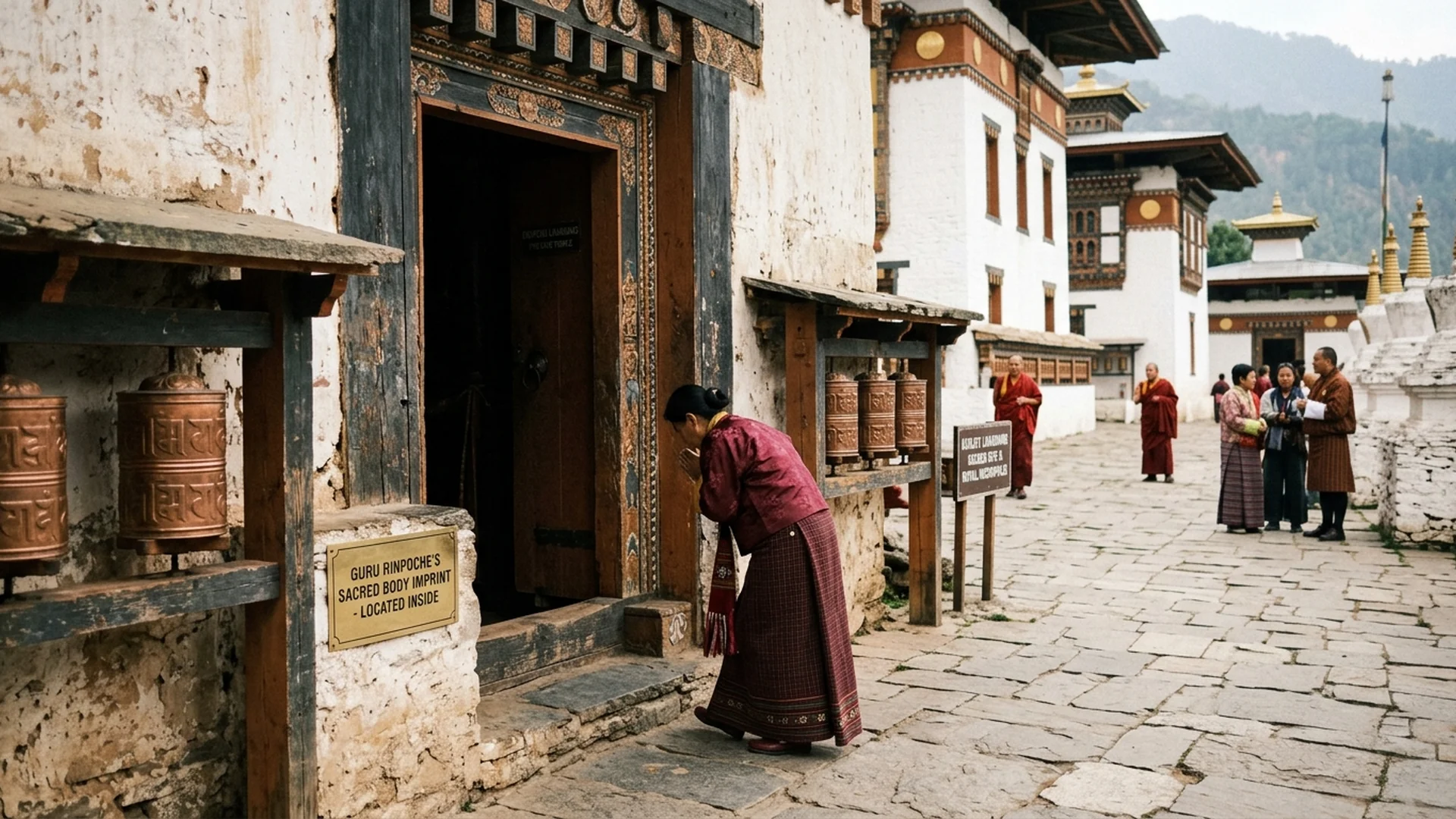
As the morning mist gradually lifts above the pine forests and expansive meadows of the Bumthang Valley—one of Bhutan’s most ancient and spiritually charged sanctuaries—a quiet whisper from the eighth century beckons travelers across the threshold of time. Kurjey Lhakhang stands as a supreme focal point of Vajrayana devotion. It is far more than a conventional monastic complex; it is a profound repository of living miracles that fundamentally transformed the spiritual landscape of an entire nation.
Approaching Kurjey Lhakhang through the lens of elevated cultural travel is akin to opening a living manuscript of history. The gentle aroma of burning juniper, curling incense smoke, and the deep, resonant chanting of resident monks merge into an atmosphere of transcendent serenity unlike any other. Framed by tranquil mountain vistas and the crystalline waters of the Chamkhar Chhu river, this sanctuary invites the discerning seeker to contemplate the subtleties of Himalayan Buddhist art, the mysteries of sacred caves, and the enduring legacy of enlightened masters in human form.
The Eighth-Century Legend: The Birth of Kurjey and Guru Rinpoche’s Imprint
The narrative of Kurjey Lhakhang unfolds in the eighth century, when Guru Rinpoche—also known as Padmasambhava, the revered master who brought Vajrayana Buddhism to the Himalayan realms—journeyed to the Bumthang Valley. He came at the urgent behest of King Sindhu Raja, ruler of the Jakhar realm, who was gravely ailing after a conflict with powerful local deities and territorial spirits.
Moved by immense compassion and wielding extraordinary spiritual mastery, Guru Rinpoche entered deep meditation within a rocky cavern, engaging in a profound spiritual contest with the unseen forces. To subdue and bind the malevolent energies, he pressed his physical form directly against the cave wall, leaving an astonishing and indelible body imprint—‘Kur’ signifying body, and ‘Jey’ signifying print. From that moment onward, the sacred site became known as Kurjey. This miraculous impression remains not merely a historical relic of devotion, but an active focal point of blessing that Bhutanese faithful believe continues to radiate protection and benevolence to all who draw near.
Architecture of the Three Royal Lhakhangs: A Legacy Across Time
The sprawling sacred domain of Kurjey Lhakhang encompasses three majestic temples standing in harmonious alignment, each bearing distinct architectural character and historical significance:
- The Oldest Temple: Built directly over the sacred cave enclosing Guru Rinpoche’s body imprint, this foundational sanctuary is dim, atmospheric, and redolent of yak butter offerings. At its sanctum sits the primary statue of Guru Rinpoche, before which pilgrims gather in silent, devoted contemplation.
- The Middle Temple (Ugyen Khangzu): Commissioned in 1900 by Gongsa Ugyen Wangchuck while he still served as the Penlop of Trongsa, prior to his ascension as the first hereditary monarch of the Wangchuck dynasty. This temple is celebrated for its exquisite wall murals and powerful guardian deity sculptures.
- The Third Temple (Zangto Pelri Lhakhang): Erected in 1984 by the Queen Mother Ashi Kesang Wangchuck as an offering for the peace and spiritual well-being of the nation. This structure visually interprets Zangto Pelri—the celestial copper-colored mountain paradise of Guru Rinpoche—through masterful woodwork and classical Buddhist iconography.
The Royal Necropolis and the 108 Chortens: Where Dynasty Meets Eternity
Beyond its profound religious stature, Kurjey Lhakhang serves as a deeply revered Royal Necropolis, housing the sacred relics and memorial chortens (stupas) of the first three kings of the Wangchuck dynasty, sovereigns who successfully steered the nation toward modern unity, peace, and preservation.
The complex is embraced by a pristine white perimeter wall lined with 108 traditional Bhutanese chortens, standing in immaculate symmetry against a backdrop of towering pines and crystalline skies. These monuments serve not only as a striking visual cadence for visitors, but as a symbolic ward against negative forces and a timeless reminder of impermanence within the wheel of existence, all held within an ambiance of profound reverence.