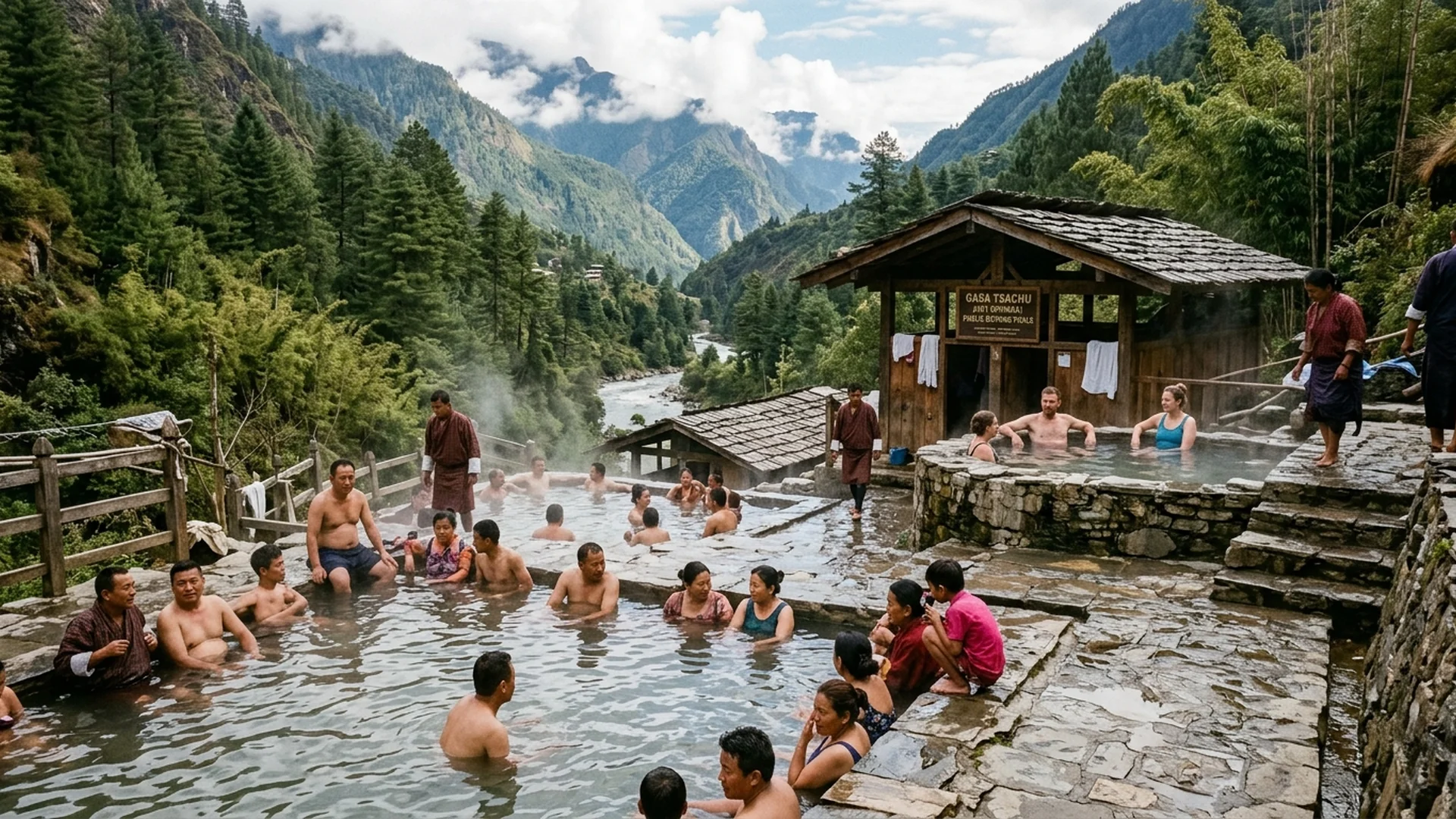
Deep within the northern Himalayan embrace of Bhutan, at an altitude surpassing 2,100 meters above sea level, the tranquil murmur of the Mo Chhu river flows alongside heavy mist drifting quietly over ancient pine forests. This is far more than a mere resting place; it is a sanctuary of physical and spiritual restoration known as Gasa Tsachu, where subterranean mineral waters and centuries of devout faith merge into a single, living tradition.
Journeying to Gasa Tsachu is not merely an excursion into a natural thermal spa. It is an unhurried pilgrimage retracing the sacred footsteps of Zhabdrung Ngawang Namgyal, the unifier of Bhutan, who traversed mountain passes from Tibet in the seventeenth century to soothe his travel-weary joints in these very waters. Fused with thirteenth-century legends of a master mystic scattering 128 medicinal herbs across the earth, these boiling mineral springs emerged from the deep terrain like liquid ambrosia gifted to all travelers.
Amidst the varying temperatures of stone-rimmed pools resting quietly against the riverbank, visitors encounter an unadorned, living tapestry of Bhutanese culture. Crimson-robed monks, faithful village elders, and nomadic herdsmen from the high-altitude plateaus of Laya descend from the snow-crowned peaks to submerge themselves in these sacred thermal waters, rejuvenating their vitality under the imposing, reverent shadow of the Gasa Dzong fortress.
A Legacy of Faith and the Legend of 128 Medicinal Herbs
According to traditional Bhutanese chronicles, the origin of Gasa Tsachu is woven into two deeply sacred narratives. The first recounts the thirteenth-century master mystic Drupthop Terkhungpa, who scattered 128 healing herbs across the landscapes of Gasa, giving rise to 128 thermal springs (Tsachu) and therapeutic cold springs (Menchu) throughout the valley.
Later, in 1616, when Zhabdrung Ngawang Namgyal, the great spiritual leader, journeyed into Bhutan from Tibet, he paused to bathe at Gasa Tsachu to relieve his joint aches and exhaustion after a grueling mountain crossing. The warm waters acted with miraculous vigor, restoring his vitality so profoundly that the Zhabdrung blessed the springs, ensuring their enduring sanctity and curative powers for generations to come.
Furthermore, local communities maintain a profound reverence for Dendup Norzang, the guardian deity of the forests and rivers dwelling deep in the wilderness directly across the Mo Chhu river. Before pilgrims step down into the mineral pools, it is customary to burn incense and offer silent prayers to Dendup Norzang, seeking purification of body and mind while inviting the fullest measure of the spring’s healing energy.
Sowa Rigpa Wisdom and the Five Thermal Pools
Within the framework of traditional Bhutanese medicine, known as Sowa Rigpa (the science of healing), natural mineral water is not merely warm water; it is regarded as an active botanical and geological pharmacopeia. Scientific analysis confirms that Gasa Tsachu waters are rich in sodium, potassium, calcium chloride, and vital subterranean trace minerals recognized for alleviating arthritis, rheumatism, chronic skin conditions, and deep-seated physical fatigue.
The thermal baths at Gasa Tsachu are arranged as five simple, unpretentious concrete pools stepping down toward the edge of the Mo Chhu river. Each pool maintains a distinct temperature gradient ranging from roughly 38 to 43 degrees Celsius, allowing visitors to gradually acclimate their physical forms in accordance with traditional hydrotherapy:
- The Warm Transition Pools: Gentle and comfortable pools ideal for initial immersion, designed to gently open pores and calm the nervous system.
- The Therapeutic High-Temperature Pools: Advanced thermal basins where heat and mineral saturation penetrate deep into muscular layers, effectively soothing stiffness in joints and chronic inflammation.
The atmosphere surrounding these baths deliberately eschews modern resort luxury, replacing it with absolute natural purity, the rushing cadence of river water, and the crisp, invigorating air of the high Himalayas.
Highland Communities and the Rhythms of the Mo Chhu River
The quiet yet vibrant charm of Gasa Tsachu lies in its role as a vital social and cultural nexus for the Bhutanese people. Throughout the winter months, spanning November to March, families journey from distant valleys to pitch tents or stay in simple guesthouses adjacent to the mineral pools, undertaking therapeutic regimens lasting days or even weeks.
A primary highlight of this gathering is the presence of the Laya nomads, who guide their herds of yaks down from the frigid northern plateaus. The Laya are instantly recognizable by their distinctive conical bamboo hats and woolen garments. They descend to Gasa Tsachu to thaw their bodies from the biting mountain winds and recover from the strenuous physical labors of the high alpine year.
Surrounding the springs, travelers witness an authentic celebration of slow-living: monks quietly reciting mantras beside the vaporous pools, elders exchanging life stories across stone ledges, and children playing freely under the watchful gaze of Gasa Dzong, which stands in majestic isolation on the ridge above.