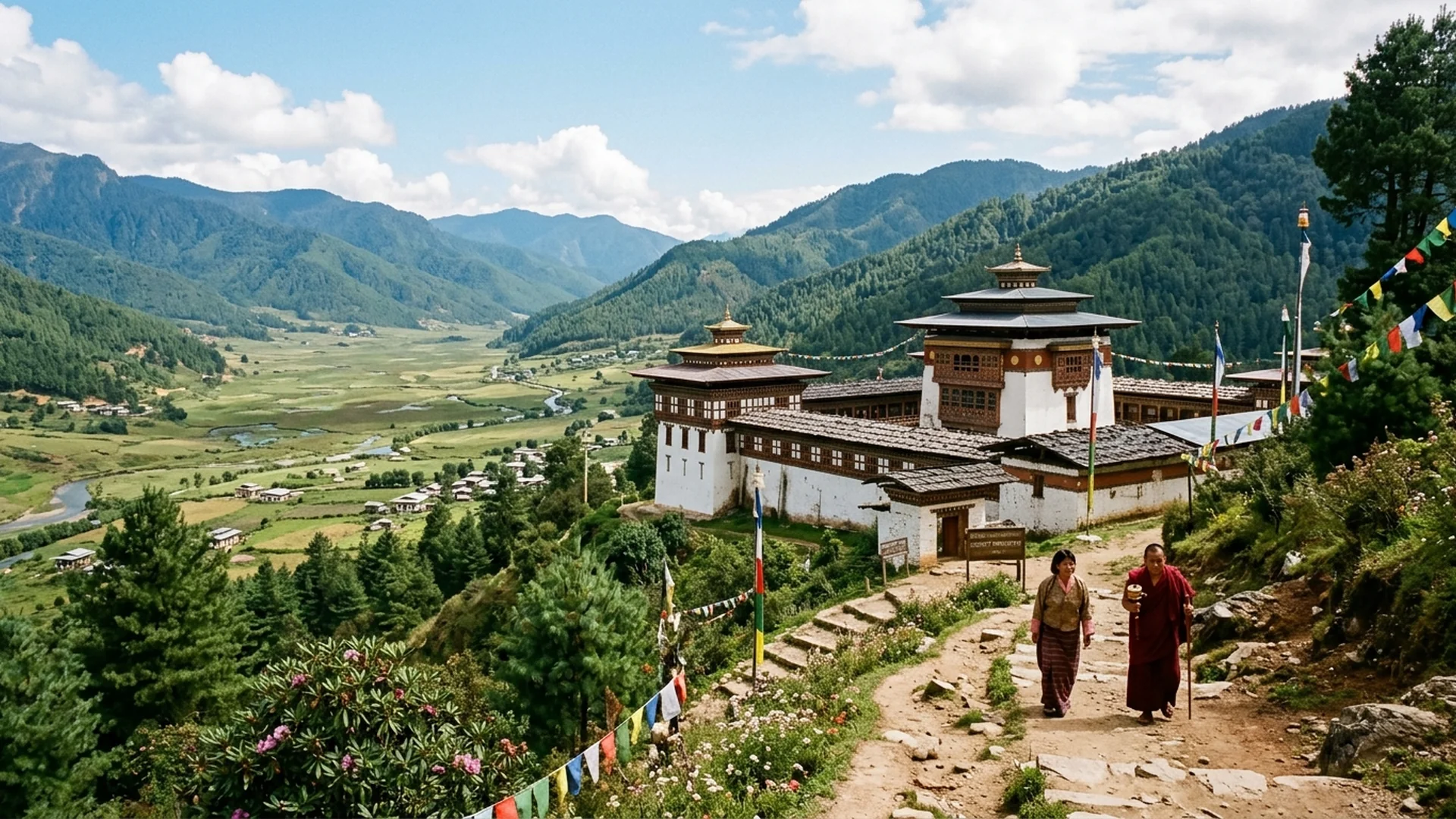
Amidst ancient pine-clad ridges rising over 3,000 meters above sea level, the Phobjikha Valley unfurls in serene stillness, resembling a realm where time itself has gently paused. This glacial sanctuary in the eastern Himalayas is far more than an untouched landscape of pristine wilderness; it is the storied home of Gangtey Monastery, a cliffside bastion of sacred architecture that has preserved an unbroken lineage of devotion for four centuries.
The profound enchantment of this sanctuary extends well beyond the esoteric depths of the Nyingmapa Buddhist tradition. It is inextricably bound to the annual migration of the sacred black-necked cranes, revered rare visitors that journey across the formidable Himalayan heights. Upon arrival, these elegant birds invariably circle the monastery three times in a graceful pradakshina—a ritual circumambulation of homage—before descending to bless the valley floor. This symbiotic union of living faith, undisturbed nature, and sublime timber craftsmanship defines one of the most transcendent destinations for discerning travelers seeking authentic spiritual tranquility.
To journey to Gangtey Monastery is to transcend mere physical travel. It is a contemplative retreat backward through time to savor the purest essence of solitude, embracing an unhurried slow-travel ethos that effortlessly marries Bhutanese cultural heritage with ultra-luxury hospitality.
The Pema Lingpa Legacy: A Nyingmapa Sanctuary Upon the Ridge
The history of Gangtey Goemba (Gangtey Monastery) traces its origins to the early 17th century, fulfilling the prophetic visions of Terton Pema Lingpa, the legendary treasure revealer and patriarch of the Nyingmapa school of Vajrayana Buddhism. The visionary’s grandson, Gyalse Pema Thinley, erected the initial wooden sanctuary in 1613 atop a verdant spur commanding sweeping, uninterrupted vistas over the sweeping bowl of the Phobjikha Valley.
Unlike the predominant Drukpa Kagyu fortresses that define much of Bhutan’s defensive architecture, Gangtey stands as the primary spiritual seat of the Nyingmapa tradition in western Bhutan, preserving the pristine oral lineages of Guru Rinpoche. Beyond housing dedicated monks and accomplished lamas, the monastery operates as an advanced monastic college, or Shedra, where profound philosophical texts are rigorously studied. The atmosphere within its venerable walls remains saturated with centuries of quiet devotion, resonant chanting, and an enduring sacred gravity forged over four hundred years.
Miracles of Faith and Nature: The Sacred Cranes of Phobjikha
As late autumn descends—typically between October and November—the Phobjikha Valley welcomes the arrival of the black-necked cranes, an endangered species escaping the bitter winters of the Tibetan Plateau. For both local residents and mindful travelers, these majestic birds inspire profound reverence through an astonishing behavioral phenomenon: upon reaching the valley, the cranes circle the Gangtey Monastery three times in a clockwise direction before settling into the marshlands, repeating the identical ritual thrice upon their return migration in spring.
Local villagers revere these avian visitors as celestial guardians of the sacred ground. This harmonious coexistence between humanity, wildlife, and monastic tradition culminates each November during the Black-necked Crane Festival, where masked sacred dances and folkloric performances celebrate ecological stewardship and spiritual unity.
Timeless Woodcraft and Sacred Artistry
Architecturally, Gangtey Monastery is a masterpiece of traditional Bhutanese engineering, erected entirely from stone and native timber without the use of a single iron nail. Within the central prayer hall, or Tshokhang, eight colossal wooden pillars support the soaring ceiling, recognized among the largest and most intricately carved wooden columns in the entire kingdom. Grounded between 2000 and 2008, the monastery underwent a monumental restoration led by master traditional artisans who meticulously renewed the ancient woodwork, intricate brackets, and soaring eaves. The restored wall murals—depicting esoteric Buddhist cosmology, historical lineages, and luminous bodhisattvas using natural mineral pigments—allow this 17th-century architectural marvel to radiate with immaculate, enduring splendor.
Slow Travel and Ultra-Luxury in the Alpine Wilderness
Beyond the meditative confines of the sanctuary, the Phobjikha Valley offers an unmatched canvas for contemplative slow travel. Connoisseurs of quiet exploration can wander the Gangtey Nature Trail, a 5.5-kilometer footpath winding leisurely through whispering pine forests, alpine pastures, and pastoral hamlets.
For discerning global travelers seeking supreme comfort, the valley accommodates world-class retreats that integrate seamlessly into the surrounding wilderness. Gangtey Lodge offers rustic-chic luxury with panoramic valley views; Amankora Gangtey provides minimalist, understated elegance; and Six Senses Gangtey curates holistic wellness journeys featuring traditional stone-bath rituals (Dotsho) and private meditative audiences with resident scholars.