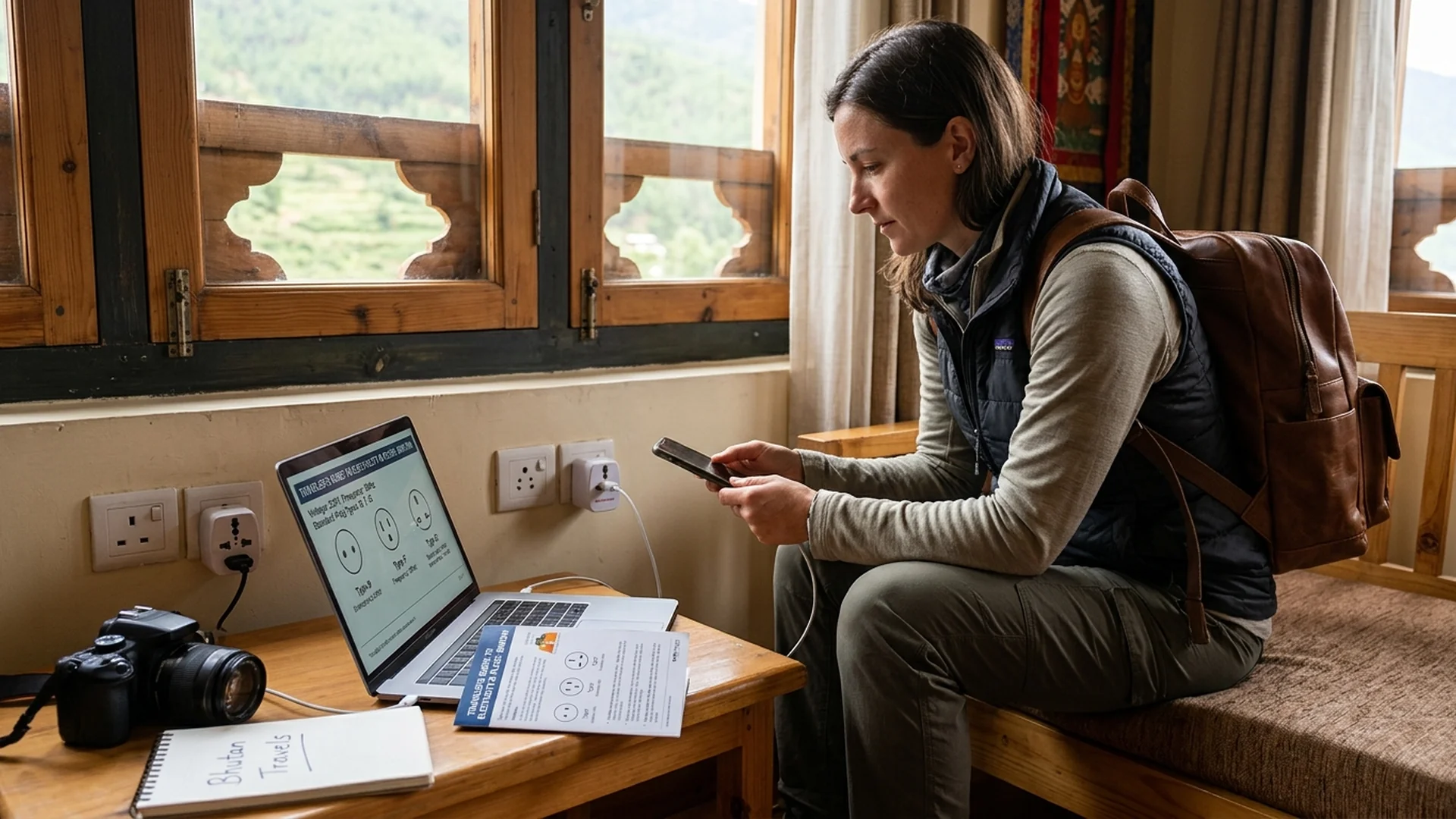
Amidst the mist-shrouded ridges and tranquil valleys of Punakha and Gangtey, a journey through Bhutan feels like stepping into a realm where time itself moves with unhurried grace. Yet, in the context of contemporary global travel, capturing the fleeting play of morning light upon ancient monasteries, pristine peaks, and spiritual sanctuaries requires a reliable arsenal of high-end electronics—from full-frame cameras and aerial drones to precision smartphones. While the kingdom draws its vitality from pristine, sustainable hydropower, the eclectic array of power outlets found across its regions demands subtle forethought. For the discerning traveler, understanding these minor technical nuances ensures that every moment of your profound Himalayan odyssey flows without interruption.
Infrastructure Rooted in Clean Energy and History
Bhutan stands globally as a vanguard of sustainable development, drawing its primary energy from pristine hydroelectric power generated by roaring Himalayan rivers. Grid stability is remarkably reliable within urban enclaves like Thimphu and Paro. However, the logistical nuance for luxury travelers lies not in power fluctuation, but in the delightful architectural diversity of power outlets encountered across different establishments. This variety mirrors the kingdom’s organic, phased modernization, meaning you may encounter European-style Type C round pins, traditional Type D sockets, British-style Type G rectangular pins, or sophisticated universal receptacles integrated into high-end sanctuaries. Acquaintance with this mosaic of connectors is the first step toward effortless preparedness.
The Art of Energy Management Amidst Alpine Chills
Documenting Bhutan’s monumental topography—whether capturing the golden illumination cresting Mount Jomolhari or the architectural majesty of a riverside dzong—demands exceptional performance from sophisticated digital gear. A common challenge faced by professional photographers is the tendency of lithium-ion batteries to discharge rapidly under high-altitude sub-zero conditions. Mitigating this requires mindful habits: keeping spare power cells close to your body in an inner coat pocket, utilizing thermal protective wraps for camera bodies, and employing high-wattage Gallium Nitride (GaN) chargers capable of simultaneously fueling laptops, cameras, and devices via USB-C Power Delivery (PD). Such understated strategies safeguard your ability to seize every transcendent visual narrative.
Aviation Standards for Your Journey to the Thunder Dragon
Approaching Paro Valley—widely regarded as one of the world’s most dramatic visual descents—involves flying with national carriers such as Drukair or Bhutan Airlines, both of which enforce rigorous safety protocols regarding lithium-ion batteries and power banks. All auxiliary power units and spare cells must be securely stowed in your carry-on luggage; checking them into the hold is strictly prohibited. Furthermore, individual watt-hour (Wh) ratings must be clearly legible and fall within international aviation safety thresholds. Maintaining an organized electronic kit that permits rapid inspection at security checkpoints reflects the hallmark of the seasoned traveler.