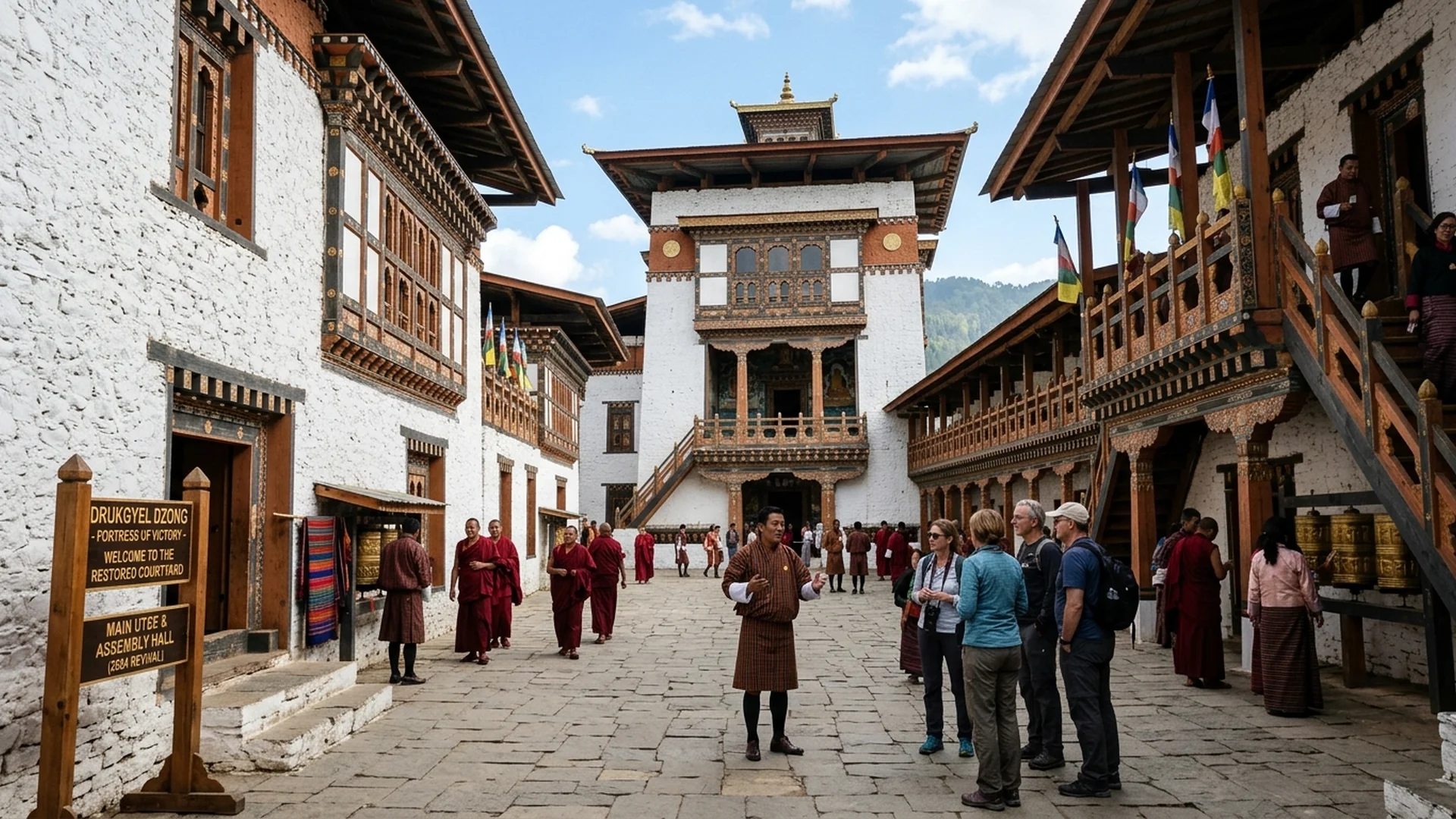
As the northern wind sweeps across the upper reaches of the Paro Valley, it carries centuries of resonant history through the silent, ancient stone foundations of Drukgyel Dzong. Today, through the enduring mastery of Bhutanese artisans and sacred architectural traditions, this legendary ‘Fortress of the Victorious Drukpas’ has been triumphantly awakened from a slumber that spanned more than six decades.
Long remembered only as a hauntingly romantic ruin standing sentinel after a devastating fire in 1951, Drukgyel Dzong has undergone an unprecedented restoration. Commissioned by His Majesty King Jigme Khesar Namgyel Wangchuck to celebrate the birth of the Crown Prince of Bhutan, this seven-year labor of devotion has faithfully returned the fortress to the exact splendor it possessed when first established in 1649.
Perched strategically at the northern throat of the valley, this magnificent 17th-century bastion rises anew against the pristine white canvas of the sacred snow-capped Mount Jomolhari. For the discerning global traveler seeking deep cultural resonance and timeless intellectual wonder, the revived dzong stands as one of the kingdom’s most captivating masterpieces.
The Legend of the Victorious Bastion: History Along Ancient Trade Routes
The very name Drukgyel Dzong translates profoundly to the ‘Fortress of the Victorious Drukpas’. Built in 1649 by Zhabdrung Ngawang Namgyal—the visionary statesman who unified Bhutan—its primary purpose was to guard the northern frontier of the Paro Valley against persistent incursions from Tibetan and Mongol armies traversing high-altitude mountain passes.
For centuries, Drukgyel Dzong was not merely an impenetrable defensive wall safeguarding national sovereignty, but a vital administrative hub controlling the historic trade arteries linking Bhutan to Tibet. The echoes of marching troops, trading caravans, and monastery bells once reverberated through these courtyards, etching historical significance into every hand-carved beam and stacked stone of the citadel.
Illusion and Strategy: Decoding the Ingenious Ancient Defenses
What distinguishes Drukgyel Dzong from other fortress-monasteries across Bhutan is its uncompromising focus on military strategy and tactical architecture. Perched upon a steep promontory shielded by sheer cliffs on three sides, the fortress naturally funneled all approach into a single, highly vulnerable bottleneck.
Ancient master builders incorporated a brilliant ‘False Entrance’ designed to lure attackers off course into a fatal pocket exposed to archers and matchlock defenders positioned above. Furthermore, subterranean escape tunnels linked the stronghold to hidden natural springs and water reservoirs, enabling the garrison to sustain prolonged sieges independently. The traditional rammed-earth walls combined with interlocking timber joinery—achieved entirely without iron nails—epitomize an intuitive mastery of engineering that transcends time.
The Grand Revival: Rising From the Ashes of 1951 Into Immortal Legacy
In 1951, a tragic midnight fire consumed the intricate timber structures and sacred monastic roofs of Drukgyel Dzong, leaving behind only blackened stone perimeter walls and a haunting central watchtower, known as the Utse. While those romantic ruins were celebrated enough to earn a tentative place on UNESCO’s tentative heritage lists, the Bhutanese people yearned for the day their fortress of victory would stand whole once more.
The miracle of restoration commenced in 2016 under the royal command of King Jigme Khesar Namgyel Wangchuck, conceived to honor the birth of His Royal Highness the Gyalsey. Traditional architects, master woodcarvers, and veteran painters labored with meticulous fidelity, consulting historical photographs and archaeological records. Today, Drukgyel Dzong stands fully restored, its white-washed walls and crimson friezes gleaming proudly beneath the Himalayan sun.
A Journey of Spirit: From Jomolhari’s Silhouette to Kyichu Lhakhang
Experiencing Drukgyel Dzong today offers an exquisite synthesis of raw Himalayan grandeur and sacred blessing. Standing upon the outer flagstone courtyards on a clear morning, travelers are greeted by the magnificent snowbound wedge of Mount Jomolhari towering at 7,326 meters directly behind the citadel—arguably one of the most sublime visual compositions in all of High Asia.
To deepen this cultural pilgrimage through the Paro Valley, guests often pair the visit with a journey to Kyichu Lhakhang, situated along the same contemplative corridor. Founded in the 7th century by Tibetan King Songtsen Gampo, it remains one of the kingdom’s oldest and most serene sanctuaries. Balancing the majestic martial history of the restored dzong with the tranquil grace of ancient temples creates an exceptionally harmonious travel experience for the mind and soul.