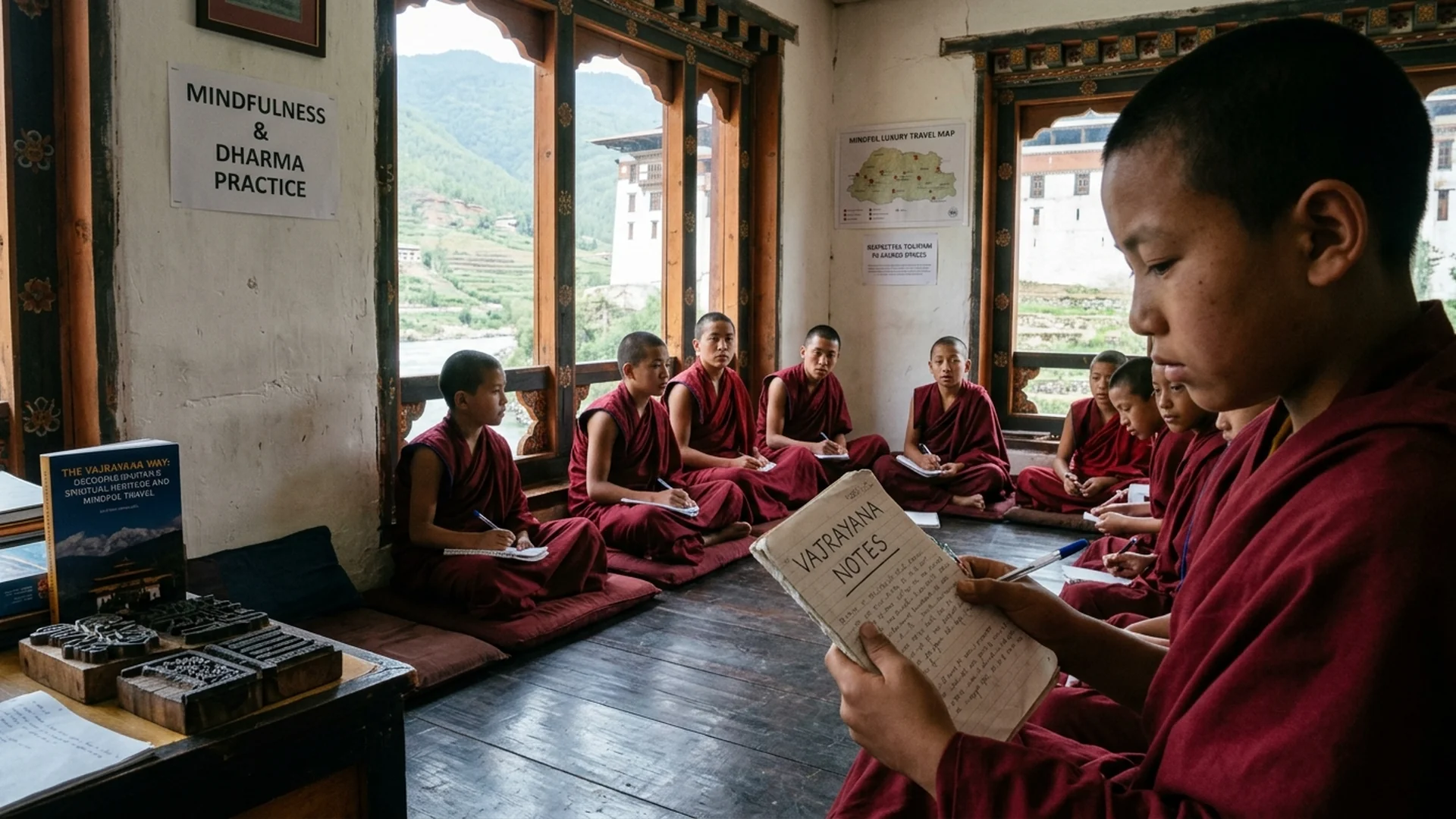
Amidst the mist drifting quietly over the Paro Valley, the resonant chime of singing bowls and the deep drone of ritual horns echo across towering cliffs. The mountain air carries the rich, soothing fragrance of burning juniper and cypress resin. Here, quietude is never a vacuum; rather, it pulses with a profound spiritual energy preserved across centuries. In this Himalayan realm of the Drukpa, Bhutanese Buddhism is not merely recorded in ancient manuscripts; it is a living philosophy breathing through every dawn and twilight.
For discerning travelers seeking genuine interior enrichment, a journey to Bhutan transcends conventional sightseeing. It invites an inward crossing, entering the sanctuary of one’s own consciousness. Vajrayana Buddhism—the Diamond Way, representing pristine, unshakeable wisdom—has indelibly shaped the nation’s culture, ethos, and governance through the visionary framework of Gross National Happiness (GNH). This creates an inimitable cultural tapestry found nowhere else on earth.
Viewing this sacred geography through the lens of heritage and devotion reveals that cliffside sanctuaries and masterwork frescoes within ancient fortresses are far more than aesthetic marvels. They are intricate spiritual codes, waiting for the receptive traveler to decode them and discover enduring peace.
Footprints of Guru Rinpoche and Living Legends on Himalayan Winds
Bhutan’s spiritual lineage crystallized clearly in the 8th century when Guru Rinpoche—revered also as Padmasambhava—traversed the formidable Himalayas from Kashmir and Tibet. His arrival brought not only the teachings of Vajrayana Buddhism to these hidden valleys, but also gently subdued indigenous Bon animistic forces, integrating them into the service of the Dharma.
The ultimate symbol of this pivotal arrival is Paro Taktsang, the Tiger’s Nest, clinging precariously to a sheer granite cliff nine hundred meters above the valley floor. According to hagiography, Guru Rinpoche arrived upon the back of a flying tigress to meditate within this precipitous cave for three months, three weeks, and three days. Ascending toward Taktsang through whispering pine forests and fluttering prayer flags is thus far more than a physical trek; it is an authentic pilgrimage testing both physical endurance and spiritual resolve.
Within the ancient sanctuary, the heavy aroma of yak butter lamps and the low, resonant chanting of monks weave an intense, atmospheric cocoon. Vajrayana devotion holds that every cave and boulder touched by Guru Rinpoche’s meditation retains an enduring field of blessings, accessible to any visitor who approaches with stillness and an open heart.
The Dzong: Fortresses of Wisdom and Living Architecture
If cliffside shrines represent Bhutan’s spiritual heart, the dzong serves as the formidable backbone of its societal and religious architecture. These massive, whitewashed fortresses were engineered to anchor both civil governance and monastic life. Their construction follows ancient indigenous engineering principles that eschew paper blueprints and iron nails entirely, yet they have withstood severe seismic activity for centuries.
Punakha Dzong, formally known as Phendew Dechen Phodrang—the Palace of Great Happiness—stands gracefully at the confluence of the Pho Chhu (father river) and Mo Chhu (mother river) rivers. In spring, blooming jacaranda trees envelop the fortress in a violet haze, sharply contrasting with pristine white walls and intricately carved, red-and-gold woodwork.
Inside the dzong, sacred thangka scrolls depict cosmic mandalas, Vajrayana visions, and the Bhavacakra (Wheel of Life). These are not mere decorative artifacts, but visual scriptures communicating the impermanence of existence and the path to liberation. Saffron-robed monks gliding across timber verandas remind visitors that a dzong is never a static museum, but a beating heart of contemporary Bhutanese society.
The Path of Inner Stillness: From GNH Philosophy to Spiritual Renewal
In a modern world obsessed with quantitative economic metrics, Bhutan remains steadfastly guided by Gross National Happiness (GNH), a metric rooted deeply in Vajrayana philosophy. This paradigm posits that true fulfillment arises not through material accumulation, but via a harmonious equilibrium among the mind, community, and the natural world.
For luxury travelers, experiencing Bhutanese Buddhism authentically goes far beyond photographing iconic landmarks. It manifests in curated, intimate encounters: private meditation sessions inside centuries-old shrines guided by high-ranking lamas, participation in traditional butter lamp ceremonies dedicated to universal compassion, or reflective philosophical discussions on the art of living mindfully in the present moment.
Pausing in an exquisite boutique sanctuary designed to harmonize with nature, accompanied by the gentle murmur of mountain streams and Himalayan wind chimes, allows for profound spiritual renewal. It transforms a conventional vacation into an enduring milestone of personal elevation.