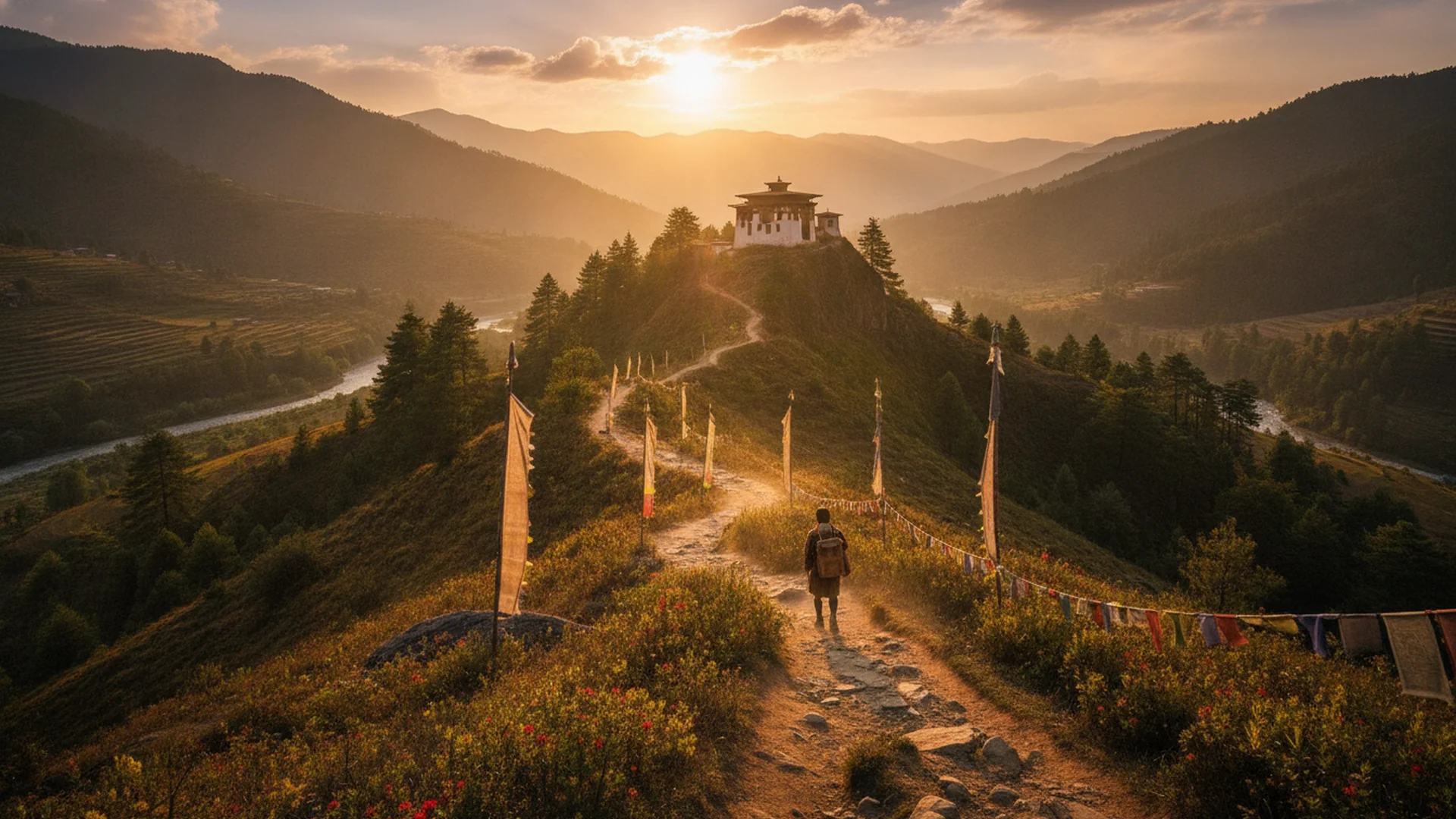
Amidst the crisp, high-altitude air of the Eastern Himalayas, the Tang Valley awakens in absolute silence, cradled within the sacred reaches of Bumthang—the spiritual heartland of the Dragon Kingdom. While contemporary travelers frequently congregate among the renowned sanctuaries of Paro and Thimphu, this remote valley preserves an unhurried, unadorned rhythm of ancient mountain life. Centuries-old footpaths tracing the crystalline currents of the Tang Chhu river gently coax the traveler backward through time, where days unfold with meditative grace.
Walking the valley is far less an exertion of physical endurance than an immersive cultural pilgrimage. The trail culminates at Ogyen Choling Palace, poised majestically upon a ridge shaped according to auspicious Vajrayana iconography like the head of a sacred elephant. This historic sanctuary once served as a meditation retreat for Longchen Rabjam, the monumental 14th-century Dzogchen master, before evolving into the ancestral stronghold of a noble lineage preserved across twenty-two successive generations.
As you drift past emerald buckwheat fields, timeworn timber homesteads, and prayer flags fluttering in the mountain breeze, every single contour of the Tang Valley whispers legends of realized masters, tertons (treasure revealers), and unwavering devotion. It is an itinerary that forever refines and deepens one’s understanding of Bhutanese heritage.
Echoes Along the Tang Chhu: Following Ancient Footsteps
Embarking on a journey through the Tang Valley is akin to turning the pages of an illuminated manuscript. The traditional footpath unfurls from the fertile floodplains flanking the Tang Chhu, wandering softly through seas of flowering buckwheat and resinous pine groves. Along the way, travelers encounter settlements such as Mesethang, where villagers continue to tend their fields and herds of sheep and yaks in timeless alignment with the turning seasons.
The spiritual significance of the valley runs deep, tracing back to the 14th century when Longchen Rabjam, the towering Nyingma scholar, sought solitude within the valley’s cliffside caves. Later, Dorji Lingpa, the revered master treasure revealer, consecrated the region by establishing sacred monastic foundations, cementing the valley as an enduring beacon of wisdom across Bumthang.
Architecture of Power and Devotion: The Elephant-Head Ridge of Ogyen Choling
As the trail climbs toward the ridge, the imposing silhouette of Ogyen Choling emerges with striking theatricality. Constructed from ancient timber and stone, the compound commands its hilltop vantage point with quiet authority. Viewed from below alongside the eastern Kanyai mountain range, the landform mirrors the auspicious contours of an elephant’s head—a Buddhist symbol of steadfast stability, immense wisdom, and enduring fortune.
The principal structures seen today were rebuilt in their current configuration during the late 19th century by Tsokye Dorji, a 15th-generation descendant of Dorji Lingpa who also served as the Trongsa Penlop. The architectural arrangement incorporates a central utse (tower) flanked by residential and administrative shagkor wings, functioning historically as a religious sanctuary, a storehouse for regional harvests, and a noble seat of governance.
A Living Museum: Rural History and Aristocratic Legacy
In 2001, Ogyen Choling underwent a profound metamorphosis. Kunzang Choden, one of Bhutan’s foremost contemporary authors writing in English and a 20th-generation descendant of the estate, partnered with her family to establish the Ogyen Choling Foundation, transforming the ancestral manor into Bhutan’s inaugural private museum.
Within its historic chambers lie thousands of curated artifacts: agrarian implements, historical weaponry, vast archives of rare hand-woven textiles, antique kitchens, traditional brewing vessels, and precious hand-copied Buddhist scriptures resting on the upper tower shelves. The interior retains an authentic atmosphere scented with aged cedar and butter lamps, where shafts of sunlight filter through carved wooden lattices onto polished floorboards, offering an intimacy no urban museum can replicate.