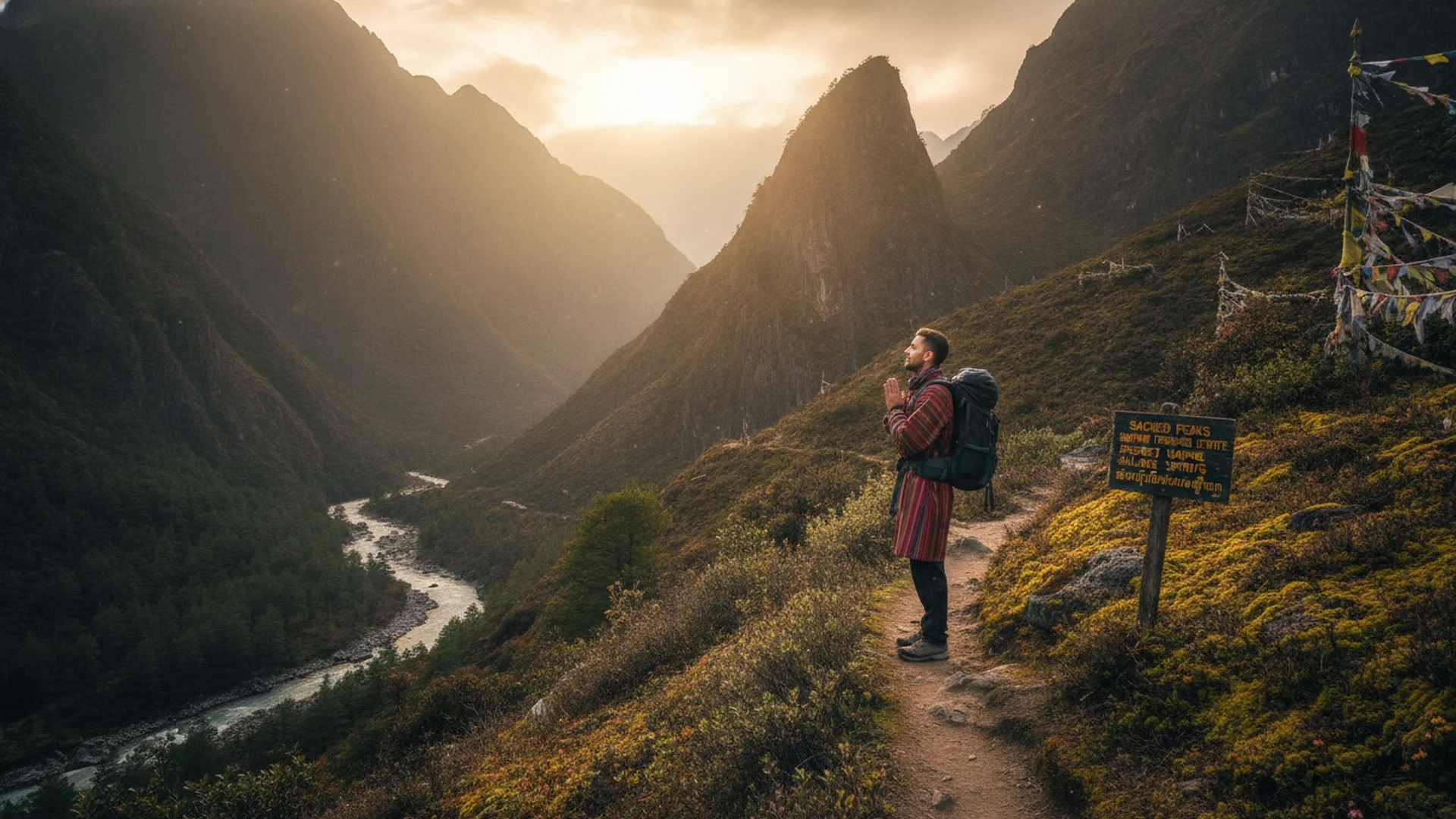
Amid the crisp, high-altitude winds sweeping across the jagged peaks of the Bhutanese Himalayas, a veil of silver mist drifts softly over five-colored prayer flags fluttering against the blue expanse. To the people of Bhutan, these towering summits are far more than geological formations of ancient rock and glacial ice; they are sacred sanctuaries housing the Yul-lha—the divine guardians and tutelary deities of the land and hidden valleys. This profound reverence is neither mere folklore nor relic of the past, but a living philosophy that has shaped the kingdom’s legislation, cultural ethos, and the delicate relationship between humanity and the natural world for centuries.
When discerning travelers step onto the pristine hiking trails of this Himalayan kingdom, the journey transcends physical exertion or the conquering of distance. It becomes an inward pilgrimage of the spirit, demanding humility, quiet contemplation, and deep attunement. Understanding and respecting the spiritual and environmental etiquette of Bhutanese trekking is the master key to unlocking the heart of Vajrayana Buddhism—a worldview that perceives an unbroken, sentient continuity between all living beings, the earth itself, and unseen spiritual realms.
The Yul-lha and Vajrayana Cosmology: When Mountains Are Living Sanctuaries
In the traditional cosmology of Bhutan, the natural world teems with localized spirits and territorial deities that were historically subdued and integrated as protectors of the Dharma within Vajrayana Buddhism. Prominent summits such as Mount Jomolhari are revered as the celestial palace of Aum Jomo, the fierce protective goddess of the frontier. Similarly, Gangkhar Puensum—Bhutan’s highest elevation at 7,570 meters—is celebrated as the sanctuary of the three spiritual sibling deities.
Rooted in this unwavering devotion, the Royal Government of Bhutan enacted landmark legislation in 1994 banning mountaineering on all peaks exceeding 6,000 meters, later extending the prohibition to all summits. This restriction stems not from administrative conservatism, but from a profound commitment to spiritual ecology. Refraining from scaling these peaks preserves the inviolate purity of the high Himalayan ecosystem, ensuring that Bhutan remains the sole nation on earth where seven-thousand-meter summits remain entirely untouched by human footprints or mountaineering debris.
The Art of the Mindful Step: Trail Etiquette and Reverence for Nature
Throughout Bhutan’s intricate network of walking paths, spiritual symbols adorn every valley. Whether encountering whitewashed Chortens, water-powered prayer wheels, or cliff faces etched with the mantra Om Mani Padme Hum, a foundational rule of Bhutanese trail etiquette is to always pass these sacred markers on the right, moving in a clockwise direction (Kora). Counter-clockwise movement is considered contrary to the auspicious currents of spiritual energy.
Furthermore, cultivating behavioral grace while traversing the wilderness is paramount. The art of trekking in Bhutan is an exercise in preserving ambient stillness. Travelers should refrain from shouting across gorges, playing music through external speakers, or exhibiting abrasive behavior. It is widely believed that jarring noises disturb or anger the Yul-lha, potentially provoking sudden squalls, high winds, or perilous conditions along the trekking route.
Pristine Headwaters and Leave No Trace: The Carbon-Negative Philosophy
Celebrated globally as the world’s only carbon-negative nation, Bhutan absorbs more atmospheric carbon than it emits—an ecological triumph that extends to every square inch of its backcountry trails. In local tradition, high-altitude springs, rivulets, and rushing rivers are regarded as the pure lifeblood of the landscape. Washing, bathing, or introducing chemical soaps and detergents directly into these waterways is strictly prohibited.
Trekkers must cleanse themselves and wash gear at least fifty meters away from any water source, utilizing strictly biodegradable products. Every scrap of refuse, down to the smallest organic wrapper or food remnant, must be packed out. Licensed trekking guides and camp staff rigorously inspect campsites each morning to ensure they are left as pristine as they were found.
Stepping Into Stillness: Ritual and Meditation on High Altitude Trails
Before embarking upon elevated alpine routes such as the legendary Druk Path or Jomolhari treks, the refined traveler follows the custom of visiting a village Lhakhang near the trailhead. Here, one pauses for silent meditation and the traditional offering of a butter lamp to the divine.
The illumination of the butter lamp symbolizes the dispelling of inner ignorance and serves as a formal request for safe passage from the valley’s guardian spirits. As the trek begins, transforming the physical exertion into a moving meditation—anchoring awareness in the breath and the deliberate rhythm of each footstep amid ancient pine forests and blossoming rhododendrons—allows travelers to experience a profound harmony with the Himalayan cosmos.