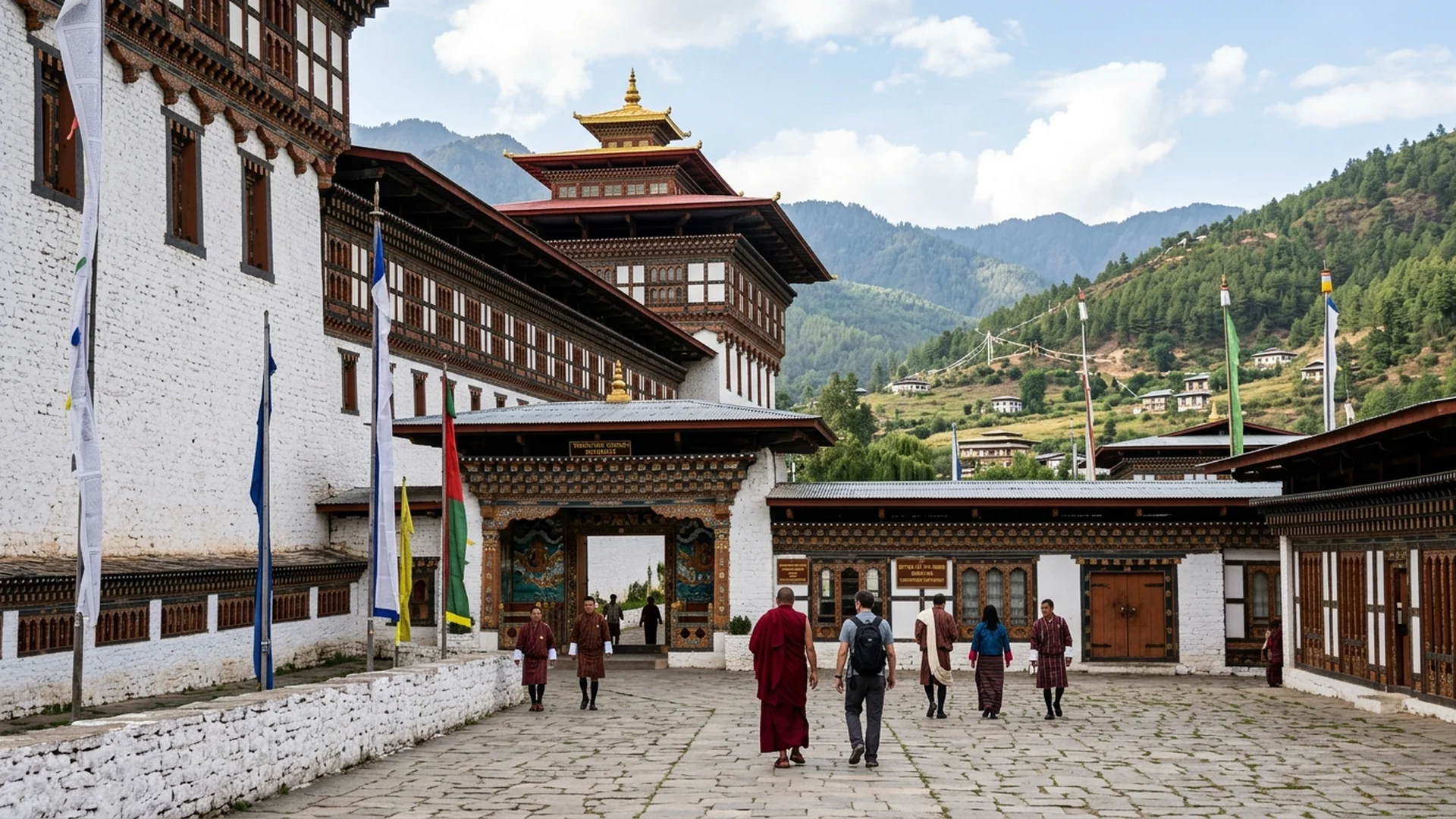
Where the crystalline waters of the Wang Chhu meander through the mist-shrouded valley of Thimphu, a fortress of immaculate whitewashed stone, vermilion accents, and gleaming golden woodwork stands in profound stillness. Tashichho Dzong—translated as the Fortress of the Glorious Religion—is far more than a historical monument or a silent reliquary of the past. It is the living, breathing crucible of power in the Kingdom of Bhutan, where the realms of governance and spirituality have intertwined in quiet harmony for centuries.
Behind its formidable masonry and tiered golden roofs lies the executive sanctum where His Majesty King Jigme Khesar Namgyel Wangchuck signs decrees and guides the nation, operating shoulder-to-shoulder with the summer residence of the Central Monastic Body, led by the Je Khenpo. This seamless duality of power embodies Bhutan’s timeless system of governance, ensuring that the temporal affairs of humanity and the eternal truths of the Dharma walk a single, unified path.
Most astonishingly of all, this monumental edifice was raised without a single blueprint drawn on paper and entirely devoid of iron nails. Every interlocking timber beam and intricately painted motif is the product of master craftsmen passing down ancestral wisdom through generations. This editorial journey offers an insider’s perspective into the sacred geography, twilight illumination, and courtly etiquette of Bhutan’s most revered sanctuary.
Decoding the Dzong Architecture and the Wisdom of Nail-Free Joinery
The Bhutanese architectural archetype known as the ‘dzong’ is a masterclass in functional genius, seamlessly merging military fortification, administrative headquarters, and monastic sanctuary into a singular compound. The present-day Tashichho Dzong, having weathered various fires and earthquakes throughout history, was grandly restored and expanded in the 1960s under the royal vision of King Jigme Dorji Wangchuck, the Third King of Bhutan.
The world-class sophistication lies within its construction methodology. Master builders of the realm eschew paper blueprints and iron fasteners entirely, relying instead on precise mortise-and-tenon joints to lock the timber framework together. The thick masonry walls, composed of stone and clay, slope gracefully inward to absorb seismic tremors and bear towering structural loads. At the heart of the complex rises the central utse, or tower, flanked by stone courtyards and timber columns adorned with the Eight Auspicious Signs (Tashi Tagye), bearing living testimony to the heritage of the Zorig Chusum.
The Dual Governance Pavilion: Where State and Sangha Converge as One
What sets Tashichho Dzong apart from any other seat of power across the globe is its simultaneous function as the working office of the head of state and the head of the monastic order. One wing of the fortress serves as the administrative core, housing the King’s throne room alongside the Ministries of Finance and Foreign Affairs, while the opposite wing accommodates the administrative offices and summer quarters of the Zhung Dratshang (Central Monastic Body).
This system of dual governance, known as ‘Choe-sid’, traces its roots to the 17th century under the visionary unifier of Bhutan, Zhabdrung Ngawang Namgyal. Walking through the courtyards of the dzong, one encounters civil servants clad in traditional gho robes and kabney scarves moving in quiet synchronicity with monks in deep crimson robes—a living tableau of Gross National Happiness in action, where governance is eternally informed by compassion and spiritual mindfulness.
Thimphu Tshechu: Sacred Mask Dances and the Living Heritage of the Courtyard
Every autumn, as the Himalayan air turns crisp, the grand courtyards of Tashichho Dzong undergo a breathtaking transformation from austere administrative enclave to vibrant festival grounds for the Thimphu Tshechu. This three-day sacred festival is dedicated to Guru Rinpoche, the revered master who brought Vajrayana Buddhism to the valleys of Bhutan.
Pilgrims and citizens from every corner of the kingdom gather in their finest gho and kira garments to receive blessings and witness the hypnotic sacred mask dances known as ‘Cham’. Performed by monks and high lamas adorned in elaborate deities and demon manifestations, these movements are designed to subdue malevolent forces and awaken inner awakening. Set against the magnificent backdrop of the fortress walls, the convergence of music, devotion, and sacred art offers an unfiltered encounter with the soul of Bhutan.