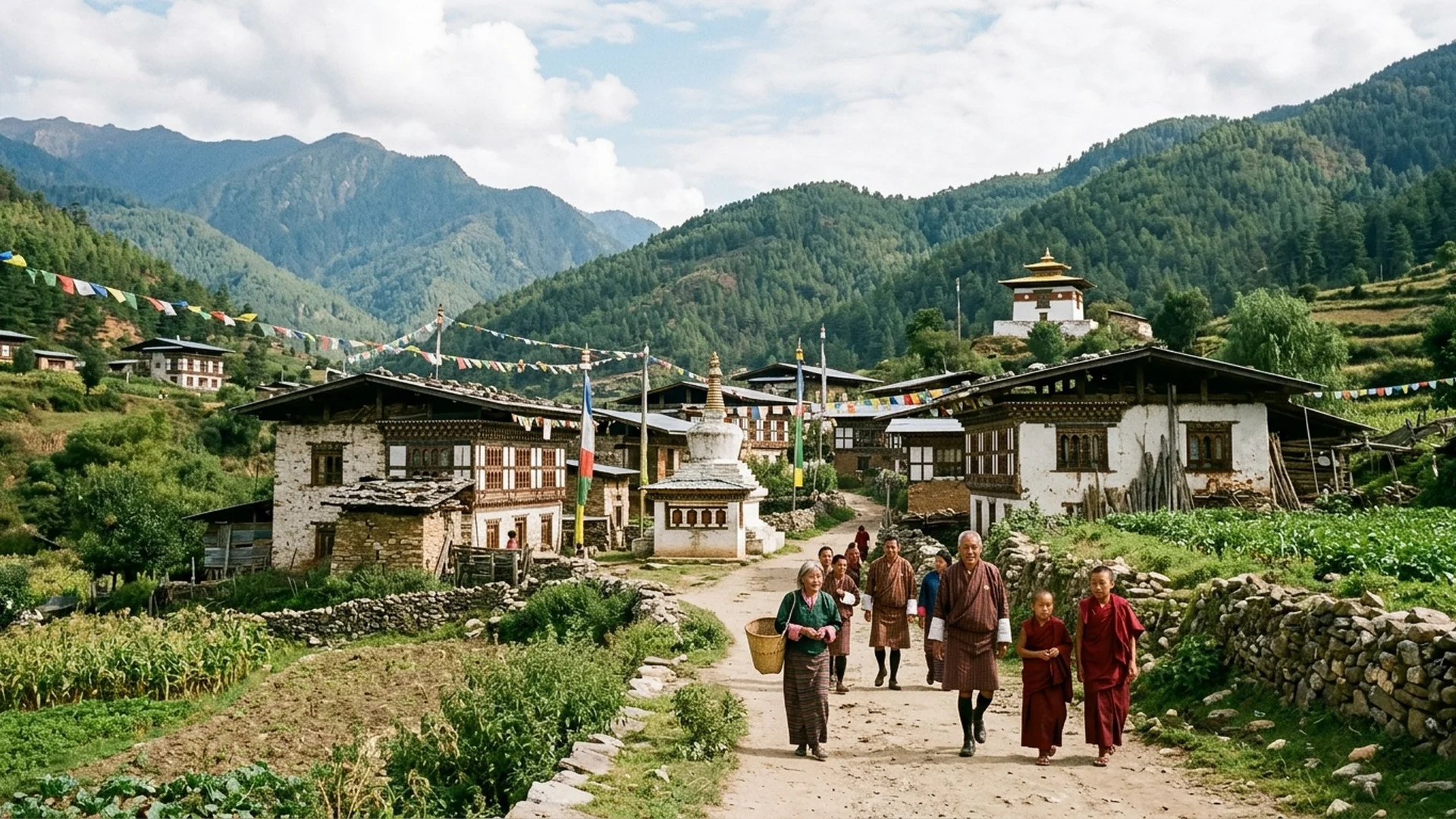
As the morning mists gently lift from the towering peaks of the Ura Valley, the quiet silhouette of an ancient settlement reveals itself against the emerald slopes. This is Shingkhar Village, a centuries-old community perched on the high ridges of the Bumthang district—the spiritual heartland of the Kingdom of Bhutan.
To journey here is to turn the clock back to an era untouched by frantic haste, stepping away from the modern world into a realm of profound simplicity. The whisper of wind through untouched pine forests and ancient meadows echoes a traditional way of life deeply intertwined with the earth, making it an unmissable pilgrimage for discerning travelers seeking the true essence of slow travel.
The Wooden Cabins of Shingkhar: Vernacular Architecture of the Highlands
The name ‘Shingkhar’ translates quite literally in the local dialect to ‘wooden house’ or ‘wooden cabin,’ telling the story of the village through its masterful vernacular architecture. Homes in Shingkhar are built organically along the mountain’s contours, utilizing one-hundred-percent natural materials: fragrant local pine and carefully stacked dry-stone foundations. Roofs are crafted from thin timber shingles, weighted down by stout stones to withstand the brisk highland gales. The village layout reflects an intuitive harmony with nature, accompanied by the gentle murmur of a crystalline stream winding through the settlement, where traditional prayer wheels turn rhythmically in the current.
Dechenling Lhakhang & Nyingma Origins: Roots of Faith in the Himalayas
Beneath the tranquil facade of Shingkhar lies a deep, venerable spiritual lineage. The village sanctuary, Shingkhar Dechenling Lhakhang, is intimately connected to the great Nyingma master Kuenkhen Longchen Rabjam, who played a foundational role in propagating Buddhist teachings across the Himalayas during the 14th century. Oral tradition holds that the site originated as a meditation hermitage established to welcome the revered teacher before evolving into the hallowed temple cherished by locals today. Within its walls, the air is thick with the scent of sacred juniper incense, flickering butter lamps, and the quiet resonance of timeless prayers.
Highland Pastoral Life: Subsistence and Adaptation Above the Clouds
The daily rhythm of life for Shingkhar’s three hundred residents unfolds entirely in sync with the seasons. While highland communities once relied primarily on nomadic yak herding, villagers have gracefully transitioned toward sustainable high-altitude agriculture, cultivating prized potatoes and resilient grains like buckwheat. Seeing villagers cooperatively sorting harvests or watching yellow-billed choughs forage near rustic timber fences captures a pastoral idyll rarely found elsewhere. This unhurried existence, graced by warm smiles and genuine hospitality, preserves the purest expressions of the Bhutanese way of life.