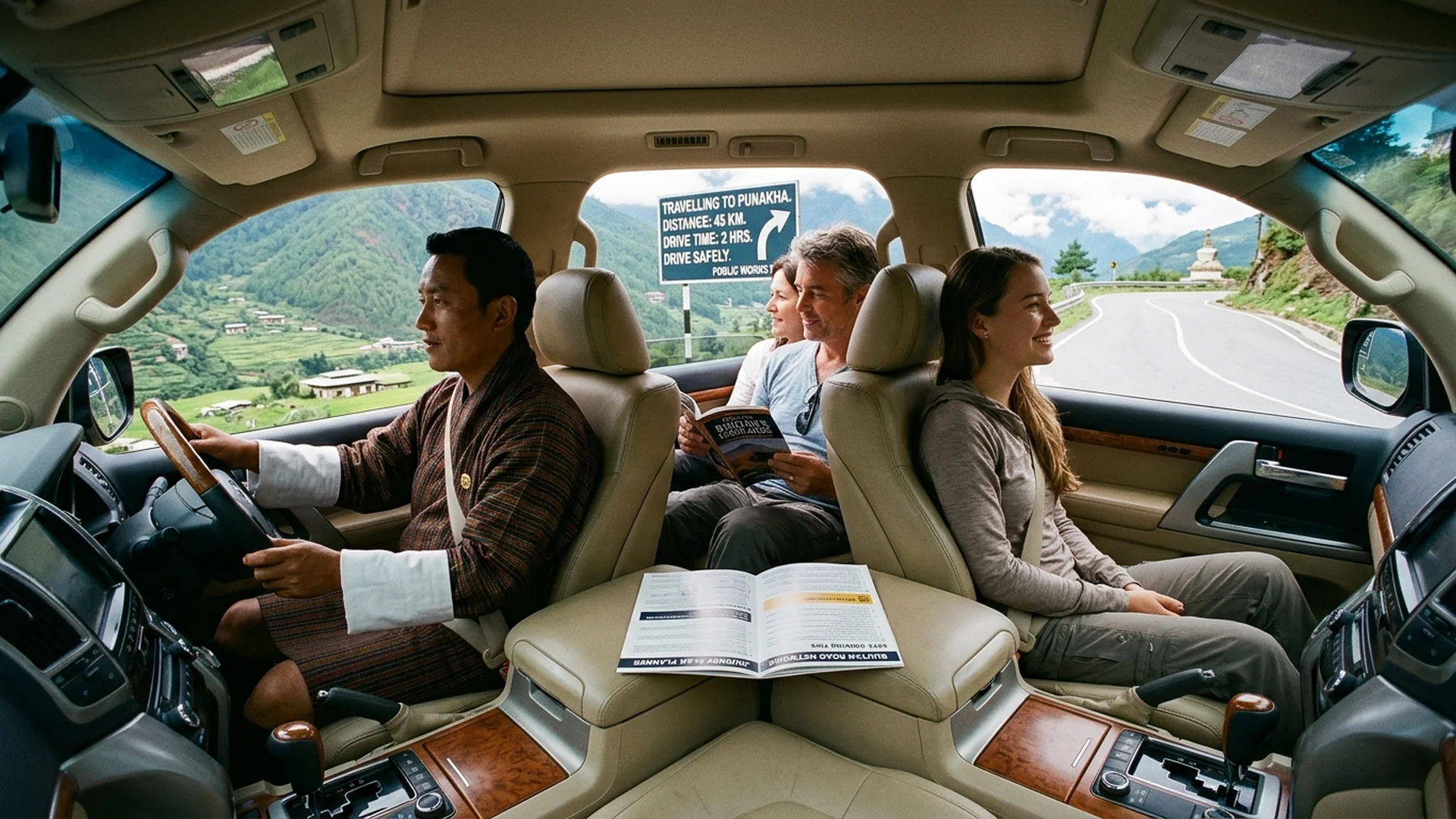
The moment your SUV glides away from Paro International Airport, the breath of the Himalayas begins its quiet enchantment. Yet, rising before you is an ancient silk road tracing sheer precipices and deep abysses—a landscape that might momentarily quicken the pulse of the comfort-seeking traveler. In truth, the formidable reputation of Bhutan’s winding mountain corridors conceals an exquisite aesthetic of slow travel unattainable anywhere else in the world. Visitors are not permitted to drive themselves here, transforming what could be a taxing transit into an elevated privilege. An expert local chauffeur gently navigates the precipitous switchbacks, allowing you to surrender entirely to the raw, pristine majesty of the kingdom.
The Reality of Drive Time: When Distance is Measured by Himalayan Scale
For travelers accustomed to high-velocity interstate highways, comprehending Bhutan’s road topology serves as an immediate masterclass in recalibrating life’s tempo. Distances that appear negligible on a map translate into hours of mindful progression because the kingdom’s topography is carved from the formidable folds of the eastern Himalayas. Every route cleaves directly into steep slate shoulders, featuring complex networks of switchbacks where safe average velocities remain naturally restricted to 30 or 40 kilometers per hour. Journeys from Thimphu to Punakha, or across mountain flanks to remote valleys, transcend mere displacement from point A to point B. Instead, they unfold as prolonged immersions in untouched forests, ancient village life, and veils of mist clinging to jagged summits. Accepting this distinct drive time reality is the master key to unlocking uninterrupted tranquility throughout your journey.
The Privilege of Quiet Assurance: Behind the Wheel with Master Chauffeurs
Any lingering apprehension regarding foreign navigation dissolves upon discovering that Bhutanese tourism regulations require visitors to explore via private vehicles accompanied by professional local chauffeurs and guides. For the discerning global traveler, this framework represents the ultimate luxury of effortless peace of mind. High-performance, four-wheel-drive luxury SUVs are meticulously maintained and equipped with superior suspension systems engineered to absorb the undulations of alpine terrain. Bhutanese drivers undergo rigorous training, mastering every hairpin turn with an innate smoothness and unhurried grace. Possessing an eagle-eyed awareness of changing road conditions ahead, they act as devoted guardians of your journey, granting you the liberty to rest your eyes, meditate, or absorb the sublime panorama unfolding outside your window with absolute confidence.
The Art of Mastering Curves and High-Altitude Wellness
Ascending high-altitude mountain passes such as Dochula, which crests at over 3,000 meters above sea level, can occasionally trigger mild motion sensitivity or altitude adaptation symptoms if the body transitions too rapidly. Seasoned Himalayan voyagers recommend proactive comfort measures: sipping warm artisanal ginger tea, utilizing discreet motion-relief patches behind the ear, and partaking in light, nourishing meals prior to departure. Furthermore, mandatory vehicle stops at scenic viewpoints for mechanical checks and leg-stretching transform naturally into golden interludes. These pauses invite you to breathe crisp alpine air, photograph the 108 memorial chortens wreathed in low-hanging clouds, or exchange warm smiles with locals, effortlessly dissolving the fatigue of prolonged transit.
Seasonal Metamorphosis: How Nature Dictates the Rhythm of the Wheels
Bhutan reveals entirely distinct personalities across its seasons, each exerting a direct influence on mountain thoroughfares. Selecting your travel window is therefore pivotal to ensuring absolute fluidity. Spring (March through May) and autumn (September through November) present the ideal confluence: crystalline skies, dry roadways, and vibrant alpine wildflowers carpeting the verges. Conversely, the summer monsoon season (June through August) brings heavy precipitation and occasional localized maintenance delays, while winter can occasionally introduce morning black ice upon high-altitude mountain passes. However, local authorities and elite touring teams maintain robust real-time communication systems, monitoring transit corridors continuously and tailoring itineraries with seamless intuition to guarantee both pristine safety and elevated comfort.