As the bitter winter wind sweeps across the soaring heights of the Himalayas, monumental banners draped against ancient stone fortresses flutter beneath the morning sun, casting long, contemplative shadows over serene valleys. This is Bhutan—a realm governed not by crude economic metrics, but by the quiet heartbeat of faith, belief, and the enlightened philosophy of Gross National Happiness (GNH).
Beneath the pristine grandeur of its untouched wilderness and formidable dzongs lies a secret tapestry of spiritual codes woven directly into the nation’s heraldry. To truly comprehend the profound symbolism hidden within the national flag, the royal emblem, and the folklore of the national animal is to unlock the initial gateway toward a transformative inner journey.
The Bhutanese Flag: The Power of the Thunder Dragon and Dual Harmony
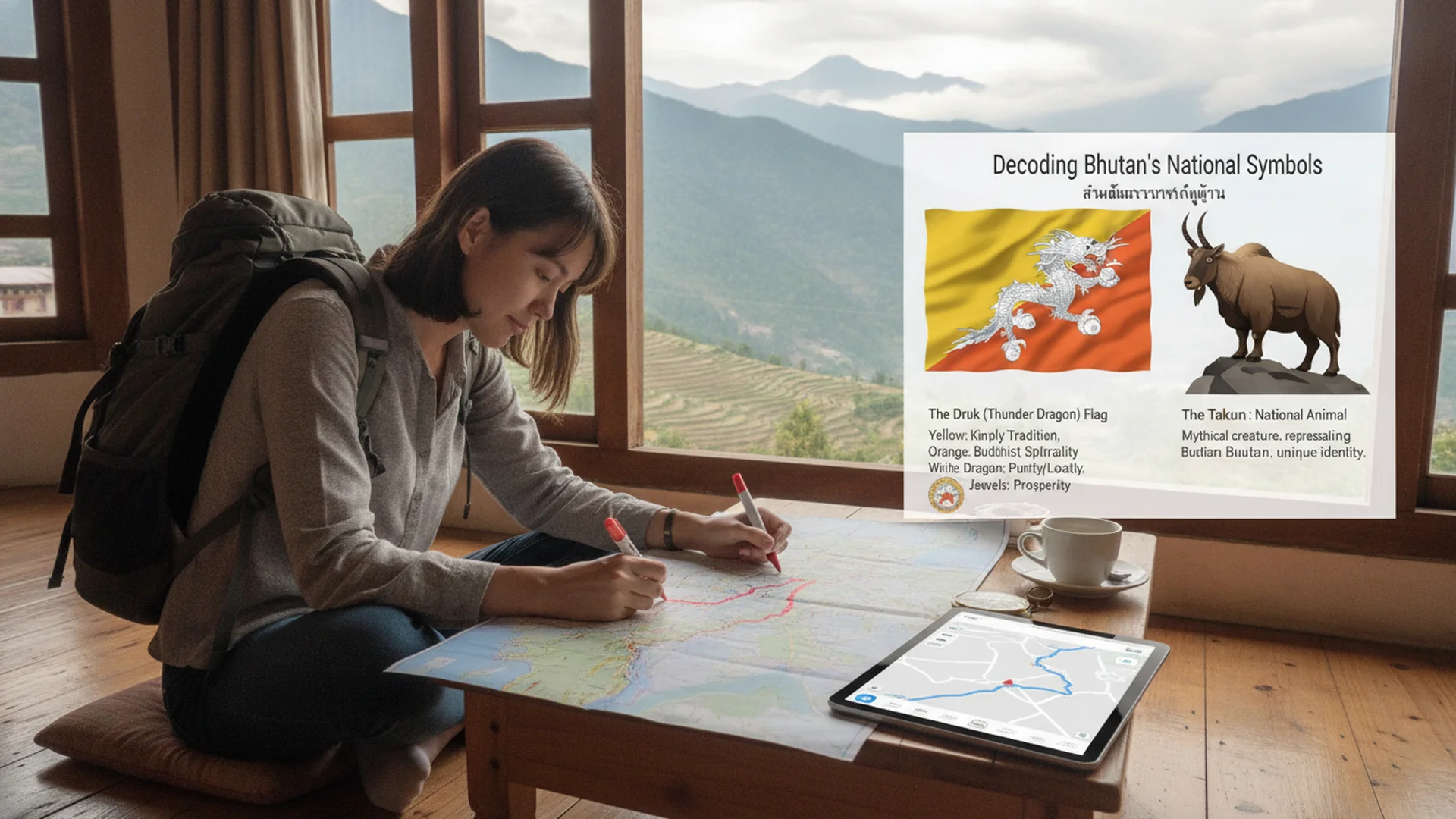
Looking up into the crystal-blue skies of Bhutan, the rectangular banner diagonally partitioned into golden-yellow above and vibrant orange-red below presents one of the most striking visual motifs in the world. The upper field of golden-yellow embodies the majesty and dynamic prosperity of the royal monarch, who serves as the unifying heart of the nation while guiding the realm through righteous governance. The lower orange-red field represents the fierce devotion and spiritual heritage of the Drukpa Kagyu school of Buddhism.
At the exact juncture where these two vibrant fields meet lies the majestic silhouette of the Druk, the pristine white Thunder Dragon, stretching diagonally across the cloth. This mythical creature is far more than a heraldic emblem; it is the living essence of Bhutan, historically known as Druk Yul, the Land of the Thunder Dragon. The dragon’s mighty roar echoes as thunder, awakening humanity from worldly illusions, while its four talons tightly clutch precious jewels to ensure the wealth, security, and absolute peace of the kingdom.
The National Emblem and Vajrayana Philosophy: The Eight Auspicious Signs of the Himalayas
Delving deeper into the intricate iconography of the Bhutanese national emblem reveals an astonishing concentration of sacred dharma. The circular crest is encircled by two golden dragons facing one another in a posture of perfect harmony, symbolizing the inseparable union of secular and spiritual governance. Within the emblem, a lotus blossom rises above precious jewels, crossed by a double vajra—or dorji—representing the diamond-like indestructible nature of Vajrayana wisdom and absolute clarity of mind.
Furthermore, the periphery of the emblem is adorned with the Ashtamangala, the Eight Auspicious Signs: the precious parasol protecting against suffering, the golden fish of abundance, the treasure vase of boundless wealth, the immaculate lotus flower, the white conch shell proclaiming the truth of the dharma, the endless knot signifying eternal interconnection, the victory banner, and the wheel of awakening. These emblems are far more than decorative motifs; they serve as perpetual reminders of the virtuous path toward liberation embraced by all who dwell within this Himalayan sanctuary.
The Legend of the Takin: Himalayan Miracles and the Eccentric National Animal
When exploring the zoological wonders of Bhutan, no creature evokes quite as much intrigue and fascination as the takin, a robust ungulate whose surreal anatomy appears straight out of an artist’s imagination. Boasting the bearded head of a wild mountain goat attached to the powerful, heavily muscled body of an ox, the takin defies conventional taxonomy.
Local folklore recounts that in the fifteenth century, the revered saint Drukpa Kunley—affectionately known as the ‘Divine Madman’—traveled through Bhutan utilizing unorthodox methods to impart spiritual teachings. Amidst crowds gathered in anticipation of a miracle, the saint devoured the entire carcass of a cow and a goat, subsequently affixing the goat’s skull onto the skeleton of the ox. With a single snap of his fingers, the miraculous beast sprang to life, shook its shaggy coat, and vanished into the dense primeval forests of the high mountains. Today, the takin stands as an enduring symbol of untamed abundance, formidable resilience, and the wild, free-spirited nature of the Himalayan wilderness.