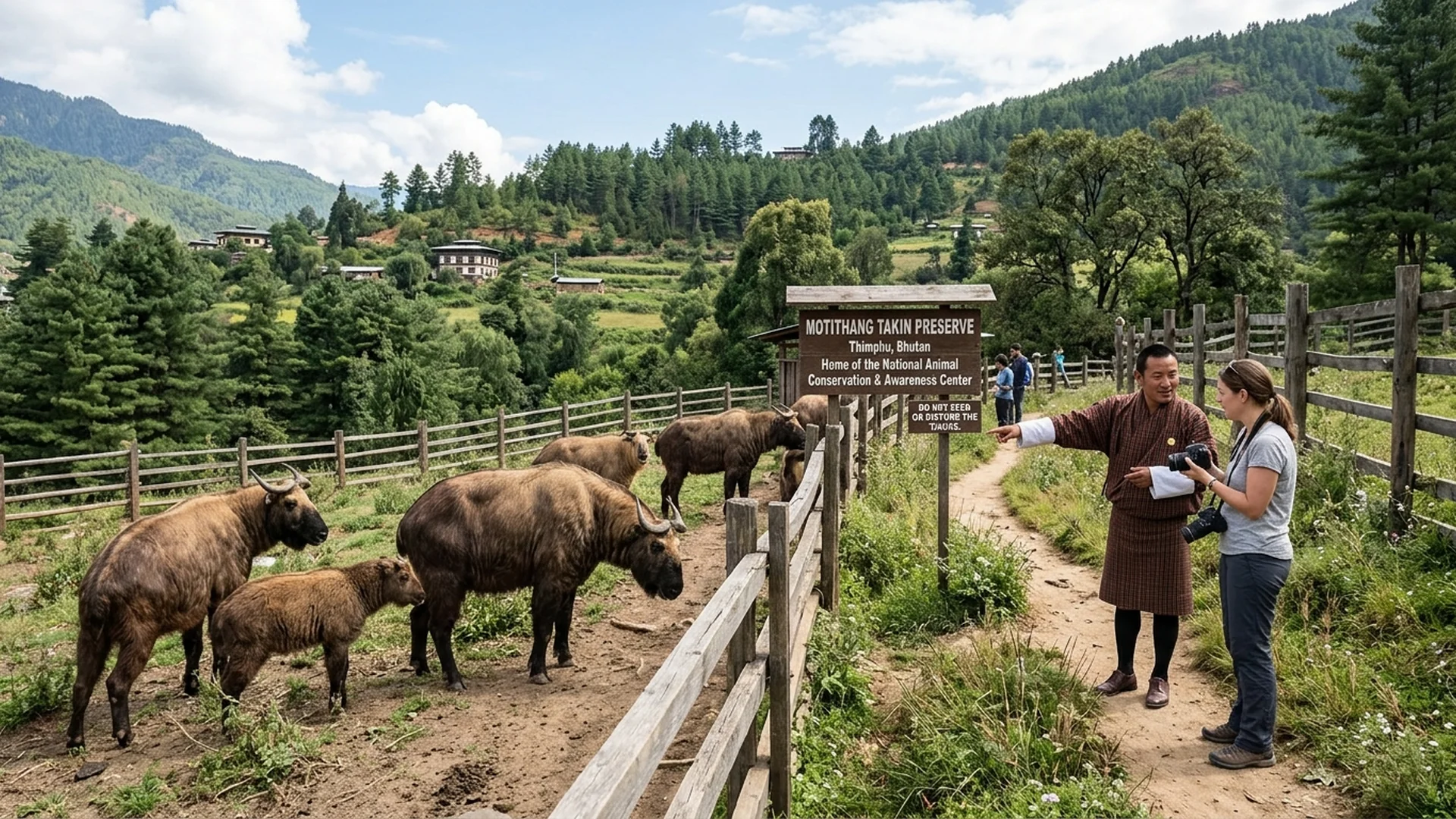
Amidst the golden pine forests that blanket the quiet valley of Thimphu, the soft thud of heavy, sure-footed hooves draws the discerning traveler into a realm where the boundary between myth and nature dissolves entirely. The takin, Bhutan’s national animal, possesses an enigmatic physique—half-goat, half-ox—that transcends mere biological wonder on the Himalayan slopes. It stands as a living emblem of spiritual heritage and profound compassion deeply rooted in the Buddhist ethos of this hidden kingdom.
At the Motithang Takin Preserve, the sun-dappled hillside forest serves not as a commercial enclosure or a conventional zoo, but as a living testament to an enlightened conservation philosophy. Born from the royal decree of a compassionate monarch who questioned the confinement of sentient beings, visiting this sanctuary is less a wildlife excursion than a quiet pilgrimage through living folklore. Here, one breathes in the crisp, pine-scented air of the high Himalayas and encounters the natural world in its most reflective, unhurried state.
At the Crossroads of Myth: The Divine Madman’s Miraculous Creation
The origins of the takin are inextricably bound to the spiritual folklore of Bhutan. In the fifteenth century, Lama Drukpa Kunley—revered across the Himalayas as ‘The Divine Madman’—traveled across these mountain valleys employing unorthodox, eccentric methods to impart profound Buddhist teachings. According to local lore, when villagers gathered to witness his mystical powers, the lama demanded a whole cow and a goat as a feast offering.
After consuming the meal down to the bare marrow, Drukpa Kunley retrieved the goat’s head and affixed it to the skeletal frame of the ox. With a sharp snap of his fingers and a resounding roar, he commanded the skeletal hybrid to spring to life. The creature bounded up the rugged mountain slopes, giving rise to the takin—a powerful beast with a heavy, bovine body and the curious, gentle face of a goat. Passed down through generations, this tale elevates the takin far beyond an ordinary wild animal; it serves as a living touchstone for the harmonious relationship between humanity, nature, and Mahayana Buddhism in Bhutan.
From Cages to Open Forests: A Sanctuary Rooted in Buddhist Ethics
The establishment of the Motithang Takin Preserve reflects a progressive environmental vision guided by deep ethical principles. Originally operated as a modest mini-zoo during the early 1990s, the enclosure was re-evaluated by Jigme Singye Wangchuck, the Fourth King of Bhutan. His Majesty reasoned that keeping wild animals confined behind iron bars directly contradicted Buddhist teachings and the foundational national ethos of universal compassion.
Consequently, the King ordered that all captive animals be released back into the wild. However, an unexpected challenge arose: the takin, having grown accustomed to human presence and supplemental feeding near the capital, refused to venture into the deep forests. Instead, they lingered near human settlements and roadways in Thimphu. To safeguard the animals without compromising their freedom, the government demarcated 8.4 acres of forested hillside in Motithang as an open sanctuary. This allowed the majestic creatures to roam freely among native flora while inviting travelers to observe their natural behaviors without causing distress.
The Aesthetics of Slow Travel: Meeting the Gentle Giants Beneath the Pines
Stepping into the Motithang Takin Preserve offers an experience entirely distinct from visiting a traditional zoological park. Here, there are no raucous crowds or somber iron cages—only unpaved earthen trails winding through stands of blue pine and blooming rhododendrons. The air is pristine and cool, carrying the earthy fragrance of fallen needles and damp moss, creating an atmosphere perfectly suited for contemplative walking.
As one follows the wooden pathways deeper into the reserve, small herds of takin emerge, grazing leisurely on tender shoots and stripping bark from ancient trees. Their thick, golden-brown coats and powerful, curved horns contrast gracefully with their gentle, inquisitive eyes. Occasionally, they approach the low wooden fences, seemingly accustomed to quiet human observers. Sharing this protected woodland are other native ungulates, including graceful Sambar deer and elusive barking deer, all coexisting in a balanced, undisturbed ecosystem.