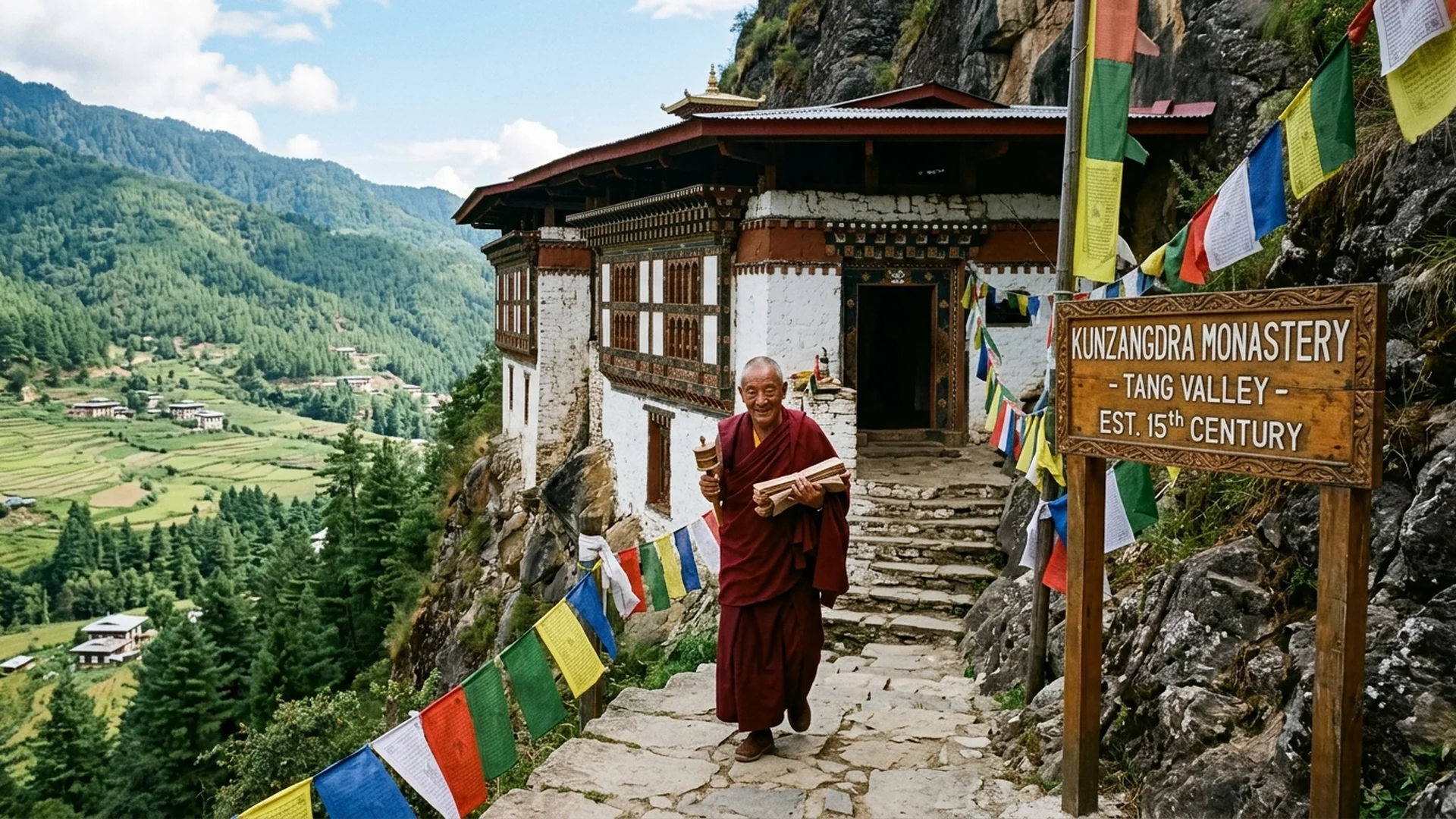
As morning mists gently lift from the hushed contours of the Tang Valley within Bumthang, a staggering 3,350-meter vertical cliff reveals an ancient monastery that seems carved straight out of unyielding faith. This is Kunzangdra Monastery, a sanctuary where time dissolves entirely, and the high-mountain winds carry echoes of sacred pilgrimages made centuries ago.
Stepping far beyond conventional tourist paths, this secluded sanctuary was founded in 1488 by the venerated treasure revealer, Terton Pema Lingpa. Far more than a mere architectural marvel, Kunzangdra is a consecrated realm blanketed in pure Himalayan energy, inviting discerning travelers to encounter the living essence of Vajrayana Buddhism in profound solitude.
Inscriptions of Grace: The Footsteps of Terton Pema Lingpa
The Tang Valley is widely celebrated as one of the most raw and breathtaking landscapes in Bumthang. It was here that Pema Lingpa—one of the most influential figures in Bhutanese religious history—chose Kunzangdra for his advanced spiritual retreats. The very name Kunzangdra translates to ‘Cliff of the All-Good,’ reflecting a deliberate vow to abandon worldly distractions and merge one’s consciousness with the universe. As a terton, or discoverer of spiritual treasures concealed by Guru Rinpoche, Pema Lingpa utilized this precipitous ledge to decode ancient texts and transmit esoteric teachings to his closest disciples. The surrounding atmosphere remains steeped in a profound tranquility that contemplative travelers feel the instant they arrive.
Architecture Suspended Between Earth and Sky
The structural design of Kunzangdra unfolds in cascading tiers along the sheer rock face, featuring three primary shrines rich in sacred Buddhist art. The lowest tier, Wangkhang, serves as the ceremonial heart, housing revered statues and an imposing thousand-armed Avalokiteshvara. Ascending further leads to Khandroma Lhakhang, a sanctuary dedicated to the dakinis (sky-faring protectors of the dharma) where the legendary Yeshe Tsogyal is believed to have practiced. The uppermost level comprises secluded meditation caves. Rather than imposing upon the landscape, the architecture honors it; natural stone faces form seamless interior walls, embodying the Vajrayana philosophy of harmonious coexistence between humanity, nature, and the divine.
Hidden Treasures and Miraculous Traces
Beyond its monastic halls, Kunzangdra safeguards esoteric artifacts and miraculous imprints rooted in local lore. Visitors fortunate enough to make the ascent encounter ancient iron-forge impressions—tangible evidence of Pema Lingpa’s mastery over both worldly craftsmanship and spiritual alchemy—as well as the meditation cave of his spiritual heir. Deep within the rock crevices, a delicate spring trickles through pristine stone, revered by the Bhutanese as sacred holy water with the power to cleanse mental obscurations and restore inner equilibrium. Every footstep within these hallowed precincts feels akin to walking along the delicate borderlands between the mortal realm and the unseen divine.