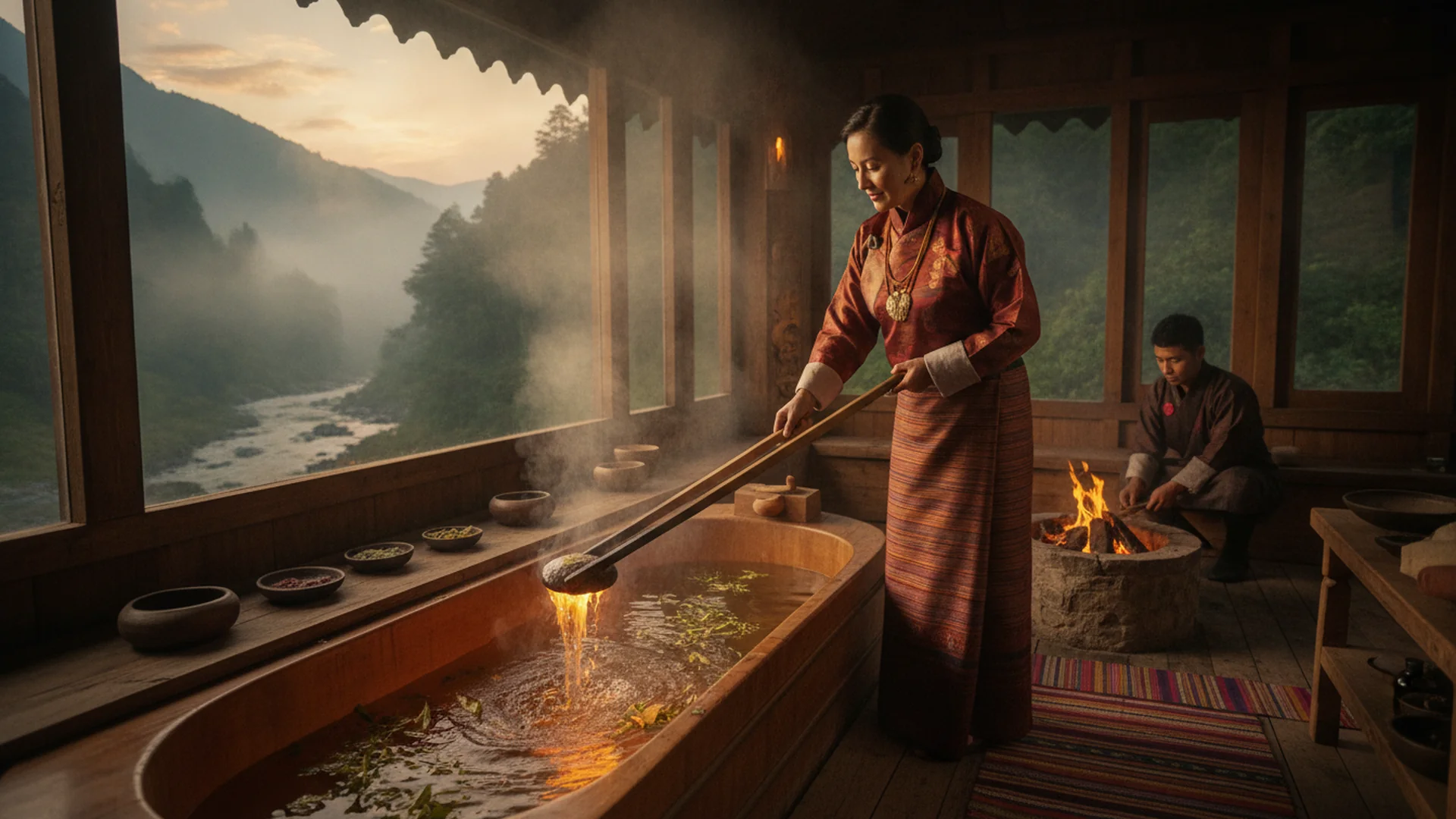
The sharp crackle of embers piercing the tranquil stillness of the Paro Valley, accompanied by the distinctive, herbaceous aroma of wild khempa leaves, marks the beginning of a healing journey preserved across centuries in the Himalayan kingdom. Known as Dotsho, the traditional Bhutanese hot stone bath is far more than a simple indulgence; it is a sacred alchemy fusing the four fundamental elements—earth, water, air, and fire—to restore equilibrium to weary travelers.
After a demanding trek up the steep, winding mountain paths to Tiger’s Nest (Taktsang Goempa)—a spiritual sanctuary clinging to a sheer cliff face that tests both physical endurance and spiritual resolve—the moment your aching muscles meet the rustic wooden tub is nothing short of transcendent. River stones, roasted over pinewood fires until glowing embers, are plunged one by one into the water, releasing mineral-rich plumes of steam that act as the ultimate reward for the discerning explorer.
Whether you seek the unadorned authenticity of a local stone-built farmhouse or the refined, zen-like tranquility of ultra-luxury sanctuaries like Amankora, Six Senses, or COMO Uma Paro, the ritual of Dotsho invites you into a state of profound stillness, offering an essential chapter in any high-end mindful journey through Bhutan.
The Mineral Science and Khempa Herb: Secrets of Himalayan Healing
The term ‘Dotsho’ derives from Dzongkha, where ‘Dot’ translates to stone and ‘Sho’ denotes soaking or heat. The heart of this ancient bath does not begin within a sleek treatment room, but rather along the rushing riverbeds of Bhutan. Local artisans carefully select dense river stones that have been polished and tempered by glacial Himalayan currents for decades, allowing them to accumulate concentrated mineral profiles rich in iron, magnesium, calcium, and silica.
The therapeutic process begins hours before immersion, as these stones are baked over open pinewood fires until they glow a fierce orange against the gathering dusk. They are then transferred into a designated wooden channel of the pine tub—shielded to prevent direct skin contact with the searing rock. When the white-hot stone meets crisp, natural mountain water, a sharp hiss sounds as the temperature rises gracefully, dissolving massive concentrations of bioavailable minerals into the bath.
The crowning touch of a true Dotsho is the infusion of ‘Khempa’, wild artemisia (wormwood) harvested from the high-altitude Himalayan slopes. When subjected to heat, the plant releases pure volatile oils and therapeutic compounds. As the body absorbs the thermal warmth, mineral infusion, and botanical extracts, blood vessels dilate, joint stiffness melts, and the nervous system is coaxed into a state of deep restorative release.
From Rustic Farmhouses to Five-Star Sanctuaries: Choosing Your Aesthetic
The true allure of experiencing Dotsho in Bhutan lies in the freedom to curate the setting according to your personal travel philosophy:
-
Farmhouse Dotsho (Authentic Rural Heritage): For travelers pursuing unscripted cultural intimacy, simple wooden tubs are housed within open-air timber sheds on family homesteads. Here, you hear the firewood crackle, watch woodsmoke drift toward the pine-clad peaks, and experience the heartfelt hospitality of rural Bhutanese hosts who continuously tend the stones, often following the soak with warm butter tea (Suja) and home-cooked regional delicacies.
-
Ultra-Luxury Spa Escapes (Refined Himalayan Wellness): Conversely, world-class luxury properties have elevated Dotsho into an art form of sublime comfort.
- Amankora: Features minimalist pine bath pavilions framed by floor-to-ceiling glass, offering private views of the surrounding forests and dramatic valley floors in Paro or Punakha, complemented by bespoke aromatherapy.
- Six Senses Bhutan: Integrates the Dotsho ritual with personalized wellness screenings and sleep optimization programs, set within secluded bathhouses designed to blend seamlessly into the dramatic topography.
- COMO Uma Paro: Combines hot stone therapy with signature COMO Shambhala wellness treatments, yoga sessions, and targeted myofascial release to systematically rejuvenate the body.
The Ultimate Post-Trek Reward: Restoring Body and Spirit
Ascending more than 3,120 meters above sea level to reach the legendary Tiger’s Nest (Taktsang Lhakhang) remains a quintessential pilgrimage for any traveler to Bhutan. Yet, the demanding ascent inevitably leaves its mark in the form of lactic acid buildup and deep muscle fatigue across the calves, thighs, and lower back.
Scheduling a Dotsho session during the twilight hours immediately following your descent represents the scientific and holistic ‘golden window’ of recovery. The sustained radiant heat of the fire-kissed stones accelerates the clearance of metabolic waste from overexerted muscles, while the active constituents of the Khempa leaves target overworked tendons and ligaments.
Beyond the physical regeneration, the quiet, fragrant steam quiets a mind stimulated by the day’s journey, guiding you into a state of profound gratitude. It transforms physical exertion into an enduring memory of absolute restoration.