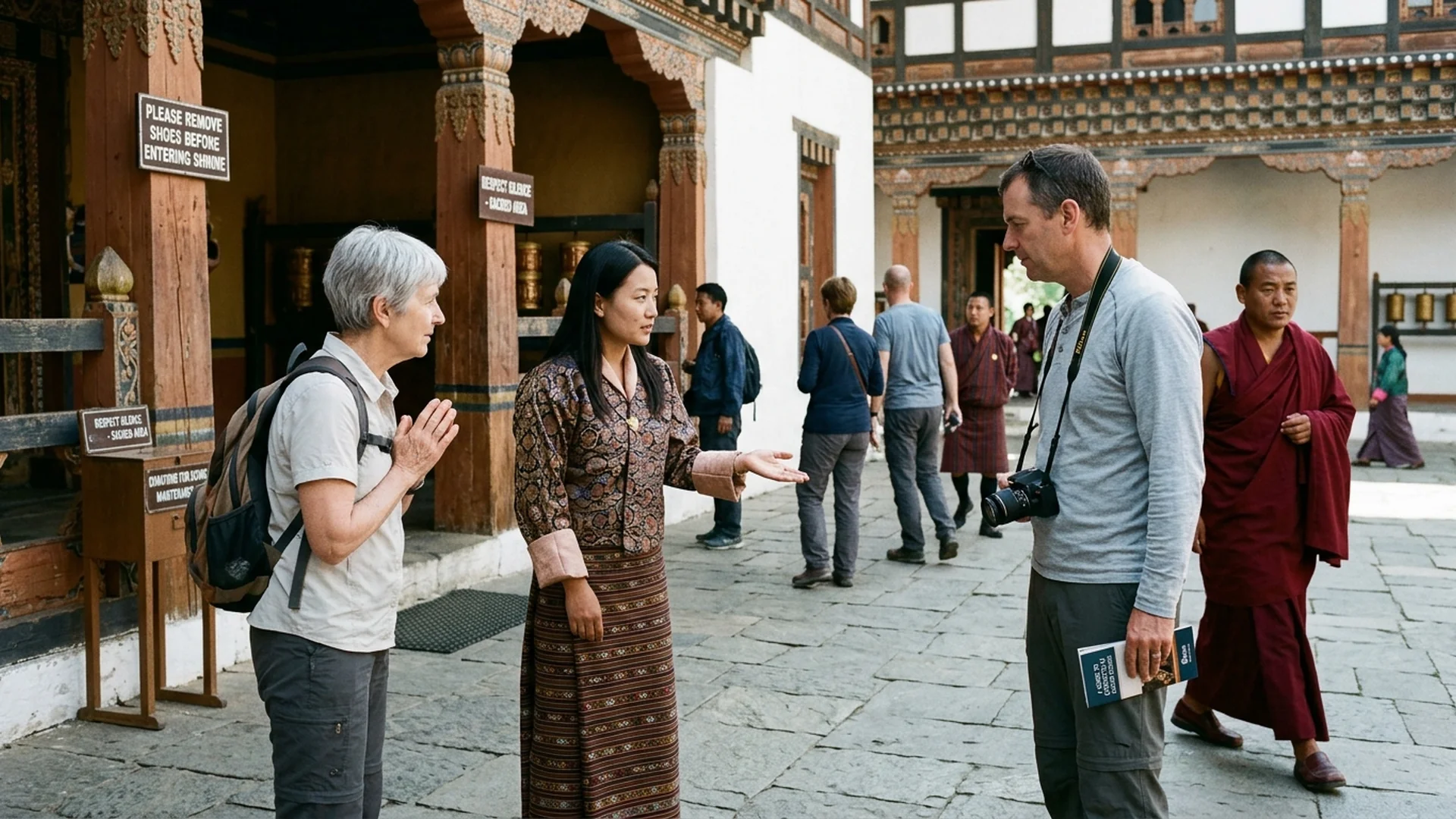
When stepping across the ancient wooden threshold of a dzong—the majestic fortress of the Thunder Dragon—the resonant chanting of Vajrayana monks echoes off whitewashed stone walls set against soaring Himalayan peaks. In this sovereign mountain realm, sacred monuments and fortresses have never been mere picturesque backdrops; they remain the beating heart of local life, moral philosophy, and governance preserved across centuries. Entering the sacred spaces of Bhutan is therefore never a passive sightseeing excursion, but rather a profound spiritual dialogue demanding deep awareness and utmost respect.
Decoding Vajrayana Buddhist customs when visiting these sacred fortresses and archaic temples is far from an exercise in rigid rules or stifling prohibitions. Instead, it embodies the art of mindful travel. Understanding the context of reverence and proper conduct serves as the golden key that opens the door to a warm, distinguished reception as an honored guest of the Kingdom of Bhutan.
Decoding the Dzong: Where Sacred Architecture Unites Faith and State
Amidst the serene valleys of Paro or Thimphu, the dzong rises as a monumental architectural marvel constructed without a single iron nail. Intricately carved timber structures and sloping, thick whitewashed stone walls function simultaneously as regional administrative centers and monastic quarters.
Stepping across the threshold of a dzong carries far deeper resonance than entering a museum. The Bhutanese perceive these fortresses as the collective spiritual anchor of the community. Showing reverence for a dzong equates to honoring the nation’s faith, monarchy, and enduring history. Once travelers grasp this context, mindful physical poise arises naturally—from stepping gracefully over timber thresholds without treading upon them to subduing one’s voice to a respectful whisper.
The Art of Distinguished Attire: Smart & Respectful Dress Codes
Traditional dress codes when visiting dzongs and sanctuaries in Bhutan do not restrict personal liberty; rather, they reflect international sophistication and deep respect for place. Local citizens traditionally don national dress—the gho for men and the kira for women—accompanied by ceremonial scarves (kabney and rachu) whenever entering dzong precincts.
While international travelers are not required to wear national dress, selecting attire in classic, understated color palettes with complete coverage represents the highest standard. Long-sleeved shirts, collared sweaters, tailored trousers, or knee-length skirts serve as impeccable choices. Sleeveless tops, plunging necklines, and shorts should be strictly avoided. Additionally, caps, hats, and sunglasses must be removed immediately upon entering courtyard or temple grounds to reveal one’s face with complete sincerity.
The Path of Mindfulness and Kora: Protocols in the Presence of Sacred Objects
The core of Vajrayana Buddhism in Bhutan is movement aligned with cosmic rhythms. Whenever encountering a chorten (stupa), prayer wheel, or inscribed mani wall, the exquisite custom is to perform a clockwise kora by walking around the object to the right. This directional movement not only demonstrates respect but symbolizes turning in harmony with the universal current and generating positive energy for life.
In the presence of sacred statues or monastics, Bhutanese etiquette dictates that one should never point with a single index finger; instead, use an open right palm facing upward to gesture. When seated within a temple hall, visitors should avoid extending their feet toward statues or monks, opting instead for a modest cross-legged posture to display humility and inward calm.
The Ethics of the Lens: Photography Etiquette and Restricted Sanctuaries
In an era where capturing images is instantaneous, Bhutan strictly preserves its inner sanctums—such as primary chapels and goenkhangs—as camera-free zones. While expansive exterior courtyards welcome free photography of sweeping architecture and intricate woodwork, smartphones and cameras must be stowed away securely the moment one enters a sacred shrine.
Respected photography rules safeguard ancient wall murals from camera flash degradation while preserving the hushed tranquility required for practitioners and fellow travelers to absorb authentic spiritual energy. Always seeking permission from monastics or locals before photographing individuals equally reflects exquisite courtesy and harmonious human relations.