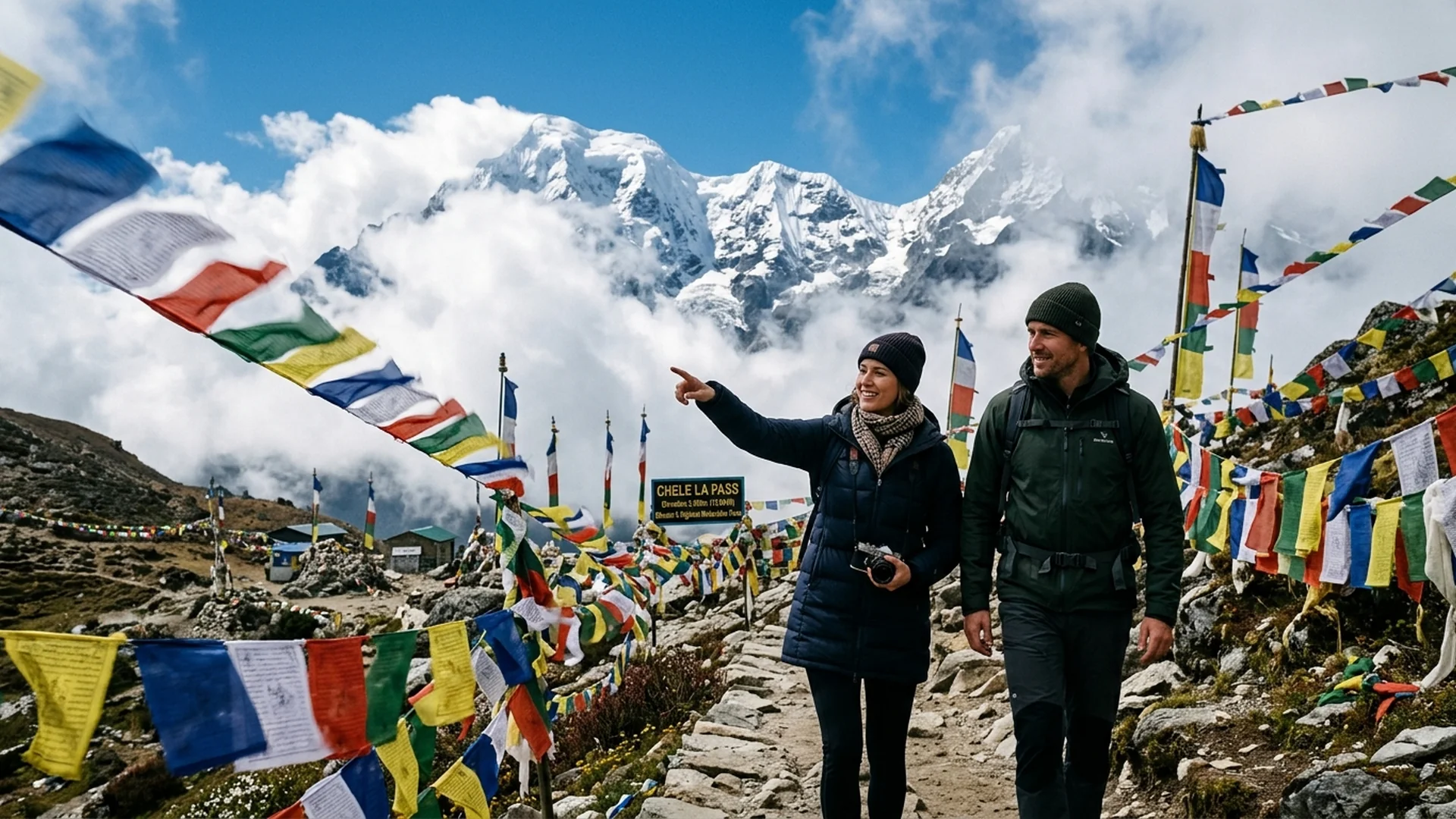
The wind carries a crystalline chill from the high Himalayas, brushing against your face as thousands of orange, red, yellow, green, and white prayer flags flutter in unison. Their low, rhythmic rustling blends with the faint murmur of ancient mantras borne on the mist. Standing at 3,988 meters above sea level on the precipitous ridge dividing the Paro and Haa Valleys, Chele La Pass acts as far more than a mere geographical transit point; it is a celestial runway that lifts the traveler’s spirit directly toward the heavens.
For the discerning eco-luxury traveler, the ascent to Chele La is an exquisite alpine drive. Premium 4WD vehicles wind gently upward along the curves of the Bondey-Haa Highway, tracing a path through dense forests of blue pine, towering hemlock, and vibrant thickets of blooming rhododendron. Layer upon layer of folded mountain ranges slowly reveal themselves until the horizon opens entirely, exposing the pristine white crown of Mount Jomolhari, the sacred 7,314-meter peak gleaming intensely against an indigo sky.
Beyond its breathtaking visual grandeur, Chele La serves as a profound spiritual threshold. It marks the departure point for an exclusive trekking route that gently descends toward Kila Goemba, an ancient nunnery tucked securely into the sheer rock face. It is an authentic insider experience that opens a quiet, refined, and deeply illuminating dimension of Himalayan exploration.
The Cloud-Veiled Frontier: Ascending 3,988 Meters of Wind and Mantra
The journey begins in the historic valley of Paro, where your vehicle embarks on a thirty-five-kilometer climb along the Bondey-Haa Highway. Gaining over 1,750 meters of elevation in just over an hour, the landscape transforms seamlessly. Lush, verdant valley floors give way to serene montane forests where massive hemlocks and firs are draped in thick cushions of moss and lichen, testifying to an undisturbed, pristine ecosystem.
As you approach the final kilometers, towering trees recede to make way for hardy alpine scrub and flowering rhododendrons. The moment the vehicle crests the pass, the atmosphere shifts into something monumental. The fierce, crisp mountain wind collides with thousands of prayer flags strung across the ridge, creating a brilliant, kinetic sea of color encoded with ancient blessings. Bhutanese tradition holds that with every passing gust, these sacred syllables are carried outward into the atmosphere, offering grace and compassion to all sentient beings.
Mount Jomolhari: Invaluable Vistas of the High Himalayas
The ultimate reward of an early morning arrival at Chele La is turning your gaze northward toward Mount Jomolhari. Revered locally as the ‘Bride of Kangchenjunga’ or the ‘Lady of the Snows,’ this 7,314-meter sanctuary of ice forms a natural crown demarcating the border between Bhutan and Tibet. It is venerated as the sacred abode of the protective deity Tsheringma, who bestows longevity and abundance upon the realm.
Flanking Jomolhari is the sharply etched pyramid of Jichu Drake, standing in stoic companionship. Sipping hot, premium-grade tea amidst the alpine chill of the ridge while absorbing the immaculate white of the high peaks against the deep blue vault of heaven is a timeless luxury—one that naturally induces a profound inner stillness.
Kila Goemba: Cliffside Nunnery and Meditative Mountain Trails
For travelers seeking a deeper, more intimate connection with Bhutanese monastic life, the descent from Chele La to Kila Goemba (or Kila Nunnery) is an exceptional hidden jewel. A gentle four-to-five-kilometer natural footpath winds downward along the ridge, meandering through quiet pine groves and rhododendron groves. In the early morning hours, soft tendrils of mist drift lazily through the canopy, lending the forest the ethereal quality of a fairy tale.
The trail terminates at Kila Goemba, one of Bhutan’s oldest nunneries, with roots tracing back to the ninth century. Ancient stone masonry and whitewashed shrines cling tenaciously to the sheer rock face, appearing to float suspended above the Paro Valley below. Here, dozens of resident nuns dedicate their lives to rigorous spiritual practice and deep meditation. Crossing the threshold into this tranquil sanctuary to witness quiet devotion and absolute humility offers an unmatchable spiritual privilege.