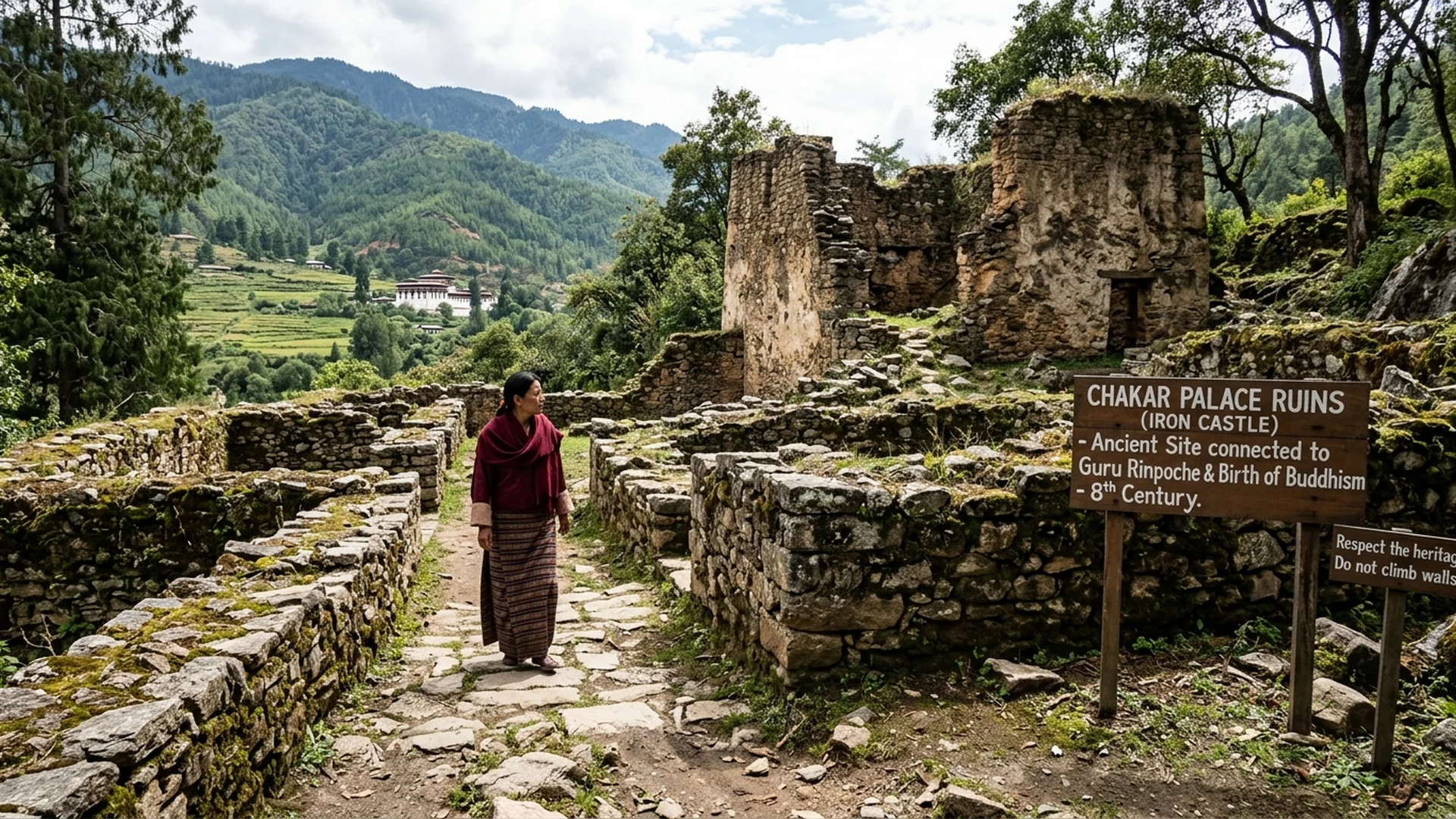
As the morning mist gently unfurls across the high-altitude expanse of the Bumthang Valley—the spiritual heartland of the Himalayas—travelers might initially perceive only a tranquil landscape of pastoral meadows and time-honored timber homesteads. Yet, upon stepping closer to the hallowed grounds of the Chakar Palace Ruins, the earth beneath yields whispers of an epochal history that forever shaped the spiritual bedrock of the Bhutanese nation. This is far more than a mere archaeological relic; it marks the pivotal axis where myth and history converged, where a legendary nine-story iron fortress once pierced the sky, and where Guru Rinpoche first set foot in the kingdom in 747 AD.
Today, a pilgrimage to the Chakar Palace Ruins and the adjacent Chakar Lhakhang offers discerning cultural travelers an intimate audience with the dawn of illumination in the Thunder Dragon Kingdom. It is an unhurried encounter with sacred geography, inviting those attuned to ancient narratives to witness where the transition from primeval darkness to the radiance of the Dharma first took root.
The Genesis of Faith: When the Iron Castle Trembled with the Dharma
The chronicle of the Chakar Palace Ruins unfolds during an era when the Bumthang Valley was ruled by Sindhu Raja, a powerful monarch facing profound physical and spiritual crises. According to regional lore, his royal seat was ‘Chakhar Gutho’—a towering, nine-story iron fortress that embodied both the peak of ancient engineering and the formidable aura of early Himalayan sovereignty.
The historical turning point arrived when the king, stricken by grief over the loss of his sons and waning authority, sought the intervention of Guru Rinpoche, also known as Padmasambhava, who journeyed from the plains of India. The master’s arrival at the iron castle was not merely an exorcism or a royal healing ritual, but the foundational establishment of Tantric Buddhism within Bhutanese soil. Thus, the iron fortress was transfigured into a sacred milestone that forever altered the spiritual trajectory of the nation.
From Ruins to Stone Sanctuary: The Legacy of the Lingpa Lineage
Though centuries of mountain elements eroded the iron and timber framework of the original nine-story citadel, the spiritual essence of the site remained indelible. In the 14th century, the revered master Dorji Lingpa—one of Bhutan’s foremost tertons, or treasure revealers—restored the sacred geography by constructing a modest stone sanctuary upon the ancient foundations, giving rise to Chakar Lhakhang as it stands today.
The contemporary architecture of the temple eschews grand monastic ostentation in favor of a quiet, intimate dignity reminiscent of an ancient sage’s dwelling. Weathered stone walls and hand-carved woodwork have been mellowed by time into a seamless harmony with the surrounding pine-clad slopes, offering visitors a sanctuary of profound stillness steeped in over a millennium of unbroken ritual energy.
A Living Museum of Bumthang: Encounters with Hidden Treasures
Within the dim, incense-warmed interior of Chakar Lhakhang, heavy with the scent of burning juniper and consecrated butter lamps, lies a repository that functions as an intimate living museum. The sanctuary preserves invaluable artifacts tied directly to the courts of Sindhu Raja and the lineage of Dorji Lingpa, bridging epochs through material culture.
For discerning connoisseurs of sacred art, the collection includes consecrated ritual masks and antique ceremonial vestments intrinsically linked to seminal monastic festivals such as the Jambay Lhakhang Drup. Contemplating these venerable objects amidst the quiet murmur of monks reciting scriptures offers an intellectual and spiritual resonance that surpasses any historical text.