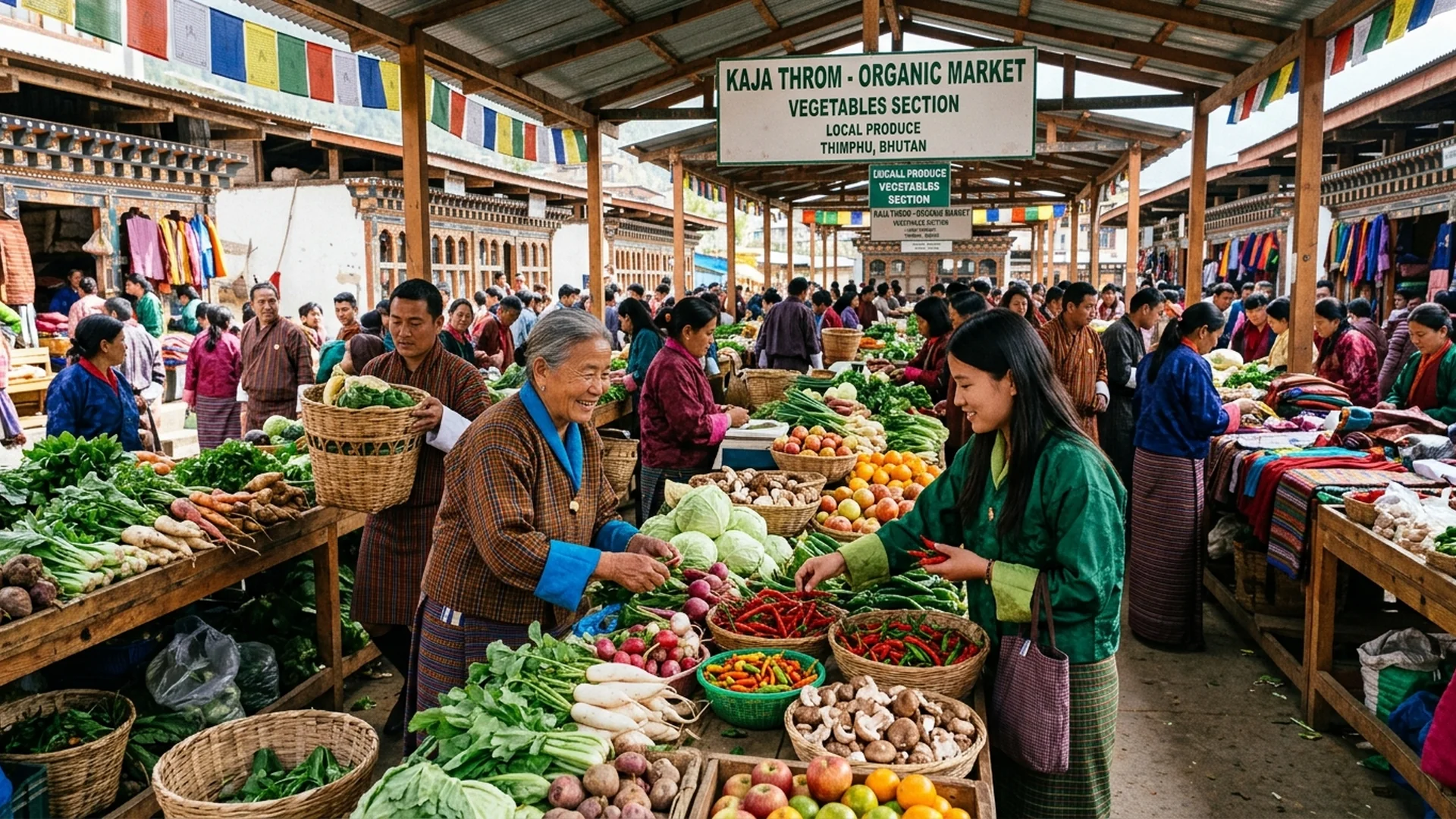
In the early morning light of the Thimphu valley, as mountain mists lift from the banks of the Wang Chhu river, the vital pulse of the Kingdom of Bhutan awakens. Once known simply as the Centenary Farmers Market, this historic trading ground has been thoughtfully reimagined under the royal vision of His Majesty King Jigme Khesar Namgyel Wangchuck into ‘Kaja Throm’—a luminous contemporary organic market and lifestyle sanctuary.
The very name Kaja Throm evokes a profound sense of gratitude and friendship, conceived to elevate the livelihoods of local farmers while opening doors for discerning travelers seeking quiet, unhurried cultural immersion. Contemporary Bhutanese timber architecture frames the space, carrying the rich aromas of freshly roasted Himalayan grains, sun-dried yak cheese, and wild forest honey. This is far more than a municipal trading post; it is a cultural drawing room connecting visitors to the living roots of the Himalayan soil.
A journey to Kaja Throm transcends the ordinary market visit, offering a direct encounter with the beating heart of Gross National Happiness. Through artisanal foods, the daily theater of farmers from distant valleys, and the creative vigor of a new generation, every sensory detail invites you into the purest organic lifestyle on earth.
From the Wang Chhu River to Kaja Throm: The Evolution of Agrarian Tradition into Contemporary Architecture
Originally established in 2008 as the nation’s largest agricultural marketplace, the Centenary Farmers Market served as the primary gathering place for villagers and growers to exchange harvests along the banks of the Wang Chhu. The comprehensive transformation into Kaja Throm replaced the older, congested layout with refined Bhutanese timber architecture that harmonizes seamlessly with modern structural elegance.
Expansive walkways sheltered beneath intricately carved wooden eaves protect visitors from mountain rains and crisp alpine breezes, while natural sunlight filters through traditional wooden ventilation lattices to illuminate orderly rows of stalls. Kaja Throm elevates hygiene and international comfort standards while preserving generous public spaces, open-air courtyards, live acoustic corners, and quiet resting benches. Here, travelers can trace the gentle flow of the Wang Chhu while absorbing the tranquil rhythm of Thimphu life.
A Treasury of Himalayan Flavors: Exploring Organic Ingredients and Bhutanese Culinary Identity
Navigating the produce stalls of Kaja Throm is a geographical journey through Bhutan’s distinct culinary landscape. More than a hundred stalls overflow with 100% organic ingredients nurtured by pristine glacial meltwater. A vital culinary cornerstone to study and taste is Bhutanese Red Rice, an ancient semi-milled grain boasting a nutty fragrance and a wonderfully satisfying chew that has sustained mountain communities for millennia.
Furthermore, this market is a haven for cheese connoisseurs. Seek out Datshi, a fresh, mild cow’s milk cheese, and Chhurpi, hardened yak cheese threaded onto strings, which serves as the rich, savory foundation of the national dish, Ema Datshi. Visitors will encounter a dazzling array of Himalayan chilies—fresh emerald pods, sun-dried crimson varieties, and ground spice blends—alongside foraged seasonal delicacies like wild fiddlehead ferns (Nakay), river asparagus, and rare forest mushrooms harvested directly from undisturbed high-altitude woodlands.
The Spirit of De-suups: Elevating Artisanal Street Food to Fine Hospitality
Among the most charming highlights of Kaja Throm is its dining precinct and food station cluster, operated by De-suups—dedicated youth volunteers who have graduated from the prestigious De-suung Skilling Programme (DSP). This royal initiative equips young Bhutanese with world-class culinary arts, hospitality, and entrepreneurial training.
In this vibrant zone, travelers encounter a refined, contemporary expression of Bhutanese street food. Expect steaming parcels of momos filled with yak cheese and fresh chilies, robust espressos brewed from specialty-grade roasted beans, artisanal pastries infused with local botanicals, and warming herbal teas. The genuine warmth, professional attentiveness, and youthful optimism of the vendors infuse Kaja Throm with an irresistible energy beloved by both urban residents and global connoisseurs.
A Cultural Bridge: The Meeting of Regional Farmers and Discerning Travelers
The most vibrant atmosphere at Kaja Throm unfolds during the weekend, from Friday through Sunday, when farmers from remote valleys such as Haa, Punakha, Wangduephodrang, and Tsirang journey overnight to share their hand-picked harvests.
Strolling through the stalls provides a rare pause from fast-paced itineraries. Listen to the gentle cadence of diverse regional dialects and meet Bhutanese vendors dressed in elegant traditional attire (Kira and Gho) who are eager to share the lineage of their produce. Engaging respectfully and humbly with local growers not only enriches the traveler’s inner journey but directly supports the grassroots economy of Bhutan’s agricultural families.