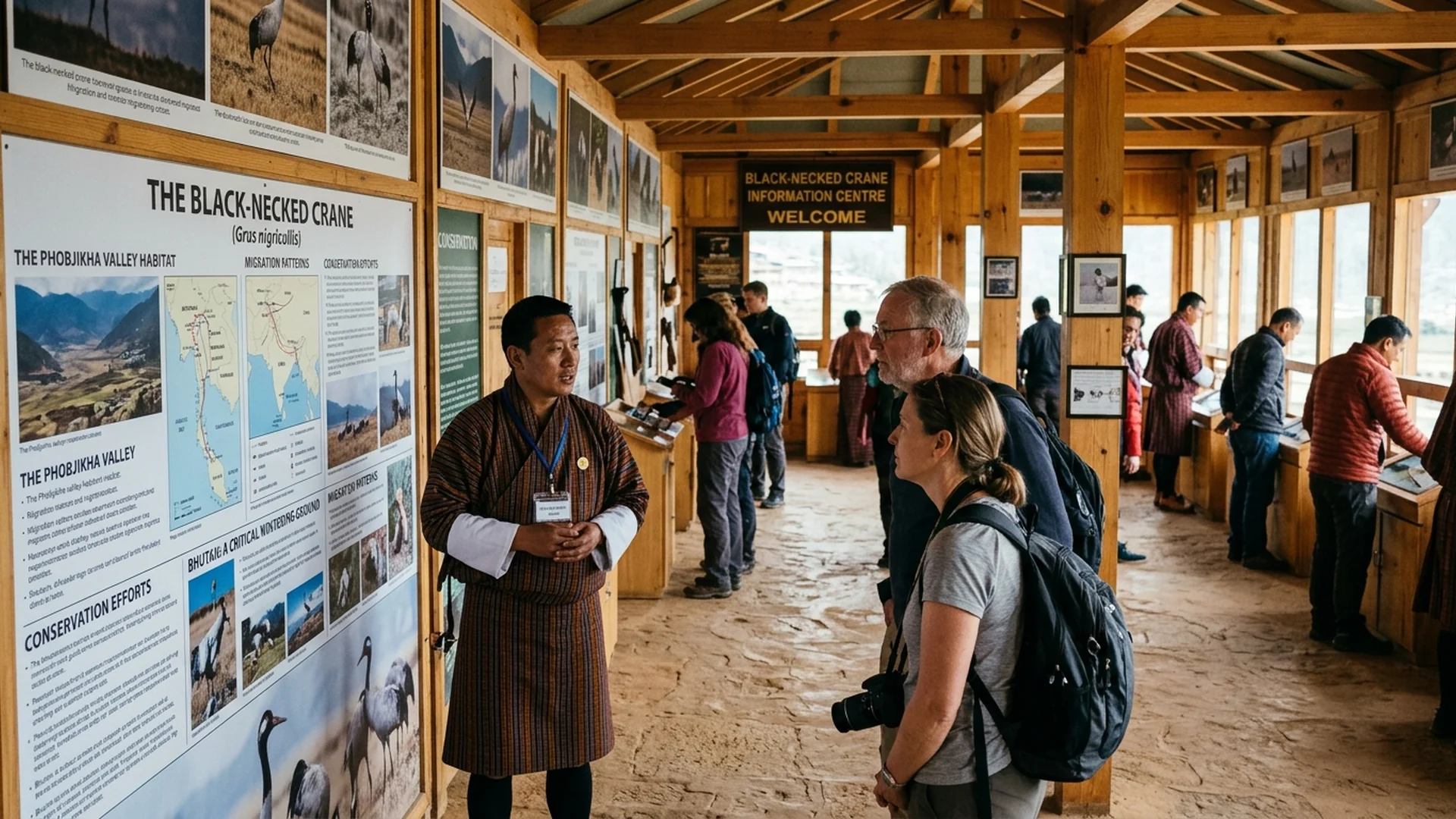
When the winter chill descends across the Himalayan ridgelines and sweeps into the vast, glacial sanctuary of the Phobjikha Valley—resting quietly over 3,000 meters above sea level—a resonant, haunting cry echoes through the crisp mountain air. This is the call of Thrung Thrung Karmo, the majestic black-necked crane, whose historic return to these sacred wetlands marks a profound annual communion between wildlife and Vajrayana Buddhist devotion.
Before settling into the tranquil marshes below, newly arrived flocks traditionally circle the venerable Gangtey Goempa—a 17th-century monastery-fortress—three full times in a clockwise direction. Managed by the Royal Society for Protection of Nature (RSPN), the Black-Necked Crane Information Centre stands as a monument to mindful coexistence. In a remarkable testament to local values, the surrounding community famously rejected overhead power grids, choosing instead to bury all electrical cables underground to safeguard the flight paths of these revered winter visitors.
Visiting this conservation hub offers an immersive window into the high Himalayas. Here, through high-powered spotting scopes, travelers can observe the delicate choreography of the Himalayan cranes in their undisturbed natural habitat without leaving a disruptive footprint.
The Circumbulk of Faith: Spirituality, Legend, and the Heavenly Cranes
In Bhutanese folklore, the black-necked crane is revered far beyond a mere migratory species; they are embraced as celestial messengers and earthly embodiments of guardian deities. Locals speak of them with deep reverence as Thrung Thrung Karmo.
For centuries, observers have marveled at their arrival from the Tibetan Plateau in late October. Rather than landing immediately in the marshes, the flocks ascend and gracefully circle the historic Gangtey Goempa perched upon the ridge, executing three synchronized clockwise circumambulations before descending. They repeat this sacred ritual upon their departure in spring. To the Bhutanese, this is an act of deep homage to the Triple Gem—the Buddha, the Dharma, and the Sangha—invoking peace and prosperity upon the valley.
The Lakeside Observatory: The Art of Mindful Observation
Designed in traditional octagonal Bhutanese architectural vernacular, the Black-Necked Crane Information Centre is harmoniously nestled into the hillside overlooking expansive marshlands and verdant meadows. Inside, expansive glass-fronted observation rooms house professional spotting scopes meticulously calibrated for high-altitude viewing.
Birdwatching here is elevated to an art form of ethical contemplation. Visitors can observe the graceful courtship dances, preening habits, and foraging routines of the cranes hundreds of meters away without causing alarm. The center also features illuminating exhibits detailing avian migration patterns across the roof of the world, alongside rehabilitation enclosures for injured residents such as Karma and Pema, two permanent avian residents cared for by RSPN wardens.
The Underground Wire Legacy: Sacrificing Convenience for the Skies
The conservation ethos of Phobjikha Valley is globally celebrated. When modernization and rural electrification reached this remote sanctuary, local villagers and the RSPN successfully petitioned the government to abandon plans for overhead high-voltage transmission lines, recognizing the fatal hazard they posed to low-flying cranes.
Opting for a far more complex and costly engineering feat, the community and authorities buried all power lines underground across the entire valley, while halting commercial drainage projects in the wetlands. This monumental decision stands as a tangible manifestation of Gross National Happiness (GNH), proving that ecological integrity and spiritual heritage can take absolute precedence over short-term economic convenience.
The Rhythm of Celebration: The Gangtey Crane Festival
Timing a journey to coincide with November 11 offers travelers entry into the Black-Necked Crane Festival, a vibrant environmental and cultural gathering hosted on the stone courtyards of Gangtey Goempa.
Established in 1998 by the RSPN alongside local elders and monastic bodies to celebrate the return of the birds, the festival features sacred Cham mask dances, folk melodies, and its crowning highlight: a delicate crane dance performed by local schoolchildren draped in black-and-white feathered costumes, gracefully mirroring the avian grace that defines this mountain sanctuary.