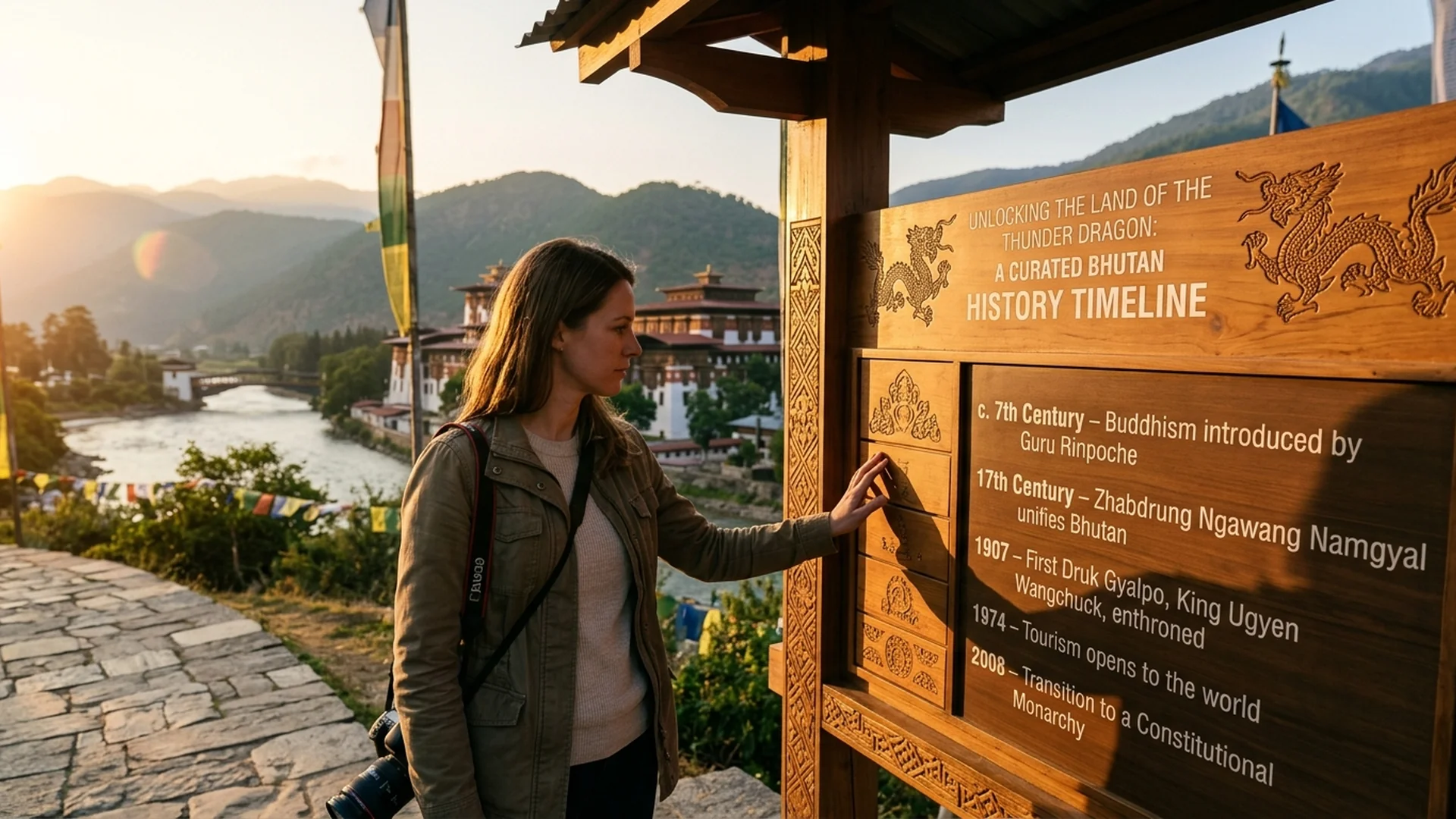
Amidst the morning mists drifting across the confluence of the Pho Chhu and Mo Chhu rivers, the architectural masterpiece known as Punakha Dzong rises like a vision from an ancient manuscript. For the casual observer, this formidable fortress framed by cascading purple jacaranda blossoms in spring is simply a breathtaking sight. Yet, for those willing to look past the surface of mere aesthetics, the dzong reveals itself as a living chronicle where every carved timber, whitewashed stone wall, and soaring prayer hall preserves the epic formation of the Thunder Dragon kingdom.
True travel through Bhutan remains incomplete without decoding the history concealed deep within these Himalayan valleys. Bhutanese history is not a static academic chronology; rather, it is a flowing current of unyielding faith, sovereign struggle, and profound statecraft passed down over centuries. From the mythic era of Guru Rinpoche soaring across jagged peaks on the back of a tigress, to the peaceful unification championed by the Zhabdrung, and onward to the steadfast stability safeguarded by the Wangchuck dynasty, the narrative is deeply alive.
When this historical timeline is woven together with the iconic landmarks and sacred sanctuaries awaiting your exploration, the physical landscape transforms into a profound intellectual and spiritual pilgrimage. Every step forward becomes an encounter of enduring resonance.
Chants Across Time: The Arrival of Guru Rinpoche and the Cliffs of Faith
Before the 8th century, the land we know as Bhutan was known as Monyul, or the ‘Dark Land of the Mon,’ shrouded in steep precipices and indigenous shamanic traditions. Everything changed with the arrival of Guru Rinpoche, revered as the Second Buddha or Padmasambhava, whose transcendental presence initiated the spiritual birth of the nation.
According to legend, Guru Rinpoche manifested in wrathful form, flying upon the back of a divine tigress to subdue malevolent spirits and meditate in a cave perched 900 meters above the Paro Valley. That hallowed site became the foundation of Taktsang Lhakhang, famously known as Tiger’s Nest. Ascending this sheer cliffside sanctuary is far more than a physical trek; it is a pilgrimage that weaves Vajrayana Buddhism into the very heartbeat of the Bhutanese soul.
Zhabdrung Ngawang Namgyal and the Nail-Less Dzong Architecture
Until the early 17th century, Bhutan remained a patchwork of warring fiefdoms and rival valleys. The turning point arrived with the momentous journey of Zhabdrung Ngawang Namgyal, a visionary Tibetan lama who successfully united the realm and instituted a dual system of governance balancing religious and administrative authority.
The Zhabdrung’s most enduring legacy is the creation of the dzong, magnificent monastic fortresses strategically positioned across the kingdom, such as Simtokha Dzong—the very first—and Punakha Dzong, the ‘Palace of Great Happiness.’ Built using traditional Zorig Chusum craftsmanship without a single iron nail or architectural blueprint, these resilient structures feature inward-sloping stone walls designed to withstand earthquakes alongside intricate woodwork, serving simultaneously as administrative hubs, monastic quarters, and sacred temples.
The Dawn of the Wangchuck Dynasty: A Legacy of Sovereignty and GNH
Following centuries of internal consolidation and peace, a new era dawned in 1907 within the sacred halls of Punakha Dzong. Religious leaders, local chieftains, and citizens unanimously elected Gongsa Ugyen Wangchuck as the first hereditary monarch, inaugurating the Wangchuck dynasty. This pivotal moment secured national unity and fostered astute international diplomacy.
Subsequent monarchs steered Bhutan through modernization without compromising its cultural identity. Notably, the fourth King introduced the revolutionary philosophy of Gross National Happiness (GNH), prioritizing spiritual well-being, ecological harmony, and cultural preservation over crude economic metrics. This guiding compass continues to inspire travelers and statesmen worldwide.
Bridging Dimensions: Reading History Through Contemporary Life
Engaging with Bhutanese culture today reveals that history is never confined to static museums; rather, it breathes vibrantly through daily existence. This is sustained by Driglam Namzha, the traditional code of etiquette requiring citizens to wear national dress—the gho for men and the kira for women—within government offices, dzongs, and sacred sites.
Furthermore, the sacred masked dance festivals known as tshechus, held across the kingdom’s dzongs throughout the year, commemorate the teachings and pivotal deeds of Guru Rinpoche. Witnessing these vibrant performances amidst crowds clad in brilliant handwoven silks offers a living portrait of a society where past and present exist as one continuous melody.